


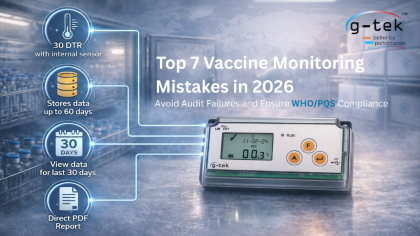
Top 7 Vaccine Monitoring Mistakes in 2026 — Avoid Audit
Failures and Ensure WHO/PQS Compliance
You might assume your vaccine freezers, storage facilities, and cold chain transport systems
are fully under control. Temperature readings are logged, alarms are active, and data is
recorded.
By the time it’s noticed, food quality is already compromised—leading to spoiled inventory,
lost revenue, and costly audit penalties.
In India’s food industry, cold storage operators face strict compliance requirements, tight
profit margins, and growing customer expectations. Yet many still rely on manual checks or
outdated monitoring systems that record deviations after the damage is done.
That’s the risk your business can’t afford.
However, audits, regulatory reviews, and internal inspections often reveal critical gaps.
Monitoring alone does not guarantee WHO Performance, Quality, and Safety (PQS)
compliance. In 2026, vaccine freezers, storage units, and cold chain transport systems
require continuous, verifiable, and audit-ready evidence to ensure vaccines remain safe,
effective, and regulatory compliant.
Even small monitoring gaps can impact regulatory confidence, operational credibility, and
vaccine integrity.
Why Compliance Pressure Matters
QA/QC managers, Operations Heads, and Director’s face real operational risks:
- Are freezer and storage logs complete and traceable?
- Does monitoring cover cold rooms, refrigerators, and warehouse storage
consistently? - Are transport logs capturing last-mile delivery accurately?
- Are alarms acknowledged, documented, and corrective actions implemented?
- Is calibration verified and traceable across all devices?
Monitoring systems must provide structured, verifiable evidence, not only temperature
readings, to ensure compliance and regulatory accountability.
7 Common Vaccine Monitoring Mistakes
- Assuming Any Device is PQS-Compliant – Only WHO PQS-certified devices meet
accuracy, alarm response, and secure data retention standards. - Confusing Monitoring with Control – These devices are engineered exclusively to
monitor and record temperature conditions for freezers, storage units, and transport
systems, providing verifiable, audit-ready evidence at every stage. - Incorrect Sensor Placement – Misplaced probes in freezers, storage units, or carriers
can misrepresent vaccine exposure. Proper validation of all zones is essential. - Incomplete Transport Coverage – Gaps during loading, transit, or last-mile delivery
create blind spots in documentation. - Weak Alarm Documentation – Alarms without acknowledgment and corrective
action records diminish audit defensibility. - Unstructured Calibration Management – Calibration must be traceable, scheduled,
and aligned with recognized standards. - Treating Compliance as One-Time – Continuous review, revalidation, and controlled
reporting are mandatory across freezers, storage, and transport.
The Solution: WHO PQS-Compliant Monitoring
A WHO PQS-compliant monitoring system ensures:
- Continuous, accurate monitoring for vaccine freezers
- Structured monitoring for storage units, cold rooms, and warehouses
- Traceable alarm history and secure, auditable data retention
- Continuous monitoring during cold chain transport, including last-mile delivery
These systems provide authoritative, verifiable evidence, supporting regulatory audits and
compliance at every stage of the vaccine journey.
Why WHO PQS Compliance Matters
WHO PQS standards protect vaccine quality from freezers to last-mile delivery. Aligning
monitoring systems with these standards ensures audit-ready documentation, regulatory
confidence, and operational clarity.
Ready to Take Action?
Ready to safeguard your vaccines across freezers, storage, and transport? Schedule a 1-1
meeting with our expert today to explore G-Tek’s WHO/PQS-compliant monitoring
solutions, designed specifically for vaccine freezers, storage units, and cold chain
transport. Ensure your team has complete, audit-ready temperature monitoring and
compliance documentation at every stage.

