A tyre plant's process engineer pulls a batch flagged for inconsistent cure and walks to…
The 0.7°C Question – Why India’s Leading Blood Banks Specify Only One Circular Chart Recorder Brand in 2026
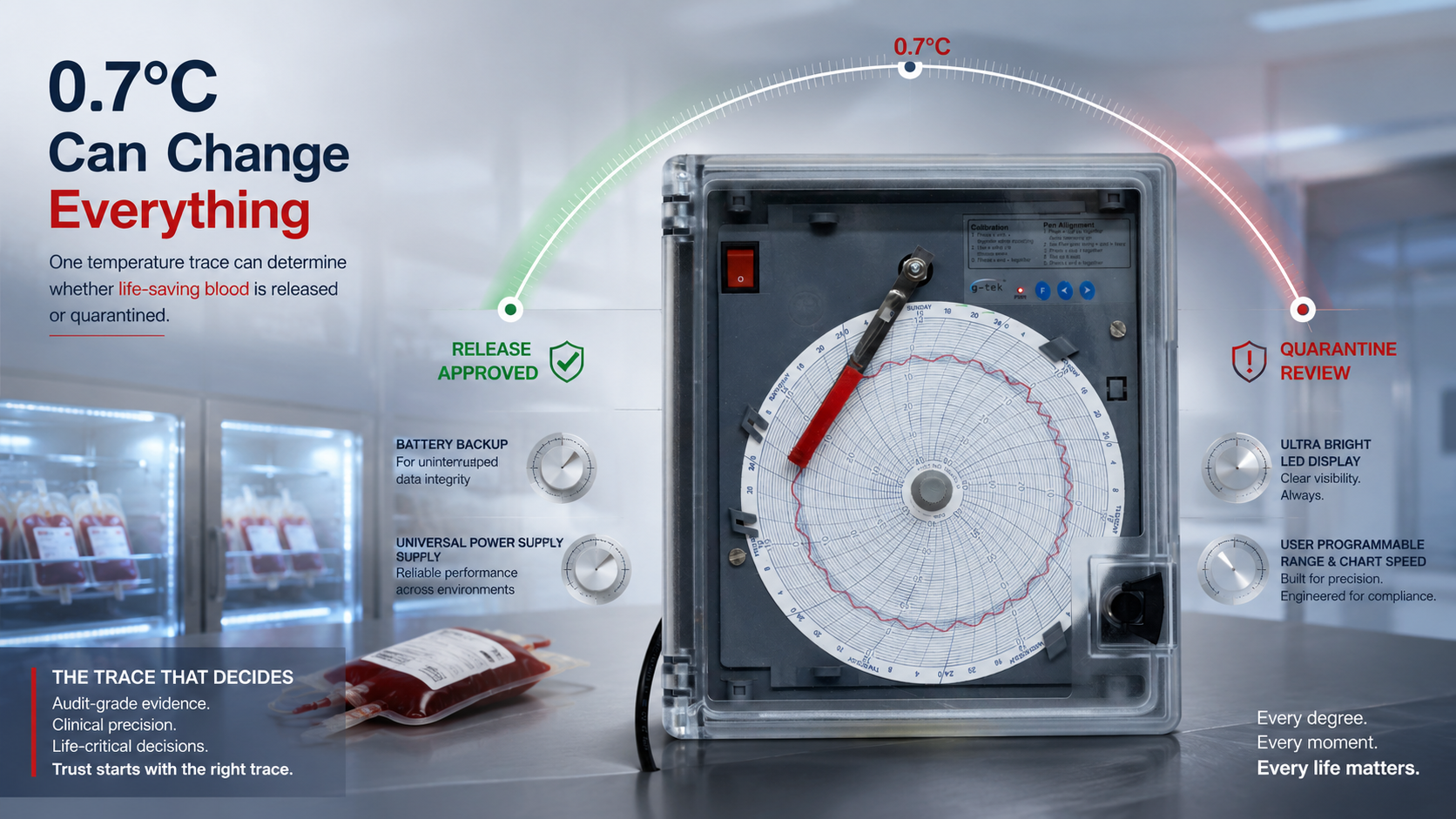
Monday morning. Your transfusion medicine officer walks in with the weekend’s chart disc. The trace shows a brief excursion above 8°C on Saturday night. A thalassaemic child is waiting for that exact unit.
Release it or quarantine it?
Everything hinges on one line drawn by one instrument.
In 2026, India’s leading blood banks are no longer leaving the chart recorder unspecified in their refrigerator tenders. They’ve learned the hardest lesson in transfusion medicine — a 0.7°C recorder drift can be the entire difference between a defensible release and a regulatory finding.
🎯
Key Takeaways
- Blood storage between 2°C and 8°C leaves no room for drift 0.7°C decides compliance vs non-compliance.
- NABH, DCGI, AABB, and state FDA auditors examine the chart trace, not the refrigerator brand.
- Six engineering pillars separate a defensible recorder from an audit liability.
- Indian OEMs like Remi factory-install G-Tek recorders for a reason.
- In-house NABL ISO/IEC 17025 calibration closes the chain-of-custody gap.
Why Is the Chart Recorder the Most Forgotten Line in Blood Bank Tenders?
Open any hospital refrigerator tender and the cabinet is specified down to the compressor. The recorder? Often one line “with chart recorder.” Unnamed. That specification gap stays invisible until audit day, when the inspector skips the brochure and pulls the chart trace the only continuous physical record of what your blood actually experienced.
What Engineering Pillars Separate a Defensible Blood Bank Recorder from an Audit Liability?
Six things hold up under scrutiny: a stepper-motor pen drive for precise placement, a crystal-controlled chart drive so 24 hours means exactly 24 hours, a 24-hour battery backup that records through a power cut, a universal input of 85–264 VAC, 47–63 Hz for India’s unstable grid, a chart range chosen for audit visibility around 2°C to 8°C, and NABL ISO/IEC 17025-accredited calibration closing the traceability loop. Miss one, and the trace becomes the weakest evidence in the room.
How G-Tek CR-2010 Sets the Standard India’s Blood Bank OEMs Already Trust
G-Tek Corporation, India’s leading manufacturer of precision recording instruments since 1990, designs the CR-2010 series specifically for the 2°C to 8°C band. Headquartered in Vadodara, Gujarat, with an in-house NABL ISO/IEC 17025-accredited calibration laboratory, G-Tek recorders are factory-installed by Remi Group across BR-120, BR-180, and BR-300 blood bank refrigerator lines, and embedded by B Medical Systems in WHO-procured cold chain units worldwide. Trusted across Zydus, Sun Pharma, Dr. Reddy’s, Biocon, Intas, Emcure, and Alembic.
The CR-2010 delivers ±0.5% full-scale accuracy, ±0.7°C maximum linearisation error on PT-100, pen resolution better than 0.1% FSD, and continuous one-second sampling in 4-inch (138×138 mm) and 6-inch (200×170 mm) DIN-cutout variants meeting IEC 61010-1 and EN 61326-1 Class A.
The Decision That Defines Every Future Transfusion Audit
If your blood bank is preparing for the next NABH survey, DCGI inspection, or AABB review the chart recorder produces the evidence everyone else relies on. The specification gap closes the day the medical director takes ownership of which recorder gets installed.
👉 Bring a G-Tek expert on the call and walk through CR-2010 specifications, calibration scope, and OEM compatibility before your next refrigerator tender goes out.
Frequently Asked Questions
What temperature should a blood bank refrigerator maintain in 2026?
A continuous 2°C to 8°C band, with excursions above 10°C triggering quarantine review under NABH 5th Edition, DCGI, and AABB standards.
Why is chart recorder accuracy critical for blood bank compliance?
A recorder with ±0.7°C linearisation error decides whether the trace reads inside the 2°C to 8°C band affecting unit release, audit findings, and patient safety.
Which circular chart recorder do leading blood bank OEMs in India use?
Indian OEMs including Remi Group factory-install G-Tek CR-2010 recorders across BR-120, BR-180, and BR-300 model lines, reflecting field-validated engineering judgement.
What makes a circular chart recorder NABH and DCGI audit-defensible?
Stepper-motor pen drive, crystal-controlled chart rotation, 24-hour battery backup, universal input, audit-visible chart range, and ISO/IEC 17025 NABL-accredited calibration traceability.
Where is G-Tek Corporation located?
G-Tek Corporation is headquartered in Vadodara, Gujarat, manufacturing precision recording instruments since 1990 with an in-house NABL ISO/IEC 17025-accredited calibration laboratory and pan-India service.
Related Posts