A tyre plant's process engineer pulls a batch flagged for inconsistent cure and walks to…
Autoclave Monitoring for AAC Block Manufacturing Compliance
When the Batch Fails and the Chart Doesn’t Exist
The compressive strength report comes back. The batch has failed.
Then comes the question every AAC plant fears:
Did the autoclave maintain 190°C and 12 bar throughout the curing cycle, or did conditions change somewhere along the way?
You look for the evidence.
There is none.
A missing record can be the difference between defending a batch and rejecting an entire consignment.
The Quiet Fear Inside Every AAC Plant
Autoclaved aerated concrete (AAC) block manufacturing depends on tightly controlled autoclave conditions.
The curing process typically requires saturated steam between 180°C and 195°C and pressure levels of 10 to 12 bar for 8 to 12 hours. Both parameters must remain stable throughout the cycle.
This is the environment required for proper tobermorite crystal formation and the strength development of AAC blocks.
Without reliable autoclave monitoring, manufacturers face several risks:
• Pressure drops during the cycle that affect block quality
• Temperature fluctuations that create under-cured sections
• Early cycle termination that leaves an entire batch inadequately cured
The challenges become even greater when customer inspections, ISO audits, or infrastructure projects require documented curing records.
At that point, quality teams need evidence, not assumptions.
The Shift Most AAC Plants Are Quietly Making
Many facilities that have improved audit performance did not simply invest in more advanced screens or software.
Instead, they focused on maintaining reliable records that operators, QA teams, and auditors can easily verify.
Industrial environments are demanding.
Heat, dust, vibration, and moisture can affect electronic systems and operator visibility.
A circular chart recorder provides something many facilities still value: a continuous, tamper-evident physical record of every curing cycle.
The chart remains visible, signable, and easy to archive for future reference.
How the G-Tek 11-Inch 2-Pen Circular Chart Recorder Supports Autoclave Monitoring
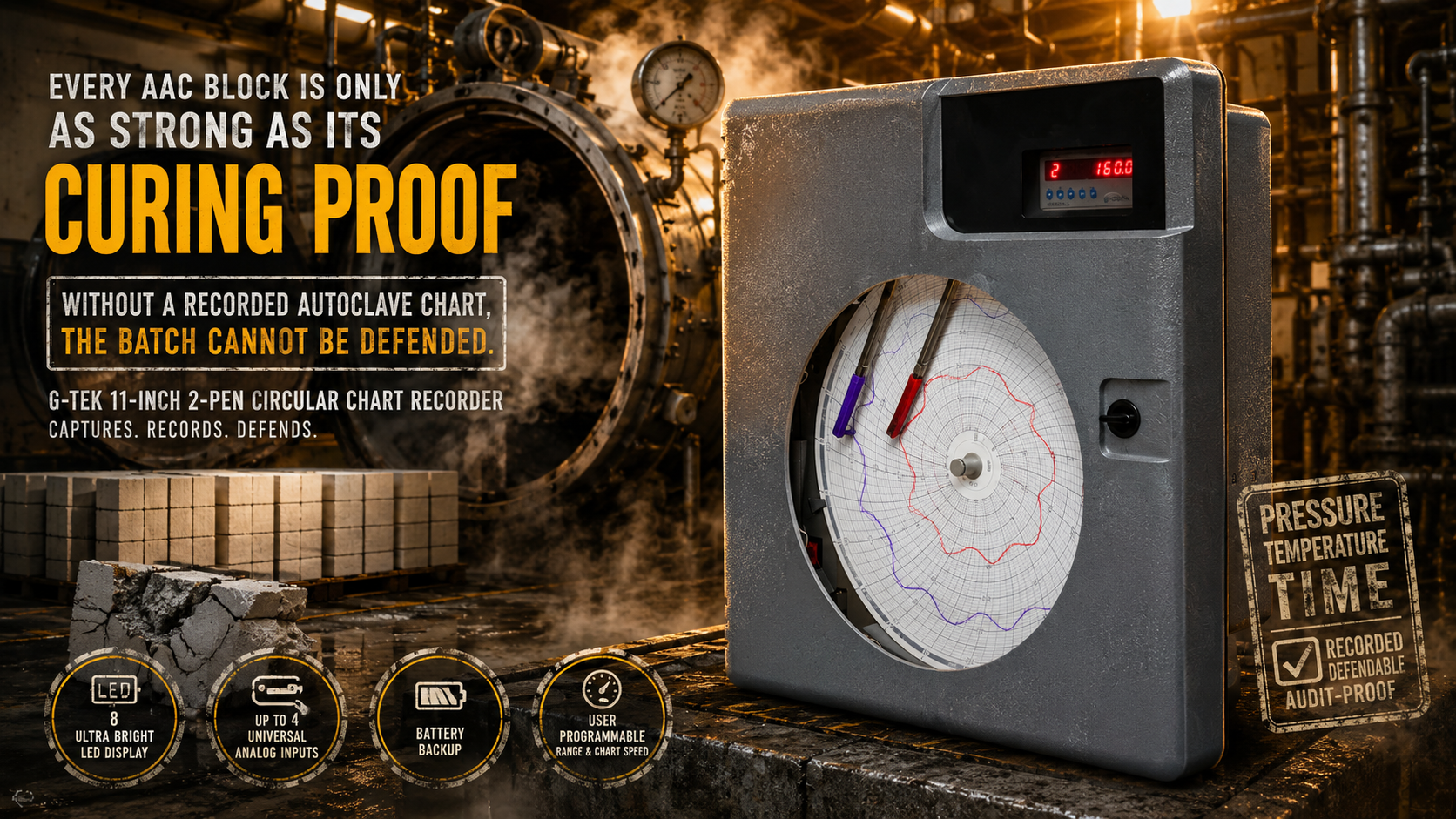
The G-Tek 11-inch 2-Pen Circular Chart Recorder records both temperature and pressure on a single chart.
This allows operators and quality teams to review the entire curing cycle in one place.
Key benefits include:
• 📡 Continuous recording of temperature and pressure throughout the full curing cycle
• 🛡️ Tamper-evident chart paper for quality documentation and audits
• ✅ Support for compliance requirements associated with IS 2185 (Part 3), IS 6072, and customer quality inspections
• 🎯 Reliable operation in hot, dusty, and vibration-prone manufacturing environments
• ⚙️ Suitable for AAC blocks, fly ash bricks, calcium silicate bricks, sand-lime products, and other autoclave-based manufacturing processes
With effective autoclave monitoring, operators can review cycle performance quickly, QA teams can verify curing conditions, and auditors can review documented evidence when required.
The G-Tek Conversation Worth Having
Every curing cycle generates critical process data.
Without a documented record, quality teams may struggle to investigate failures, validate production conditions, or respond to audit requests.
Autoclave monitoring helps transform every curing cycle into a documented process supported by temperature and pressure records.
For AAC block manufacturers, autoclave OEMs, and quality teams, this provides greater confidence in both production and compliance activities.
If your facility is still operating without a dual-parameter record for every batch, now may be the right time to evaluate a more structured monitoring approach.
👉 Speak with a G-Tek specialist to learn how the 11-inch 2-Pen Circular Chart Recorder can support autoclave monitoring, batch traceability, and audit readiness.
Related Posts