A tyre plant's process engineer pulls a batch flagged for inconsistent cure and walks to…
Imported or Indian-Made Data Logger? What Buyers Discover Post-Warranty
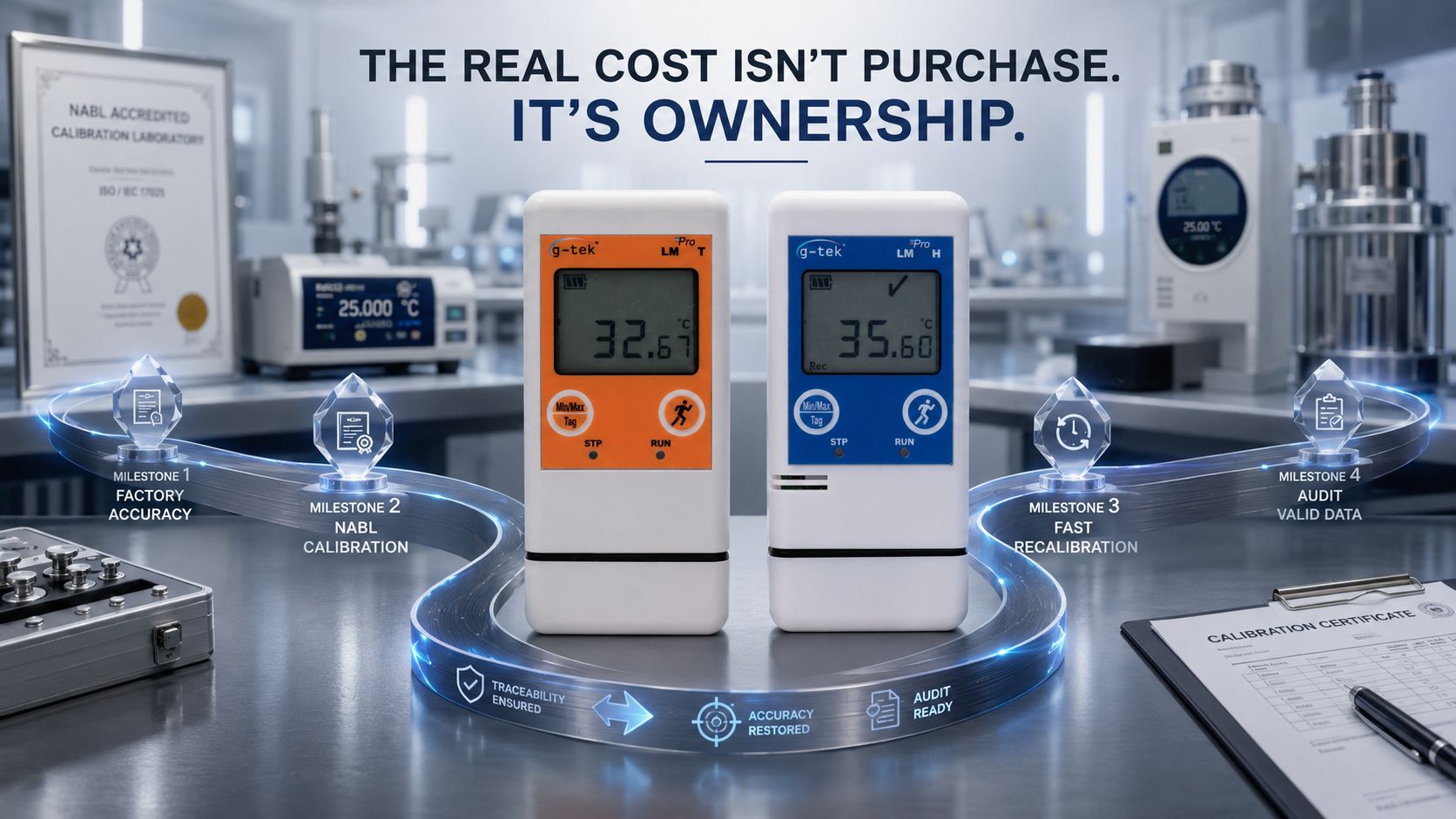
On the spec sheet, the imported logger looked unbeatable and performed as promised through the warranty. Then year two arrived. The certificate lapsed, the unit shipped abroad for recalibration, and a critical logger vanished for weeks while production waited sometimes returning with quiet drift. The spec sheet never warned anyone.
In 2026, the real difference between an imported and an Indian-made data logger isn’t on the spec sheet. It surfaces after the warranty ends, when recalibration turnaround, accuracy restoration, and local support decide whether the device stays audit-valid or sits waiting.
🎯 Key Takeaways
- The imported-vs-Indian gap rarely shows at purchase it shows at recalibration and service.
- Imported loggers often go abroad for recalibration, stalling production for weeks.
- A general local lab can recalibrate, but may introduce drift or a scope mismatch.
- A maker with its own NABL lab restores factory accuracy, fast, with traceability.
- Total ownership not the spec sheet decides the smarter long-term choice.
Imported vs Indian-Made Data Logger – Where’s the Real Difference?
At purchase, the two look almost identical: same accuracy class, ranges, promises. The real difference lives in the ownership lifecycle, not the brochure.
An imported data logger ties you to recalibration abroad long turnaround, customs clearance, support across time zones. An Indian-made unit from a maker with its own calibration lab brings that cycle home: faster recalibration, factory accuracy restored, local support in your zone.
Imported isn’t bad. The lifecycle is simply built differently and you only feel it once the warranty ends.
What Happens to a Data Logger After the Warranty Ends?
A calibration certificate is typically valid for one year, so recalibration isn’t a one-time event it returns every year, for the life of the device.
For an imported logger, the moment forks two ways. Ship it back abroad weeks of turnaround plus customs. Or use a general local lab that may introduce drift or work to a scope that doesn’t match the instrument. Either way, a critical logger sits off the floor when production needs it, and a unit holding your 21 CFR Part 11 records and supporting USP <1058> qualification cannot simply vanish. That traceability is exactly what NABL ISO/IEC 17025 accreditation protects.
Why G-Tek’s In-House NABL Lab Changes the Ownership Math
This is where G-Tek Corporation’s setup quietly matters. Manufacturing the LM Pro T and LM Pro H loggers in Vadodara since 1990, G-Tek runs its own NABL ISO/IEC 17025-accredited calibration laboratory in-house. When a logger’s calibration lapses, it returns to the people who built it, where recalibration restores its factory accuracy, with a certificate scope-matched and traceable to national standards through NPL India. No shipping abroad, no customs queue, no general lab guessing.
It’s the ownership math QA teams at Intas, Cipla, Aurobindo, and Zydus factored in: accuracy you restore locally and fast, keeping records aligned with WHO GDP (TRS 957, Annex 5).
Year One Is the Spec Sheet. Year Two Is the Real Test.
If you’re weighing an imported logger against an Indian-made one, the spec sheet only describes year one. What happens at recalibration turnaround, accuracy, support is what you live with afterward.
👉 Not sure how the ownership picture compares for your facility? Tell the G-Tek team your loggers and recalibration needs, and get a recommendation that keeps your data audit-valid, locally and fast.
Frequently Asked Questions
Are Indian-made data loggers as accurate as imported ones?
Yes. Accuracy depends on calibration traceable to national standards, not country of origin, and an in-house NABL lab restores it faster.
What's the real difference between imported and Indian-made data loggers?
Specs look alike at purchase. The difference shows at recalibration imported units often ship abroad, while an Indian maker restores accuracy locally.
What happens when an imported data logger needs recalibration?
It often returns abroad with weeks of turnaround and customs delays, or goes to a general lab risking drift or scope mismatch.
Why does an in-house NABL lab matter for a data logger?
It restores loggers to factory accuracy with a scope-matched, traceable certificate and fast turnaround, keeping data audit-valid.
Where is G-Tek Corporation located?
G-Tek is in Vadodara, Gujarat, manufacturing data loggers since 1990, with an in-house NABL ISO/IEC 17025 lab and pan-India sales and service.
Related Posts