By Asutosh Shah & Alpesh Shah · Founders, G-Tek Corporation. 30+ years in temperature monitoring,…
When One Chart Needs to Show Two Things at Once, and Sound an Alarm if Either Slips
By Asutosh Shah & Alpesh Shah · Founders, G-Tek Corporation 30+ years in temperature monitoring, recording, and calibration instrumentation.
“One parameter, one pen: that’s always been enough.” Until the process changes. A second variable starts to matter, and suddenly the operator is squinting at a chart from across the floor. There’s no way to know a value slipped until the shift is already over. That’s the moment a basic recorder stops fitting and a two-parameter chart recorder with a display and an alarm starts to.
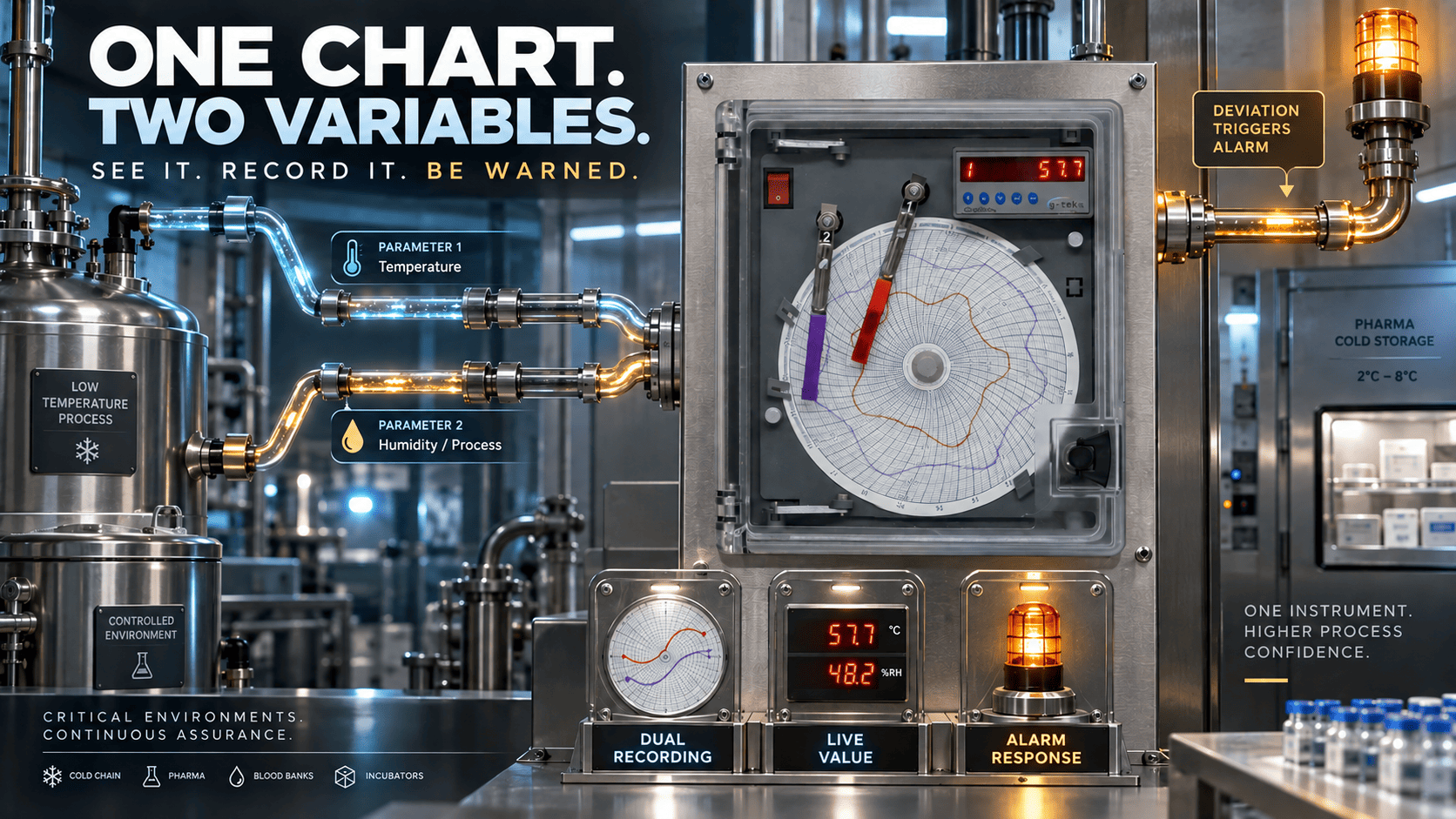
A two-parameter chart recorder with an LED display and alarm relay records up to two variables on one chart. It shows the live value readable from a distance. It also triggers an alarm the moment a reading crosses a set limit. That’s three jobs a basic single-pen recorder can’t do.
🎯 Key Takeaways
- Some processes need two parameters recorded on one chart, not just one
- An LED display lets an operator read the live value from across the room
- An alarm relay output warns the moment a reading crosses a set limit
- One recorder combining all three avoids juggling separate instruments
- It accepts RTD, thermocouple, or process inputs to match the process
One Two-Parameter Chart Recorder, Three Jobs a Basic Chart Can’t Do
A 6-inch two-parameter recorder records up to two variables on one chart. It displays the live value on an LED readable from a distance. It also provides an alarm relay output that triggers when a reading crosses a limit. That combines recording, display, and alerting in one unit.
Most floors start with a single pen because the process only asked for one. But when a second variable becomes worth tracking against the same timeline, the gap shows fast. The chart still records, but nobody can read the value from a distance, and nobody gets warned when it drifts. Recording alone was never the whole job. Seeing and being alerted are the other two.
When do you actually need two parameters, a display, and an alarm?
You need all three when a process has two variables worth tracking together. They also matter when operators must read the value without walking up to the chart. Finally, they matter when a deviation needs an immediate alert rather than being noticed later.
Picture a busy production floor. The chart sits on a panel; the operator is ten metres away. Without an LED readout, checking a value means stopping and walking over. Without an alarm, a slipped reading hides on the trace until someone reviews it, often after the batch has moved on. These are the exact processes that outgrow a basic chart. If you’re also weighing continuous digital records, G-Tek’s data loggers cover that side. But for panel-mounted charting with live display and alerting, a two-parameter chart recorder is the direct fit.
Match the recorder to what the process actually demands
Choose a recorder by the number of parameters, whether you need a live display, and whether you need an alarm. That way, you neither carry unused features nor re-source when a basic recorder falls short.
This is the exact gap G-Tek Corporation designed the CR6″ 1P-2P to fill, drawing on more than 30 years in Vadodara. It records one or two parameters on a 6-inch chart. It also carries an LED display to read the instantaneous value from a distance. Its alarm relay output triggers when a reading crosses its limit. It accepts RTD Pt-100 (IEC 60751), thermocouple, and process inputs (4-20mA / 0-20mA / 0-1V) to suit the process. In addition, every unit traces to G-Tek’s own NABL ISO/IEC 17025-accredited calibration laboratory for a defensible record. It sits within G-Tek’s wider circular chart recorder range, so the model can be matched to the process instead of forced onto it.
Before You Choose a Two-Parameter Chart Recorder: Verify These
- Parameter count: confirm you need 2 (not 1, and not 3-4, which needs an 11″ model)
- Display need: is an LED readout from a distance important on your floor?
- Alarm requirement: do you need an alarm relay output to act on deviations?
- Sensor/input type: RTD, thermocouple, or process signal to match your process
- Calibration: a NABL-traceable certificate for a defensible record
Record It, See It, and Be Warned in One Unit
If your process needs two parameters tracked, a readout visible across the floor, and an alarm when something slips, a basic recorder won’t cut it. One two-parameter chart recorder built for all three fits the job the first time.
👉 Need two parameters, a display, and an alarm on one recorder? Share your process and parameters with the G-Tek team, and get a clear recommendation on the CR6″ 1P-2P.
Frequently Asked Questions
What is a two-parameter circular chart recorder?
It records up to two variables on one 6-inch chart at the same time, so both can be tracked against a single timeline.
Why would I need an LED display on a two-parameter chart recorder?
It shows the live value so an operator can read it from a distance, without walking up to the chart on a busy floor.
What does an alarm relay output do?
It triggers an alarm the moment a reading crosses a set limit, so a deviation prompts immediate action instead of being caught later.
What does the G-Tek CR6″ 1P-2P support?
One or two parameters on a 6-inch chart with LED display and alarm relay, accepting RTD, thermocouple, and process inputs, NABL-traceable.
Where is G-Tek Corporation located?
G-Tek is based in Vadodara, Gujarat, manufacturing recording and monitoring instruments for over 30 years with pan-India support.
Related Posts