By Asutosh Shah & Alpesh Shah · Founders, G-Tek Corporation 30+ years in temperature monitoring,…
Seven Circular Chart Recorders, One Right Choice: How to Match the Model to Your Application
By Asutosh Shah & Alpesh Shah · Founders, G-Tek Corporation 30+ years in temperature monitoring, recording, and calibration instrumentation.
“Which circular chart recorder do we need?” sounds simple until you realise there isn’t one answer. A blood bank fridge, a tyre curing press, and a hydro-testing rig all use a circular chart recorder, and not one should run the same model.
The right choice comes down to three things: how many parameters you’re recording, what chart size and display you need, and whether the application demands an alarm or a specific sensor.
The right circular chart recorder is chosen by matching the model to the application: the number of parameters recorded, the chart size, the display and alarm needs, and the sensor type. So a blood bank, a curing press, and a pressure rig each need a different model.
However, most buyers miss this. You feel it only after the unit arrives: too few parameters, the wrong chart size for the panel cutout, or no alarm where the audit needed one. Then comes the re-source, the delay, and the explanation to your QA head.
🎯 Key Takeaways
- “Circular chart recorder” isn’t one product; the right model depends on the application
- Choose by parameters recorded (1, 2, or 3-4), chart size, display, alarm, and sensor type
- Small units like blood banks and incubators suit compact 4″/5″/6″ recorders
- Multi-parameter processes like tyre curing need a 3-4 parameter model
- As a result, matching the model to the job avoids re-sourcing and over- or under-specifying
One name, several very different recorders
Circular chart recorders come in different models defined by how many parameters they record, their chart size, and their display and alarm features, so choosing the right one means matching those to your application, not picking “a chart recorder.”
Each variable changes the model. For example, parameter count decides a single trace or three-to-four on one chart. Chart size (4″, 5″, 6″, or 11″) must also fit both process and panel. Display may be none, or an LED readout for operators at a distance. An alarm relay matters where an excursion must trigger a response, and the sensor (RTD to IEC 60751, thermocouple, or process input) depends on what you measure.
So which circular chart recorder fits which application?
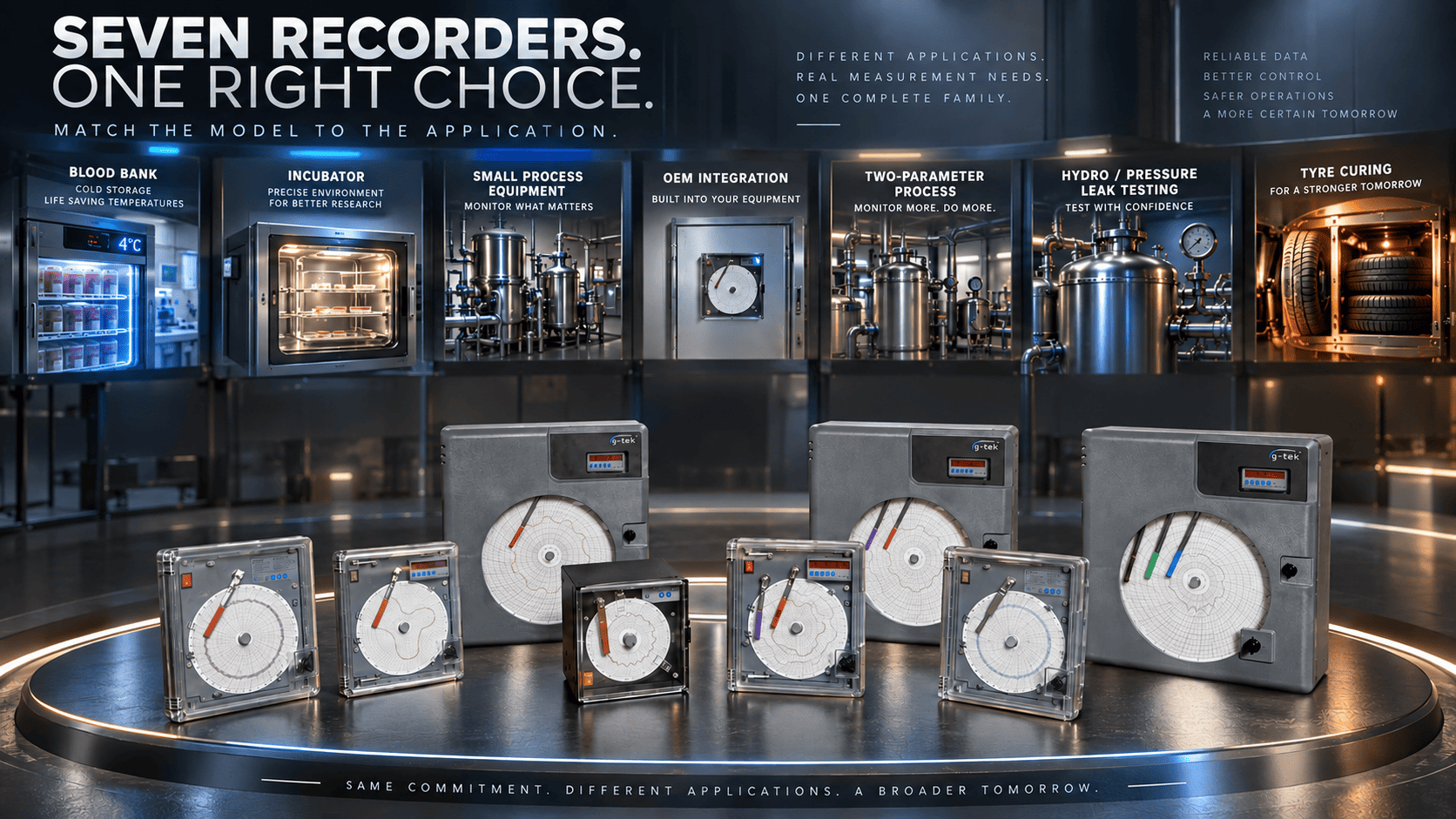
Small temperature units like blood banks and incubators suit compact 4″, 5″, or 6″ single-parameter recorders. Meanwhile, two-parameter processes needing a visible readout suit a 6″ model with LED and alarm. Finally, multi-parameter processes like tyre curing need an 11″ 3-4 parameter recorder.
Mapped across the range:
- CR4″/CR5″/CR6″ No-Display → blood banks, incubators, small equipment
- CR6″ Open Frame → built into blood bank refrigerators (RTD Pt-100, pressure pen)
- CR6″ 1P-2P → 1-2 parameters, LED display, alarm relay output
- CR11″ 1P-2P → hydro / pressure leak testing
- CR11″ 3P-4P → tyre curing (3-4 parameters)
The small models sit under blood-bank recording expectations tied to the Drugs & Cosmetics Act and NABH. Similarly, multi-parameter units serve process quality under IATF 16949 and ISO 9001. Likewise, the 11″ 1P-2P suits pressure work referenced to ASME codes.
Where stored records matter beyond paper, a data logger also works as a companion, not a replacement.
Match the model to the job before you buy, not after
Confirm your parameter count, chart size, display, alarm, and sensor needs against the model before ordering. So the recorder fits the application the first time, with no re-source.
This is where 30+ years matters. G-Tek Corporation, in Vadodara, builds a full circular chart recorder range: from compact 4-, 5-, and 6-inch models for blood banks and incubators, to the open-frame version built into refrigerators, to 11-inch 3-4 parameter recorders for tyre curing. In addition, each accepts RTD, thermocouple, or process inputs, and every unit is traceable to G-Tek’s own NABL ISO/IEC 17025-accredited calibration laboratory. One range, matched to the job.
Before You Choose a Circular Chart Recorder: Verify These
- Parameter count: how many variables on one chart (1, 2, or 3-4)
- Chart size + panel fit: 4″/5″/6″/11″ matched to your unit and cutout
- Display & alarm: do you need an LED readout or alarm relay output?
- Sensor type: RTD Pt-100, thermocouple, or process input (4-20mA / 0-1V)
- Calibration: a NABL-traceable certificate for a defensible record
Get the Right Recorder for Your Job the First Time
- Which circular chart recorder is right depends entirely on your application. In short, matching the model to your parameters, chart size, and alarm needs upfront is what prevents a re-source later.
- 👉 Not sure which circular chart recorder fits your application? Share what you’re recording and the unit it goes on with the G-Tek team, and get a clear recommendation on the right model.
Frequently Asked Questions
How do I choose the right circular chart recorder?
Match the model to your application: parameters recorded (1, 2, or 3-4), chart size and panel fit, display or alarm need, and the sensor type your process uses.
Which circular chart recorder suits a blood bank refrigerator?
Compact 4″, 5″, or 6″ single-parameter recorders. For built-in OEM use, the 6″ open-frame model with an RTD Pt-100 sensor and pressure pen is designed to integrate.
What recorder is used for tyre curing?
An 11-inch 3-4 parameter recorder, capturing three to four traces on one chart against the same timeline.
Does G-Tek offer recorders with a display and alarm?
Yes, the 6-inch 1-2 parameter model includes an LED display and an alarm relay output for processes needing a visible readout and alerting.
Where is G-Tek Corporation located?
In Vadodara, Gujarat, manufacturing recording and monitoring instruments for over 30 years, with an in-house NABL-accredited calibration laboratory and pan-India support.
Related Posts