By Asutosh Shah & Alpesh Shah · Founders, G-Tek Corporation 30+ years in temperature monitoring,…
A Shaking Chamber Has a Harder Job Than a Still One and So Does Its Temperature Record
By Asutosh Shah & Alpesh Shah · Founders, G-Tek Corporation 30+ years in temperature monitoring, recording, and calibration instrumentation.
For years, labs improvised: drop an orbital shaker inside an incubator and hope the two played nicely. The incubated shaker replaced that with one integrated unit: heating and agitation together, far more convenient. But combining them created a subtler challenge a still incubator never had: proving the temperature stays uniform across a platform that never stops moving.
Motion changes everything about how heat distributes and how you have to record it.
In an incubated shaker, constant orbital motion and a loaded platform create temperature variation between positions, so uniformity must be proven by recording at multiple points across the platform, not trusted from the single control sensor.
🎯 Key Takeaways
- An incubated shaker combines heating and constant orbital agitation in one chamber
- Motion, airflow, and a loaded platform make temperature vary between positions
- A flask at the edge can run at a different temperature than one at the center
- The single control sensor cannot prove every position held; multi-point recording can
- OEMs who build in uniformity recording ship shakers labs can qualify with confidence
A moving chamber distributes heat differently than a still one
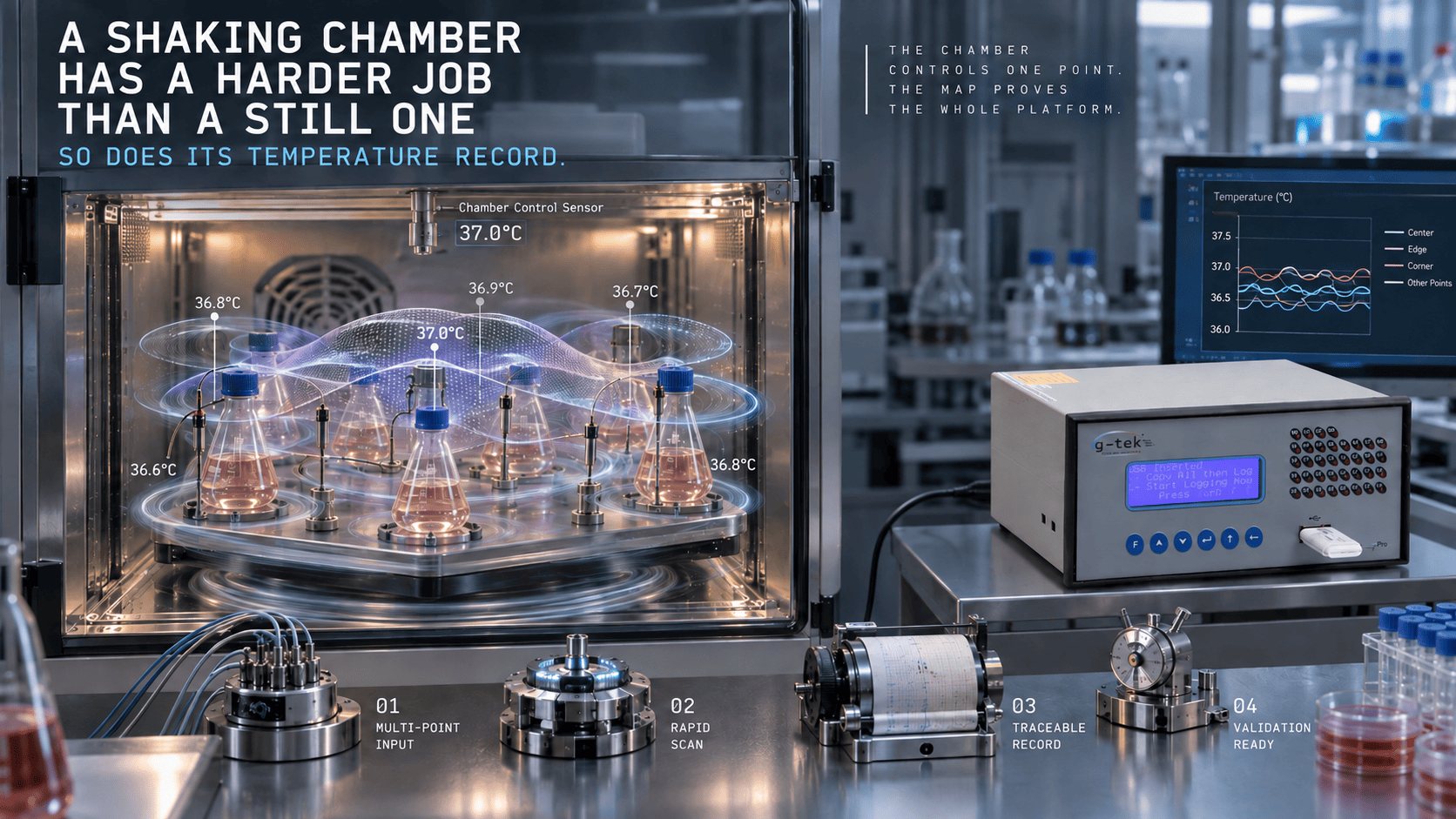
An incubated shaker’s constant motion and loaded platform create temperature differences between positions, so uniformity can’t be assumed from the control sensor. A flask at the edge may sit at a different temperature than one at the center.
Orbital motion drives its own airflow, and a full platform of flasks channels it, so positions near the walls, corners, and door run differently from the middle. Cell growth and enzyme reactions are temperature-sensitive, so that spread shows up in results: the display held 37°C, yet outer flasks grew differently from the ones in the center, and the OEM’s equipment takes the blame for a non-conformance nobody could see.
How do you prove uniformity in something that’s always moving?
You prove it by recording temperature at multiple points across the platform (center, edges, corners) continuously through operation, capturing the spread the flasks actually experience while the shaker runs.
That means uniformity mapping in the loaded, running condition, not empty and static. Enough points, continuous over time, independent of the control loop. It is the discipline a portable data logger brings to a mapping study, only here the chamber never stops moving. In a lab accredited to ISO/IEC 17025, that running-condition record turns a claim into evidence.
Recording temperature accurately at many points at once is exactly what G-Tek Corporation has done for more than 30 years in Vadodara. The SC5x/SC9x Universal Scanner records from multiple sensors placed across a shaker’s platform (center, edges, and corners). It logs continuously on GtekNet™ while the unit runs, into a traceable, 21 CFR Part 11 report that shows the real spread the flasks experience. With 8 to 32 channels, it maps the whole platform in a single run. Every channel is traceable to G-Tek’s own NABL ISO/IEC 17025-accredited calibration laboratory, so the record holds up in a lab-accreditation or GMP assessment.
Build uniformity recording in, for the running condition
Design the shaker so temperature can be recorded at multiple platform positions during actual operation. The display runs the chamber; it can’t prove the flask at the edge. A shaker that documents uniformity while running is one a lab can qualify faster and order again.
Ship a Shaker That Proves Uniformity in Motion
If your incubated shakers are specced by cell-culture and microbiology labs, uniformity proof across the moving platform is what protects their results.
👉 Building your next incubated shaker? Walk the G-Tek team through your platform size and temperature range, and get a clear recommendation on multi-point uniformity recording built in from the start.
Frequently Asked Questions
What is an incubated shaker?
One unit combining temperature control with orbital agitation for cell culture, microbial growth, and enzyme reactions.
Why is uniformity harder in a shaking incubator?
Constant motion and a loaded platform change how heat and air distribute, so edges and corners run differently from the center.
How do you prove uniformity in a shaking incubator?
Record at multiple platform positions continuously while the unit runs loaded, capturing the real spread.
Which G-Tek product records incubated shaker uniformity?
The SC5x/SC9x Universal Scanner logs multiple platform points on GtekNet™, producing a traceable, NABL-calibrated uniformity report.
Where is G-Tek Corporation located?
In Vadodara, Gujarat, manufacturing monitoring and recording instruments for over 30 years, with an in-house NABL-accredited calibration laboratory.
Related Posts