By Asutosh Shah & Alpesh Shah · Founders, G-Tek Corporation 30+ years in temperature monitoring,…
Fifteen Seconds at 72°C: The Pasteurization Window That Leaves No Room for a Guess
By Asutosh Shah & Alpesh Shah · Founders, G-Tek Corporation 30+ years in temperature monitoring, recording, and calibration instrumentation.
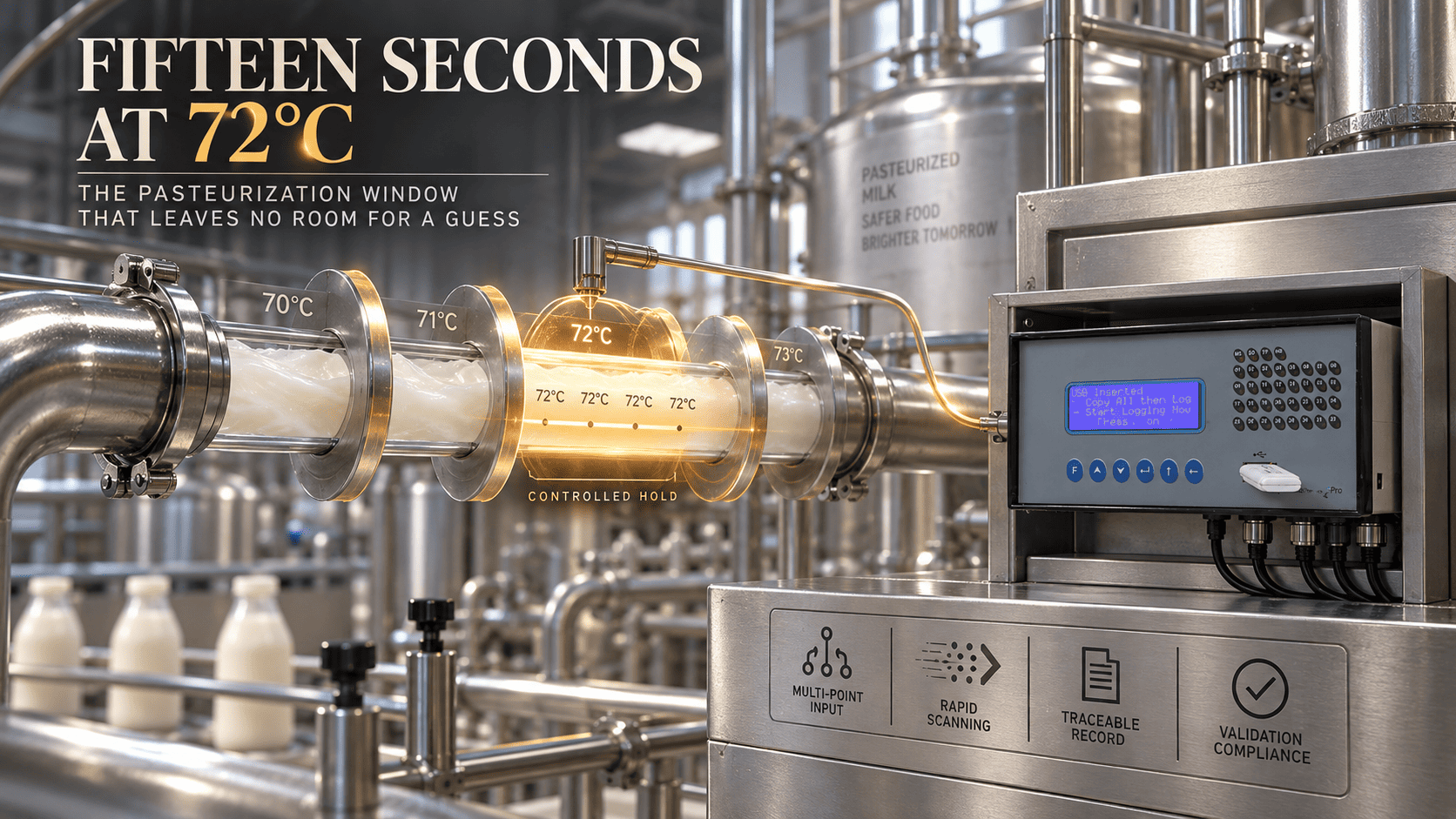
Seventy-two degrees. Fifteen seconds. That’s the pasteurization temperature window that separates safe milk from a public-health risk, and it’s over almost before it began.
Pasteurization isn’t a “heat it until it’s hot” process. It’s a precise time-temperature pair: the product must reach the target and hold it. Miss the temperature by a degree or the hold by a fraction, and it’s legally not pasteurization, no matter how hot the tank felt.
Pasteurization is defined by a precise time-temperature combination: commonly 72°C for at least 15 seconds (HTST) or 63°C for 30 minutes (batch). So proving it means continuously recording that the temperature held for the full time.
🎯 Key Takeaways
- Pasteurization is a time-temperature pair, not just “heating”
- Common benchmarks: 72°C for ≥15 seconds (HTST), or 63°C for 30 minutes (batch/LTLT)
- The temperature must hold for the full time at the critical control point
- A gauge or spot reading can’t prove the window held across every batch
- OEMs who build in continuous recording ship equipment processors can validate
Pasteurization is a time-temperature pair: both halves must be proven
Pasteurization is defined by holding a specific temperature for a specific time, such as 72°C for 15 seconds, so proving it needs a continuous record of both temperature and duration, not a single reading.
The temperature is continuously measured and controlled. The time is set by the holding tube in HTST, or the hold period in batch. Both halves define the process. A record proving one without the other proves nothing. This logic underpins the FDA PMO (Grade “A” Pasteurized Milk Ordinance) and FSSAI pasteurization standards.
Where does pasteurization most often need continuous recording?
Continuous recording is most critical at the pasteurization temperature point (the end of the holding tube in HTST, or throughout the hold in batch), where the product must hold the required temperature for the full time.
That point is the critical control point. Continuous recording there captures every batch and catches a dip a spot check misses. For high-fat or high-solids products the required temperature climbs higher still. The window can’t be eyeballed. Alkaline phosphatase testing (ISO 11816 / IDF) confirms the result; the record proves the process.
Recording a precise temperature continuously and traceably is core to what G-Tek Corporation has done for over 30 years in Vadodara. The SC5x/SC9x Universal Scanner records temperature at the critical control points of a pasteurization line continuously, on GtekNet, into a batch-traceable, 21 CFR Part 11 report. Every channel traces to G-Tek’s own NABL ISO/IEC 17025-accredited calibration laboratory, so the record stands up to a food-safety audit. For processors on a continuous Paperless Recorder instead, the same batch-wise recording is available inline at the machine.
Build the recorder into the process, not alongside it
Design pasteurization equipment to record temperature continuously at the critical point, into a traceable report, so every batch’s time-temperature compliance is documented automatically, not checked by hand.
An OEM who ships equipment that records the window itself ships equipment a processor can validate on day one. The Universal Scanner turns “we pasteurized it” into “the batch held 72°C for the full 15 seconds”: proof that survives an inspection.
Ship a Pasteurizer That Proves the Window Every Time
If your pasteurization equipment is specced by dairy or food processors, proof that the time-temperature window held is what protects every batch. Equipment that records it continuously validates faster.
👉 Building your next pasteurization line? Walk the G-Tek team through your process and critical control points, and get a clear recommendation on continuous time-temperature recording built in from the start.
Frequently Asked Questions
What is the standard pasteurization time and temperature?
Common benchmarks are HTST (at least 72°C for 15 seconds) and batch (LTLT, 63°C for 30 minutes). The exact combination depends on the product and regulations.
Why isn’t reaching the temperature enough?
Because pasteurization means holding the temperature for a set time. The product must maintain the required temperature for the full duration at the critical point.
Where must pasteurization temperature be recorded?
At the critical control point: the end of the holding tube in HTST, or throughout the hold in batch pasteurization.
Which G-Tek product records pasteurization temperature?
The SC5x/SC9x Universal Scanner records continuously at the critical control points on GtekNet, producing a batch-traceable, NABL-calibrated report.
Where is G-Tek Corporation located?
G-Tek is based in Vadodara, Gujarat, manufacturing monitoring instruments for over 30 years, with an in-house NABL-accredited calibration laboratory and pan-India support.
Watch the Fridge, Not Just What’s Inside It
Protecting the stock means knowing the equipment holding it is healthy. Equipment monitoring catches a failing unit from its performance trend long before the temperature ever moves.
Related Posts