By Asutosh Shah & Alpesh Shah · Founders, G-Tek Corporation 30+ years in temperature monitoring,…
With ETO, Temperature Is Only One-Third of the Story. Miss the Rest and Sterility Fails
By Asutosh Shah & Alpesh Shah · Founders, G-Tek Corporation 30+ years in temperature monitoring, recording, and calibration instrumentation.
Most people picture sterilization as heat: hot enough, long enough, done. Ethylene oxide breaks that mental model completely. An ETO sterilizer works at low temperatures, often 25–55°C, without cooking anything, which is exactly why it’s used for the heat-sensitive medical devices steam would destroy.
But that gentleness comes with a catch. With ETO, temperature is only one of three conditions that must hold at the same time. Get the temperature right and miss the others, and the load isn’t sterile. It just looks like it should be.
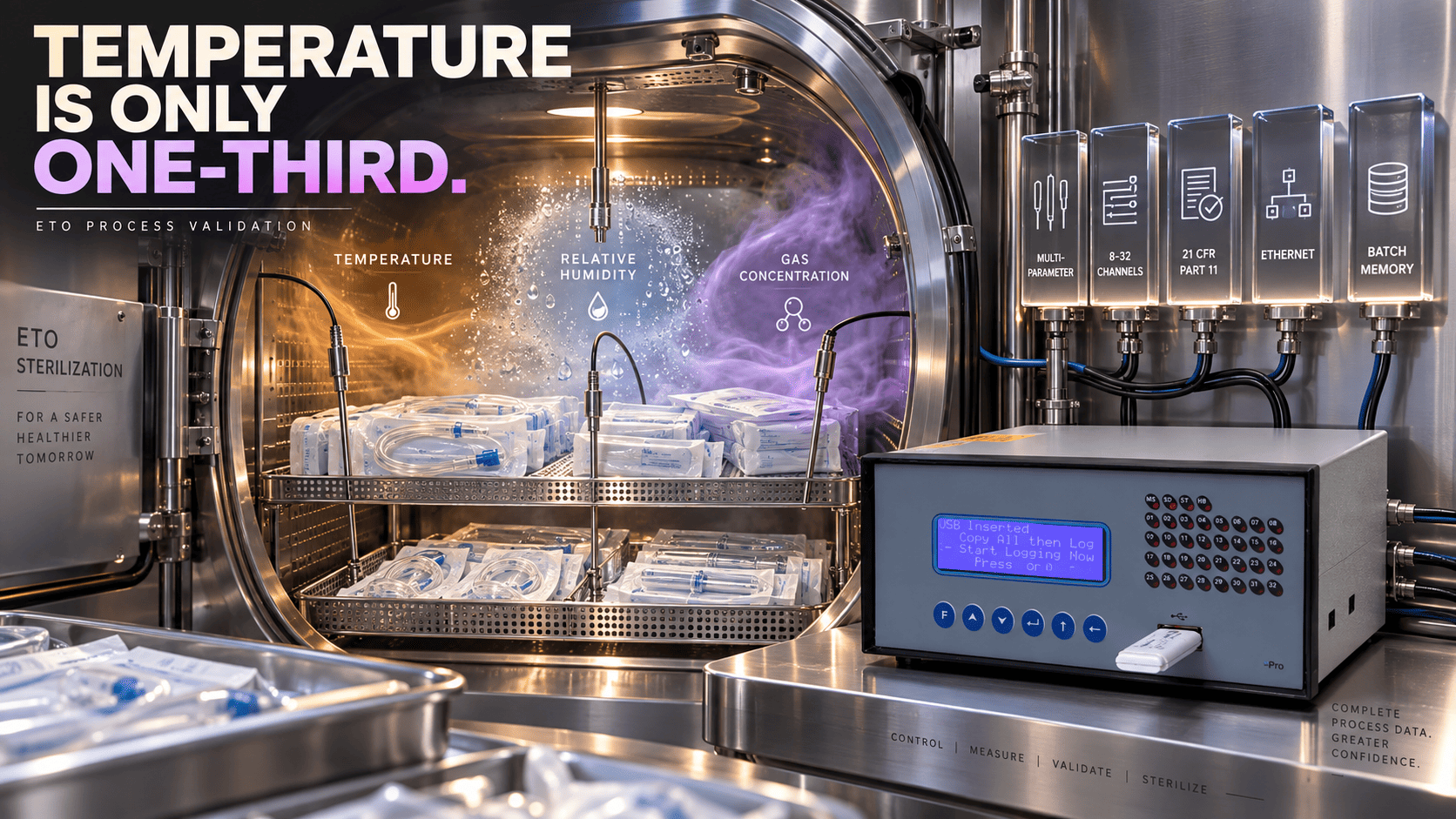
ETO sterilization depends on three conditions held together (temperature, relative humidity, and gas concentration), so proving an ETO cycle means recording all of them continuously, not temperature alone.
🎯 Key Takeaways
- ETO sterilizes at low temperature (often 25–55°C), ideal for heat-sensitive devices
- Sterility depends on three conditions together: temperature, relative humidity, and gas concentration
- Humidity is critical: too dry (below ~30% RH) and ETO can’t sterilize
- A temperature-only record cannot prove an ETO cycle worked
- OEMs who build in multi-parameter recording ship sterilizers their clients can validate
Why isn’t temperature enough to prove an ETO cycle?
Temperature isn’t enough for ETO because sterilization depends on temperature, relative humidity, and gas concentration acting together. If humidity falls too low or gas concentration drops, the cycle fails even at the right temperature.
Here’s the science. ETO kills microbes by alkylation, and alkylation needs moisture present to happen. Go too dry (below roughly 30% RH) and the process simply can’t do its job. Gas concentration, commonly ~450–1200 mg/L, must be maintained through the entire hold. Temperature by itself tells you almost nothing about whether those two held. A chamber can read a flawless profile while the cycle was already lost.
Humidity is the parameter most often under-recorded and the most quietly critical
Relative humidity is the ETO parameter most often treated as secondary, yet moisture is what makes sterilization possible. So a continuous humidity record across preconditioning and the gas hold matters as much as the temperature record.
Loads are preconditioned to both temperature and humidity before gas is admitted. RH must then stay in range (commonly ~30–80%) throughout the cycle. A single momentary reading proves nothing about whether it held for the full duration. This is precisely where a multi-parameter recorder, rather than scattered single-purpose instruments like isolated data loggers, earns its place on the machine.
Capturing several parameters together is exactly what G-Tek Corporation has built its instruments to do over more than 30 years in Vadodara. The SC5x/SC9x Universal Scanner takes temperature (thermocouples, RTDs) and process signals like humidity and pressure transmitters (4–20 mA / 0–1 V) on one system. It records every critical ETO parameter continuously on GtekNet, across multiple points in the load, into a single batch-traceable, 21 CFR Part 11 report. With 8 to 32 channels, one Universal Scanner covers the whole picture instead of separate instruments for each parameter. Every channel is traceable to G-Tek’s own NABL ISO/IEC 17025-accredited calibration laboratory, so the ETO record holds up in an ISO 11135 validation.
Record every ETO parameter on one system, across the load
Build the sterilizer to record temperature, humidity, and process conditions together on one system, at multiple points across the load. That way the full ETO cycle is documented continuously for validation, not pieced together from separate instruments.
Multi-point, multi-parameter recording is what lets a medical-device client stand in front of an auditor and show the whole cycle. ISO 11135 frames the validation; ISO/TS 21387 guides process trending; the record has to back both. An unrecorded humidity dip isn’t just a gap. It’s an unprovable cycle.
Ship an ETO Sterilizer That Proves All Three Conditions
If your ETO sterilizers are specced by medical-device makers, sterility rests on temperature, humidity, and gas holding together. A machine that documents all three validates faster and earns the repeat order.
👉 Building your next ETO sterilizer? Walk the G-Tek team through the parameters and load you need to monitor, and get a clear recommendation on recording temperature, humidity, and process conditions together from the start.
Frequently Asked Questions
Why is ethylene oxide used instead of heat sterilization?
ETO sterilizes at low temperatures, often 25–55°C, so it protects heat- and moisture-sensitive devices that steam would damage. It works chemically, not by high heat.
What parameters must be monitored in an ETO cycle?
Temperature, relative humidity, and gas concentration, held together, along with pressure and dwell time. Sterility depends on all of them simultaneously, not temperature alone.
Why is humidity so important in ETO sterilization?
ETO needs moisture to work. If RH drops too low, often below ~30%, the process fails even at correct temperature, so humidity must be recorded continuously.
Which G-Tek product records ETO sterilizer parameters?
The G-Tek SC5x/SC9x Universal Scanner records temperature and process inputs like humidity and pressure together on GtekNet, continuously and batch-traceable, with NABL-traceable calibration.
Where is G-Tek Corporation located?
G-Tek Corporation is based in Vadodara, Gujarat, building monitoring and recording instruments for over 30 years, with an in-house NABL ISO/IEC 17025-accredited calibration laboratory.
Related Posts