By Asutosh Shah & Alpesh Shah · Founders, G-Tek Corporation 30+ years in temperature monitoring,…
Your Vaccine Fridge Is Being Watched. But Is the Fridge Itself?
By Asutosh Shah & Alpesh Shah · Founders, G-Tek Corporation 30+ years in temperature monitoring, recording, and calibration instrumentation.
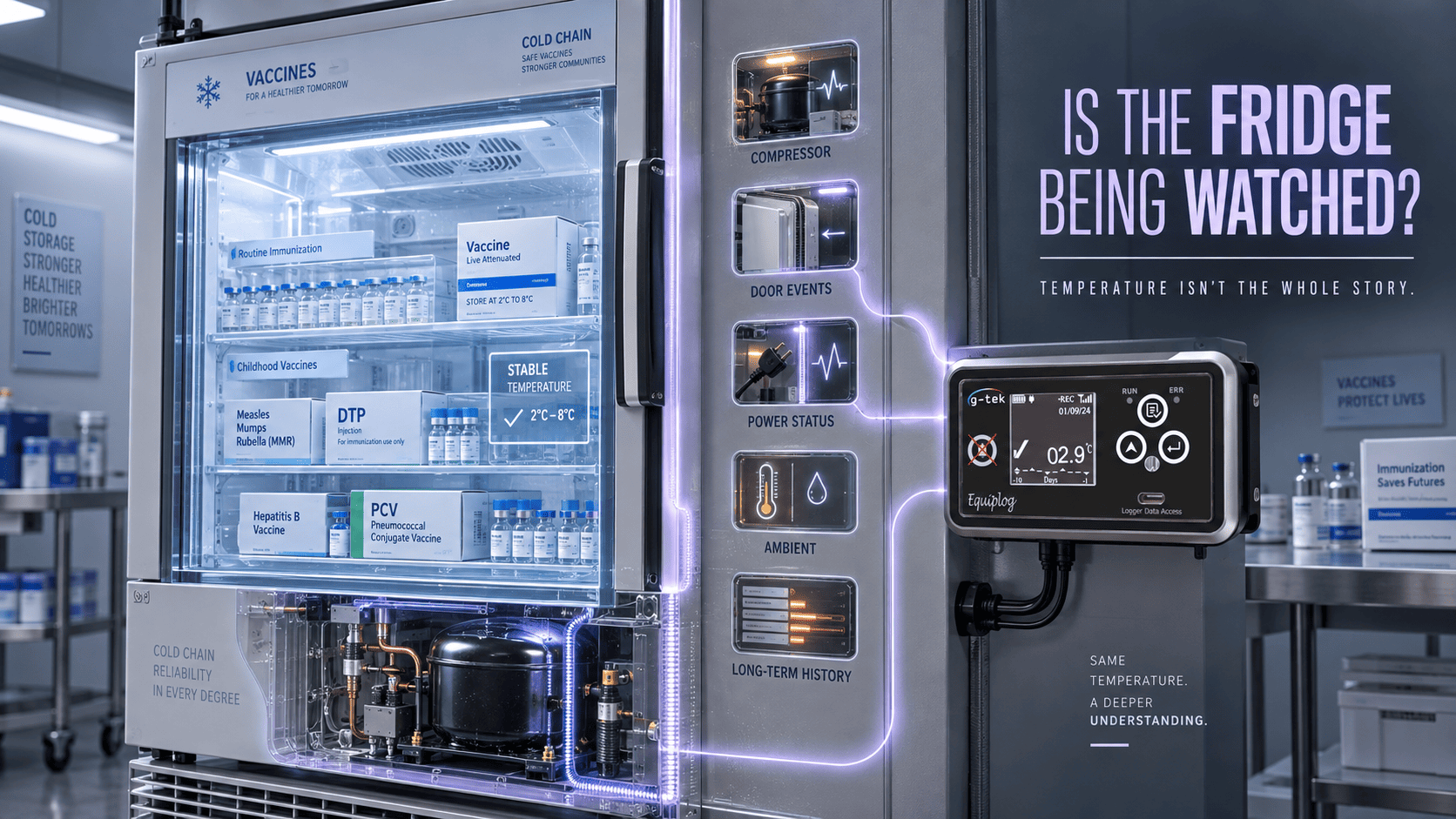
Here’s a question most cold-chain checklists never ask: you’re monitoring what’s inside the fridge, but is anything monitoring the fridge? That’s the job of equipment monitoring.
There’s a real difference. A temperature logger tells you the vaccine sits at 4°C right now. It says nothing about the compressor working harder each week, the unit cycling more often, or its performance quietly sliding toward failure. By the time the temperature moves, the equipment problem is already an emergency.
Equipment monitoring tracks how a fridge, freezer, or cold room is performing over time (its own behaviour and events), so a failing unit is caught from its performance trend, before the temperature ever moves out of range.
🎯 Key Takeaways
- Monitoring the stored product’s temperature is not the same as monitoring the equipment’s performance
- A unit can be slowly degrading while the temperature still reads normal, until it fails
- Equipment monitoring tracks performance and events over the long term, catching problems early
- A device storing long-term data viewable without a PC makes routine checks simple
- Catching a weakening unit before failure protects the stock inside it
Monitoring the product and monitoring the equipment are two different jobs
Monitoring the stored product tells you its temperature now; monitoring the equipment tells you how the unit itself is performing over time, and only the second one warns you a fridge is failing before the temperature moves.
A temperature logger protects the contents. Equipment monitoring protects against the unit letting you down. Both matter, but they answer different questions, and most facilities only ever do the first. If your vaccine storage setup logs temperature alone, you’re seeing half the picture.
What does equipment monitoring actually capture that a temperature check doesn’t?
Equipment monitoring captures long-term performance and events: how the unit behaves over weeks and months, not just the current reading. So a slow decline or repeated abnormal event becomes visible before it turns into a failure.
That’s the “struggling for weeks” story a quick glance never shows. A full year of performance data, with recent history readable on the display, turns a mystery breakdown into a pattern you saw coming. For WHO-PQS programmes and WHO EVM (effective vaccine management), this is the equipment-assurance layer that sits alongside your everyday temperature logging. It’s exactly the visibility WHO Good Distribution Practice expects across the cold chain.
Check the equipment as routinely as you check the temperature
Make equipment performance a routine check, not an afterthought. Use a monitor that stores long-term data and shows recent history right on the display, so anyone can review a unit’s health without a PC.
This is the gap G-Tek Corporation built Equiplog to close, drawing on more than 30 years of monitoring expertise in Vadodara. Equiplog is a WHO-PQS-qualified equipment monitoring device (PQS references DL01.2 and EM01.2). It records a unit’s performance in real time, stores up to a year of data, and shows around 30 days of recent history on its own display, with no PC needed to review it. Its calibration traces to G-Tek’s own NABL ISO/IEC 17025-accredited laboratory, so the equipment record stays accurate and audit-defensible.
Before You Choose an Equipment Monitor: Verify These
- Performance + event logging: does it track the unit’s behaviour over time, not just temperature?
- Data retention: how long it stores, and how much shows on-display
- No-PC review: can staff check recent history on the device itself?
- WHO-PQS qualification: confirm the PQS reference (Equiplog → DL01.2 / EM01.2)
- Calibration: NABL-traceable, so the record holds up under audit
👉 Running vaccine or cold-chain equipment? Share your units and monitoring setup with the G-Tek team and get a clear recommendation on adding equipment performance monitoring with Equiplog.
Frequently Asked Questions
What’s the difference between temperature monitoring and equipment monitoring?
Temperature monitoring tracks the product’s temperature now. Equipment monitoring tracks how the unit performs over time, catching a fridge that’s slowly failing before the temperature moves.
Why monitor the equipment if the temperature is fine?
Because a unit can degrade while still holding temperature, until it fails and stock is lost. Equipment monitoring reveals the slow decline early, giving time to act.
What does Equiplog record and store?
Equiplog monitors performance in real time, stores up to a year of data, and shows about 30 days of recent history on its display, with no PC required to review a unit’s health.
Is Equiplog WHO-PQS qualified?
Yes, under WHO-PQS references DL01.2 and EM01.2, with calibration traceable to G-Tek’s own NABL ISO/IEC 17025-accredited laboratory.
Where is G-Tek Corporation located?
G-Tek is based in Vadodara, Gujarat, manufacturing monitoring instruments for over 30 years, with an in-house NABL-accredited calibration laboratory and pan-India support.
Watch the Fridge, Not Just What’s Inside It
Protecting the stock means knowing the equipment holding it is healthy. Equipment monitoring catches a failing unit from its performance trend long before the temperature ever moves.
Related Posts