
The logger looked perfect on the quote. Clean spec sheet. Signed, installed, running. Then the…
What Is Dew Point? Why “Dry” Compressed Air Can Still Cause Condensation and Product Damage
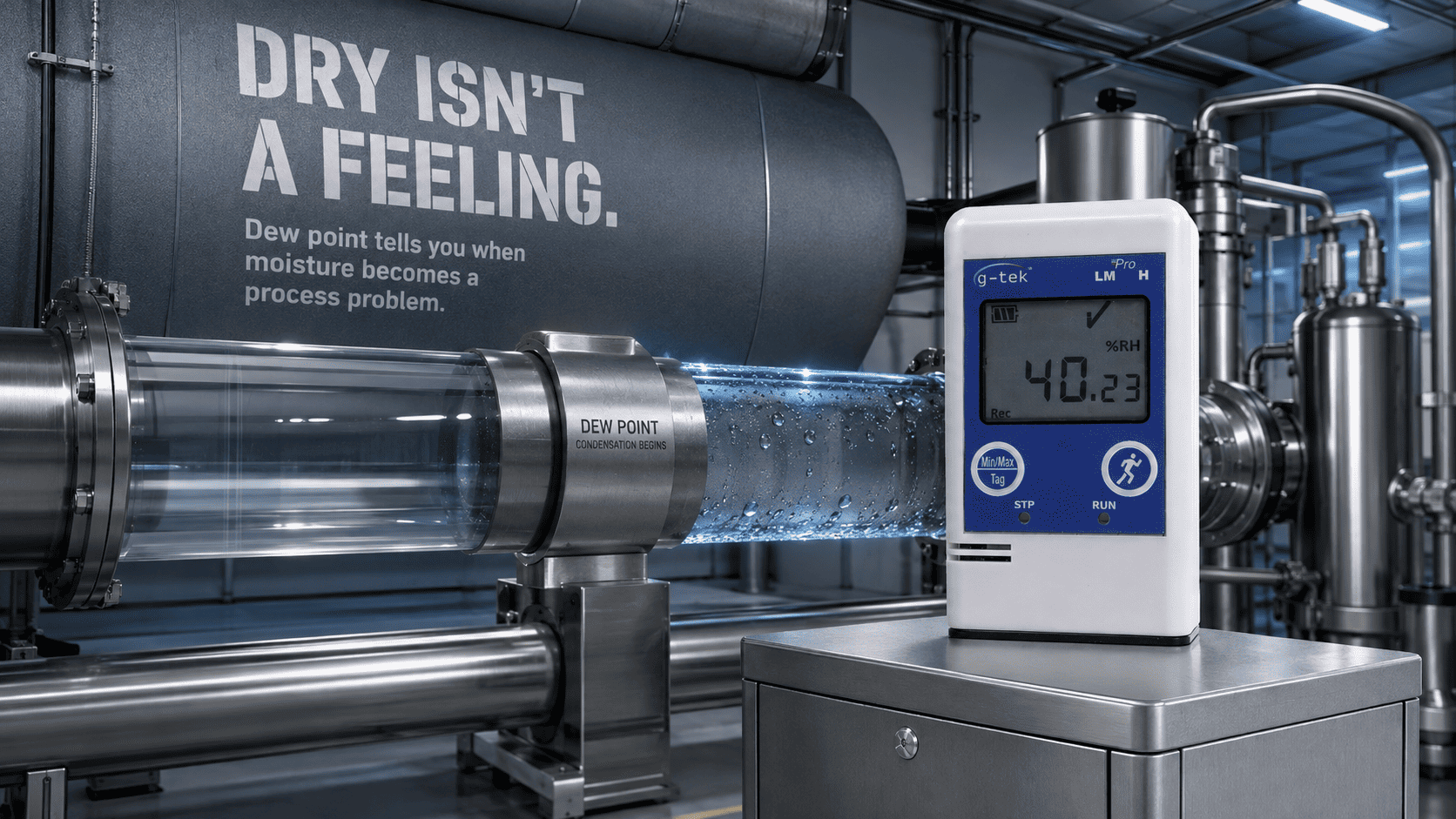
“Dry” is a feeling, not a measurement.
Air that feels bone-dry can still be one temperature drop away from soaking your product in condensation. And the number that tells you exactly when that happens is one most people never check: dew point.
Miss it, and “dry” compressed air can corrode a line, moisture can bead inside a cleanroom, or a batch may spoil for reasons nobody can explain. The air was never the problem. The dew point was.
🎯 Key Takeaways
- Dew point is the temperature at which air becomes saturated and moisture starts to condense.
- “Dry-feeling” air can still condense if the temperature drops to its dew point.
- Lower dew point = drier air = lower condensation risk.
- It’s an important specification for compressed air quality, cleanrooms, and humidity-sensitive processes.
- Monitoring dew point, or the humidity behind it, can help predict moisture problems before they happen.
What Is Dew Point in Simple Terms?
Dew point is the temperature at which air becomes fully saturated with moisture and water begins to condense out. The higher the dew point, the more moisture the air is carrying and the sooner condensation can occur as things cool.
Warm air can hold more moisture than cold air. As air cools toward its dew point, it can no longer hold the same amount of water vapour, so the excess begins to form as condensation on nearby surfaces.
That’s the basic mechanism.
Dew point reflects the actual moisture content of the air and is therefore useful when you need to understand when condensation may begin.
Relative Humidity Moves With Temperature Dew Point Doesn’t
Here’s the trap.
Relative humidity is a percentage that changes as temperature changes, even when the actual moisture content remains the same.
The same parcel of air can show a lower RH in a warm environment and a much higher RH when cooled, even though no additional moisture has been added. That’s why RH alone can sometimes make air appear “dry.”
Dew point behaves differently. For the same moisture content, the dew point remains essentially unchanged unless moisture is added or removed.
For process work, monitoring temperature and humidity provides the information needed to evaluate dew point. G-Tek’s LM Pro-H humidity data logger records temperature and RH so the moisture trend can be monitored instead of guessed.
That makes dew point especially useful when you need to predict when moisture will begin to form.
Why Does Dew Point Matter in Compressed Air and Cleanrooms?
Dew point matters most in compressed air systems, cleanrooms, and enclosed processes — anywhere a temperature drop can push moisture in the air toward condensation.
Compressed air deserves special attention.
ISO 8573-1 classifies compressed-air quality partly by pressure dew point, which indicates the temperature at which moisture begins to condense while the air remains under pressure.
For example:
- Class 1: pressure dew point of −70°C or lower
- Class 2: pressure dew point of −40°C or lower
- Class 4: pressure dew point of +3°C or lower
The lower the pressure dew point, the drier the compressed air.
If system temperatures fall below the applicable pressure dew point, liquid water may begin to form inside piping. That can lead to corrosion, contamination, process instability, and product damage.
Cleanroom environmental control under frameworks such as ISO 14644 also depends on managing temperature and humidity appropriately for the process.
How Do You Monitor Dew Point Before Moisture Becomes a Problem?
Monitoring dew point means continuously tracking the moisture conditions that determine when condensation can occur.
This is where instrumentation earns its place.
G-Tek Corporation, manufacturing monitoring instruments in Vadodara for over 30 years, provides systems such as the Universal Scanner that can record humidity, temperature, and relevant process signals used to understand moisture conditions.
Measurement channels can also be supported through G-Tek’s NABL ISO/IEC 17025-accredited calibration laboratory.
The point isn’t simply the device. It’s catching the moisture trend before it becomes a visible condensation problem.
Catch the Moisture Before It Condenses
Understanding what dew point is is the first step. Seeing how moisture conditions change in your process is the next.
Monitoring temperature and humidity turns a hidden moisture risk into measurable information you can act on before condensation begins.
👉 Fighting moisture in compressed air or a cleanroom? Bring the G-Tek team the conditions you’re monitoring and get a clear recommendation on tracking the humidity and temperature behind your dew point.
Frequently Asked Questions
What is dew point in simple terms?
Dew point is the temperature at which air becomes saturated with moisture and condensation begins to form. A higher dew point generally indicates more moisture in the air.
How is dew point different from relative humidity?
Relative humidity changes with temperature. Dew point more directly reflects the moisture content of the air and is useful for predicting when condensation may occur.
Why does dew point matter for compressed air?
Compressed air with a high pressure dew point contains more moisture. If the system cools below that dew point, water can condense inside the line and contribute to corrosion, contamination, and product damage.
Can air feel dry but still cause condensation?
Yes. Air can feel dry and still contain enough moisture to condense if a surface or process temperature drops to or below its dew point.
How do you monitor dew point?
Dew point can be monitored directly with suitable instrumentation or evaluated from accurate temperature and humidity measurements. Continuous monitoring helps identify rising moisture before condensation becomes a problem.
Related Posts