The Hidden Crisis in Pharma Data Management If you're a QA/QC manager, operations head, or…
You Don’t Have to Choose Between a Paper Chart and Digital Data
By Asutosh Shah & Alpesh Shah · Founders, G-Tek Corporation · 30+ years in temperature monitoring, recording, and calibration instrumentation.
The usual assumption is that you pick a side. A paper chart recorder, visible and signable at the unit. Or a digital logger that produces downloadable reports. Old way or new way.
It’s a false choice.
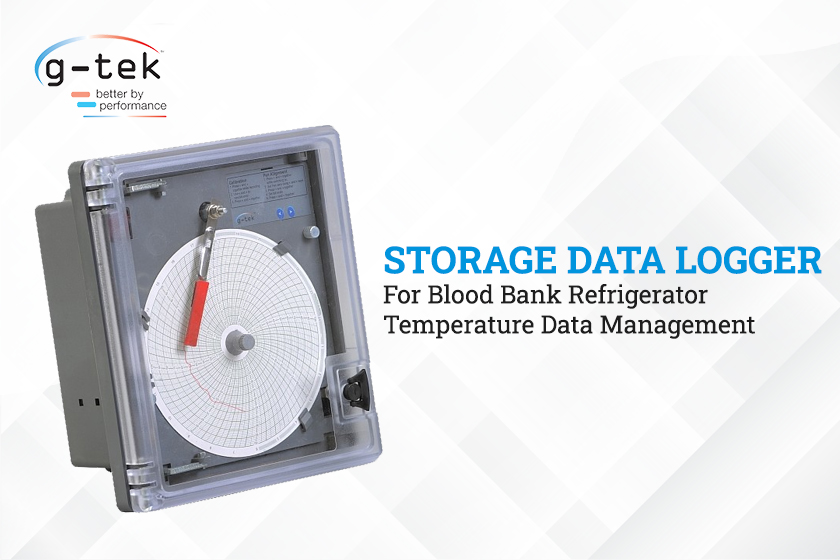
A storage recorder with chart and memory is a circular chart recorder with internal memory. It marks the visible paper chart while simultaneously storing time-stamped data and events electronically.
Therefore, one device produces both the physical record and the digital report.
Key Takeaways
One instrument gives the inspector a chart to see and the auditor a report to download.
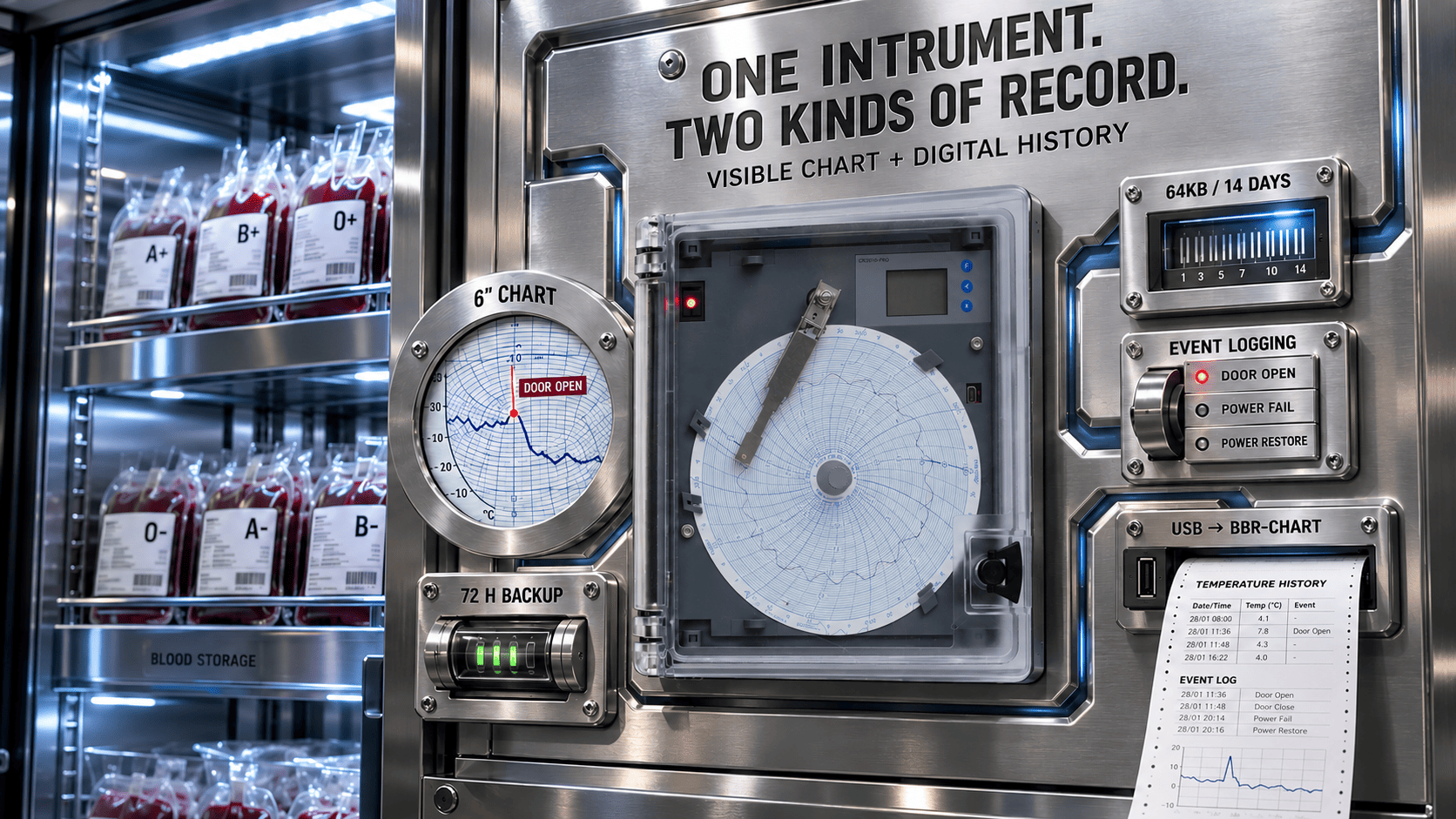
64KB of internal memory holds 14 days of data at a 5-minute interval.
Door open/close and power fail/restore are logged alongside temperature.
Cyclical memory keeps the most recent record always available.
One device instead of two ends duplicate calibration and mismatched records.
One Device, Two Kinds of Record
A storage recorder produces two records from one instrument: the inkless paper chart visible on the unit and a time-stamped digital record held in internal memory.
The digital record then downloads to software for reports.
The chart answers the requirement nobody can wave away: something physical on the unit, readable at a glance and signable.
The memory answers the other one: a record that can be pulled, analysed, and attached to a report.
Same sensor, two outputs. That’s the premise behind G-Tek’s storage recorders.
What Does It Capture That a Plain Chart Can’t?
Beyond the temperature trace, a storage recorder logs events with a time stamp. These include door open and close, power failure and restore.
As a result, the record shows not just what the temperature did, but what happened around it.
A plain chart shows a rise. It doesn’t say why. The event log does: the door stood open for eleven minutes at the hour the trace climbed.
That context turns an audit observation into an explanation.
Door input is a potential-free contact, so the existing switch ties straight in.
Conventional circular chart recorders trace the excursion; a storage recorder documents its cause.
G-Tek Corporation built the CR2010 series BBR Pro around exactly this dual requirement.
It marks a 6-inch inkless chart on pressure-sensitive paper while holding 14 days of data at a 5-minute interval in 64KB of cyclical memory.
An LCD display, real-time clock, direct RTD Pt-100 input and door-switch input sit on one unit. Battery backup also carries it through a power failure.
Data moves over USB 2.0 into BBRChart to view, analyse and report.
Every unit leaves G-Tek’s own NABL ISO/IEC 17025-accredited calibration laboratory.
Stop Running Two Systems to Satisfy Two Requirements
If you keep a chart recorder for visibility and a separate logger for digital data, consolidate.
One storage recorder with chart and memory covers both requirements. This halves the instruments to calibrate and removes the chance of two records disagreeing.
Two instruments on one chamber mean two calibration cycles, two sets of paperwork, and one awkward question when the traces don’t agree.
For blood storage under the Drugs & Cosmetics Act rules, and for hospitals working to NABH accreditation, a single traceable record is cleaner to defend.
One Instrument, Both Records
If you’re keeping a chart for the inspector and a logger for the auditor, you’re maintaining two systems for one job.
A storage recorder closes that gap with a single device.
Running a chart recorder and a separate logger side by side? Walk the G-Tek team through your current setup and get a clear view of what a single storage recorder would replace.
Frequently Asked Questions
What Is a Storage Recorder?
A circular chart recorder with internal memory. It marks the paper chart on the unit while storing time-stamped data and events for download.
How Much Data Does It Hold?
The CR2010 BBR Pro stores 14 days at a 5-minute interval in 64KB of cyclical memory. Therefore, the latest record is always present.
What Events Does It Log?
Door open and close, power failure and restore. Each event is time-stamped alongside the temperature trace.
Can I Produce an Audit Report?
Yes. Data downloads over USB into BBRChart for analysis and reporting, while the chart stays visible on the unit.
Where Is G-Tek Based?
Vadodara, Gujarat – manufacturing recording and monitoring instruments for over 30 years, with an in-house NABL-accredited calibration laboratory and pan-India support.
Related Posts