By Asutosh Shah & Alpesh Shah · Founders, G-Tek Corporation. 30+ years in temperature monitoring,…
Fridge or Freezer? The WHO-PQS Logger You Need Changes With the Temperature
By Asutosh Shah & Alpesh Shah · Founders, G-Tek Corporation · 30+ years in temperature monitoring, recording, and calibration instrumentation.
A fridge and a freezer are not the same problem.
It sounds obvious written down. In practice, cold-chain programmes order “vaccine loggers” as one line item. They distribute them across both refrigerators holding vaccines just above freezing and freezers holding them far below.
Two very different temperature worlds. Two different sensor and device requirements. Two different WHO-PQS qualifications built for each.
Put the wrong one in the wrong unit, and nothing dramatic happens on day one. The gap only appears later, at review.
Choosing the right WHO-PQS logger for vaccine fridge vs freezer storage depends on the temperature range of the unit. WHO-PQS qualifies different loggers for different storage conditions: an external-sensor device for vaccine refrigerators and a freezer-specific device for frozen storage.
Key Takeaways
Vaccine refrigerators and freezers run at very different temperatures and need differently built loggers.
WHO-PQS qualifies separate devices for fridge storage and freezer storage.
An external-sensor logger suits in-fridge monitoring, with the probe inside and the body accessible.
A freezer-specific device is built to measure accurately at frozen storage temperatures.
Matching the device to the unit closes gaps that only surface at programme review.
The Unit’s Temperature Decides the Device, Not the Label on the Box
The right WHO-PQS logger is decided by the temperature range of the unit it monitors. A vaccine refrigerator and a vaccine freezer each have a device qualified for their range. Therefore, a logger built for one is not interchangeable with the other.
Sensors and electronics perform within a rated range. A device designed for storage just above freezing was never built to measure far below it. That isn’t a brand limitation. It’s metrology.
WHO-PQS reflects this by qualifying separate devices against separate technical specifications: E006/TR06.3 for refrigerator monitoring and E006/TR06.4 for freezer monitoring.
The guidance underpinning it, WHO GDP and TRS 957 Annex 5, together with TRS 961 Annex 9 on storage monitoring, expects each storage point to be monitored by equipment suited to it.
Which is why the question is never “do we have vaccine loggers?” It’s “does each unit have the one qualified for its range?”
WHO-PQS Logger for Vaccine Fridge vs Freezer: Which One Goes Where?
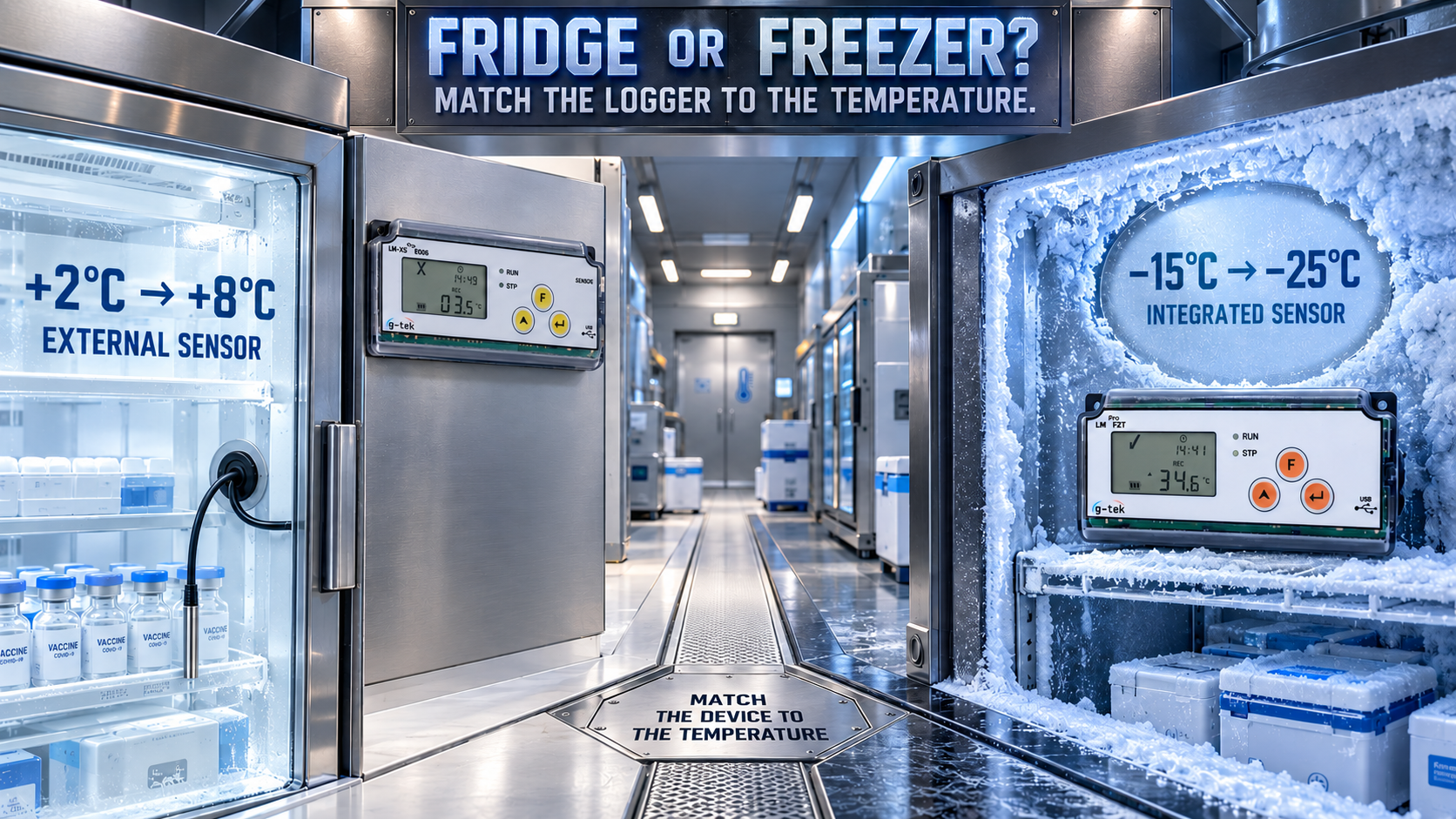
For vaccine refrigerators, an external-sensor logger places the probe inside the unit while the body and display stay accessible outside.
For freezer storage, a freezer-qualified device is used because it is built to measure accurately at frozen temperatures.
Mapped plainly:
| Storage Point | Device | Sensor | WHO-PQS |
|---|---|---|---|
| Vaccine refrigerator / in-fridge | LM-XS Pro E006 | External probe | E006/TR06.3 |
| Freezer storage | LM Pro FZT (Type-1) | Internal | E006/TR06.4 |
The external probe matters more than it first appears. The sensor sits where the vaccines sit, while the display stays outside, readable without opening the door.
Both devices show recorded history on-screen, so a routine morning check doesn’t need a laptop. This is part of why the full vaccine series range is built around on-device review rather than download-first workflows.
Before You Order, Verify These
Unit type and range: Refrigerator or freezer? Confirm the actual operating temperature.
WHO-PQS reference: Does the device’s PQS code match the storage type?
Sensor type: External probe for in-fridge placement, or internal where appropriate.
On-device history: How many days can staff review on the display without a PC?
Calibration: NABL-traceable certificate covering the range you actually monitor.
That last point quietly decides the other four. A certificate that stops short of your freezer range leaves the record exposed exactly where it matters most.
Therefore, calibration scope deserves reading before the order, not after.
Matching the device to the storage point is the whole reason G-Tek Corporation builds a WHO-PQS range rather than a single logger, drawing on more than 30 years in Vadodara.
The LM-XS Pro E006 is qualified for vaccine refrigerator monitoring, with an external sensor that sits inside the unit while the body stays accessible.
The LM Pro FZT is qualified for freezer storage, with each device meeting its own WHO-PQS technical specification. Every unit is calibrated in G-Tek’s own NABL ISO/IEC 17025-accredited laboratory.
Audit Your Storage Points, Then Match Device to Unit
List every storage point and its temperature range first. Then, assign the WHO-PQS device qualified for that range.
This ensures each fridge and each freezer is monitored by the device actually built for it.
Walk the site. Write down every unit, what it holds, and what temperature it runs at. Then assign.
It takes an afternoon, and it turns a vague inventory of data loggers into a defensible monitoring map.
No gaps to explain later.
Frequently Asked Questions
Can the same vaccine logger be used in a fridge and a freezer?
Generally, no. WHO-PQS qualifies separate devices for refrigerator and freezer storage. Therefore, the correct logger depends on the unit’s actual operating range.
Which logger is used for a vaccine refrigerator?
An external-sensor device such as the LM-XS Pro E006. The probe sits inside the unit, while the display stays accessible outside, readable without opening the door.
What makes a freezer logger different?
It is built and qualified to measure accurately at frozen storage temperatures, under its own WHO-PQS technical specification rather than the refrigerator one.
Can staff check readings without a computer?
Yes. G-Tek’s WHO-PQS vaccine loggers show recorded history on the device itself. Therefore, routine checks happen at the unit without downloading data.
Where is G-Tek Corporation located?
Vadodara, Gujarat — manufacturing monitoring instruments for over 30 years, with an in-house NABL ISO/IEC 17025-accredited calibration laboratory and pan-India support.
Match Every Unit to the Device Built for It
A cold-chain programme is only as sound as its weakest storage point. Assigning the right WHO-PQS device to each fridge and each freezer is what removes the gaps before a review finds them.
When selecting a WHO-PQS logger for vaccine fridge vs freezer storage, always match the device qualification and calibration range to the actual storage conditions.
Mapping loggers across your fridges and freezers? Send the G-Tek team your storage points and their temperature ranges. Get a clear recommendation on which WHO-PQS device belongs where.
Related Posts