By Asutosh Shah & Alpesh Shah · Founders, G-Tek Corporation. 30+ years in temperature monitoring,…
Put the Probe in the Cold, Keep the Logger Out: Why External-Sensor Loggers Exist
By Asutosh Shah & Alpesh Shah · Founders, G-Tek Corporation. 30+ years in temperature monitoring, recording, and calibration instrumentation.
A logger that survives the cold and a logger that measures it accurately are not the same thing. Drop an all-in-one device into a deep freezer and two problems start at once. The electronics and battery are working far outside their comfortable range. And the only way to read the data is to open the door and take the unit out. That disturbs the very temperature you are trying to protect. An external-sensor data logger exists precisely to separate those two jobs.
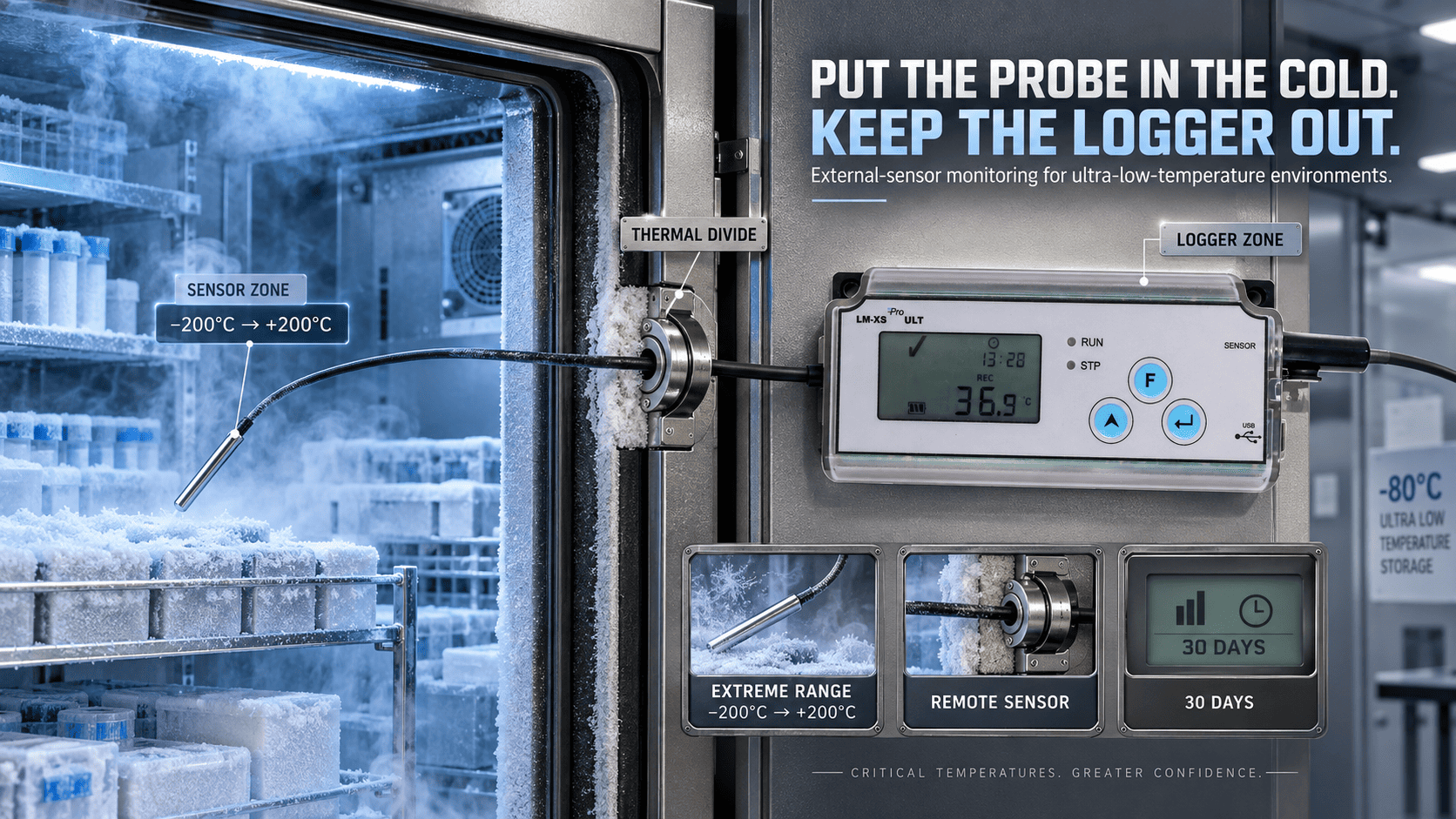
An external-sensor data logger places only the probe inside the cold or hard-to-reach space, while the logger body, display, and battery stay outside. So the measurement is accurate at the extreme and the status can be read without opening the unit.
🎯 Key Takeaways
- An all-in-one logger inside a deep freezer operates outside its comfortable range: accuracy and battery both suffer
- Reading or downloading it means opening the unit and disturbing the monitored temperature
- An external-sensor logger puts only the probe in the cold, keeping electronics and display outside
- The probe’s rated range decides how extreme a temperature you can actually measure
- Viewing recent history on the display, without a PC, keeps routine checks simple
Why not just put the whole logger inside?
Putting the whole logger inside a deep-cold or extreme space pushes its electronics and battery beyond their comfortable range. That affects accuracy and battery life. It also means opening the unit every time you want to read or download the data.
The probe is built for the extreme. But the circuit board and battery are not.
Separating them means the sensing element sits where the measurement actually matters, while the components that need protection stay in ambient conditions. There is also a second gain most buyers only notice later. Every door opening is a temperature excursion you created yourself while trying to verify there wasn’t one. Keeping the display outside removes that habit entirely.
For products held under WHO GDP and TRS 961 Annex 9 storage expectations, that difference shows up directly in the record an auditor reads.
In an External-Sensor Data Logger, the Probe’s Rated Range Is What Actually Decides Your Limit
With an external-sensor data logger, the measurable temperature range is set by the probe. An RTD Pt-100 probe rated for an extended range can measure far colder or hotter than any all-in-one device could survive. The logger body, however, stays protected.
So check the probe’s rating. Not a general line about “the logger’s range.”
An RTD Pt-100 sensor built to IEC 60751 (see IEC) covers a wide extended span. It’s deep enough for ultra-low freezers, blood plasma storage, frozen food chambers, and shipping containers. That single specification is what separates a device that records at your temperature from one that merely endures it.
Separating the probe from the electronics is exactly the design principle behind G-Tek Corporation’s LM-XS Pro ULT, built on more than 30 years of monitoring experience in Vadodara. Its external RTD Pt-100 sensor covers an extended range of −200 to +200°C, deep enough for blood plasma, vaccines, frozen foods, and shipping containers. Meanwhile, the logger body stays outside with a large display. It shows a ✔ if temperature stayed within limits and an X if it didn’t, plus an audio-visual alarm. It stores up to 120 days of data. The last 30 days can also be reviewed right on the display without connecting to a computer. Data also exports through LmViewXSE006-Uni as PDF, Excel, or CSV, supporting 21 CFR Part 11 record expectations where regulated. It is also listed under WHO PQS E006 / TR06.4. Every unit traces to G-Tek’s own NABL ISO/IEC 17025-accredited calibration laboratory.
Choose an External-Sensor Data Logger by Probe Range, Display Access, and Data Retention
Choose an external-sensor logger by three things. First, check the probe’s rated temperature range. Then check whether you can read status and recent history on the display without a PC. Finally, check how long it stores data for your review cycle.
Most selection errors happen because only the third one gets checked.
Before You Choose an External-Sensor Data Logger: Verify These
- Probe rated range: confirm it covers your actual temperature, not just the word “freezer”
- Logger body placement: where the electronics and display will physically sit, outside the cold
- Display access: can you read status and recent history without connecting a PC?
- Data retention: days stored, matched to your review and audit cycle
- Calibration: NABL-traceable certificate covering the range you actually monitor
That last point decides whether your record survives scrutiny. G-Tek’s in-house calibration laboratory issues certificates across the monitored span, and the full data logger range covers ambient through ultra-low applications.
Measure the Extreme Without Putting Your Logger In It
The probe belongs in the cold. The electronics don’t.
So an external-sensor data logger keeps the measurement accurate at the extreme and the status readable without ever opening the unit.
👉 Monitoring deep-cold or hard-to-reach spaces? Share your temperature range and where the logger would sit with the G-Tek team, and get a clear recommendation on the right external-sensor setup.
Frequently Asked Questions
What is an external-sensor data logger?
Only the probe goes into the monitored space while the body, display, and battery stay outside. That keeps measurement accurate at extremes and lets you read status without opening the unit.
Why not put an all-in-one logger inside the freezer?
Its electronics and battery then operate far outside their comfortable range, affecting accuracy and battery life. Reading data also means opening the unit, disturbing the temperature inside.
What temperature range can an external probe measure?
It depends on the probe. For example, the LM-XS Pro ULT uses an RTD Pt-100 sensor with an extended range of −200 to +200°C, suiting plasma, vaccines, frozen foods, and containers.
Can I check the data without a computer?
Yes. A ✔ shows temperature stayed within limits, an X shows it didn’t, with an audio-visual alarm, and the last 30 days can be viewed on the display itself.
Where is G-Tek Corporation located?
Vadodara, Gujarat, manufacturing monitoring instruments for over 30 years, with an in-house NABL ISO/IEC 17025-accredited calibration laboratory and pan-India support.
Related Posts