By Asutosh Shah & Alpesh Shah · Founders, G-Tek Corporation. 30+ years in temperature monitoring,…
Nobody’s in the Cold Room at 2 AM, but Something Should Be Watching It
By Asutosh Shah & Alpesh Shah · Founders, G-Tek Corporation 30+ years in temperature monitoring, recording, and calibration instrumentation.
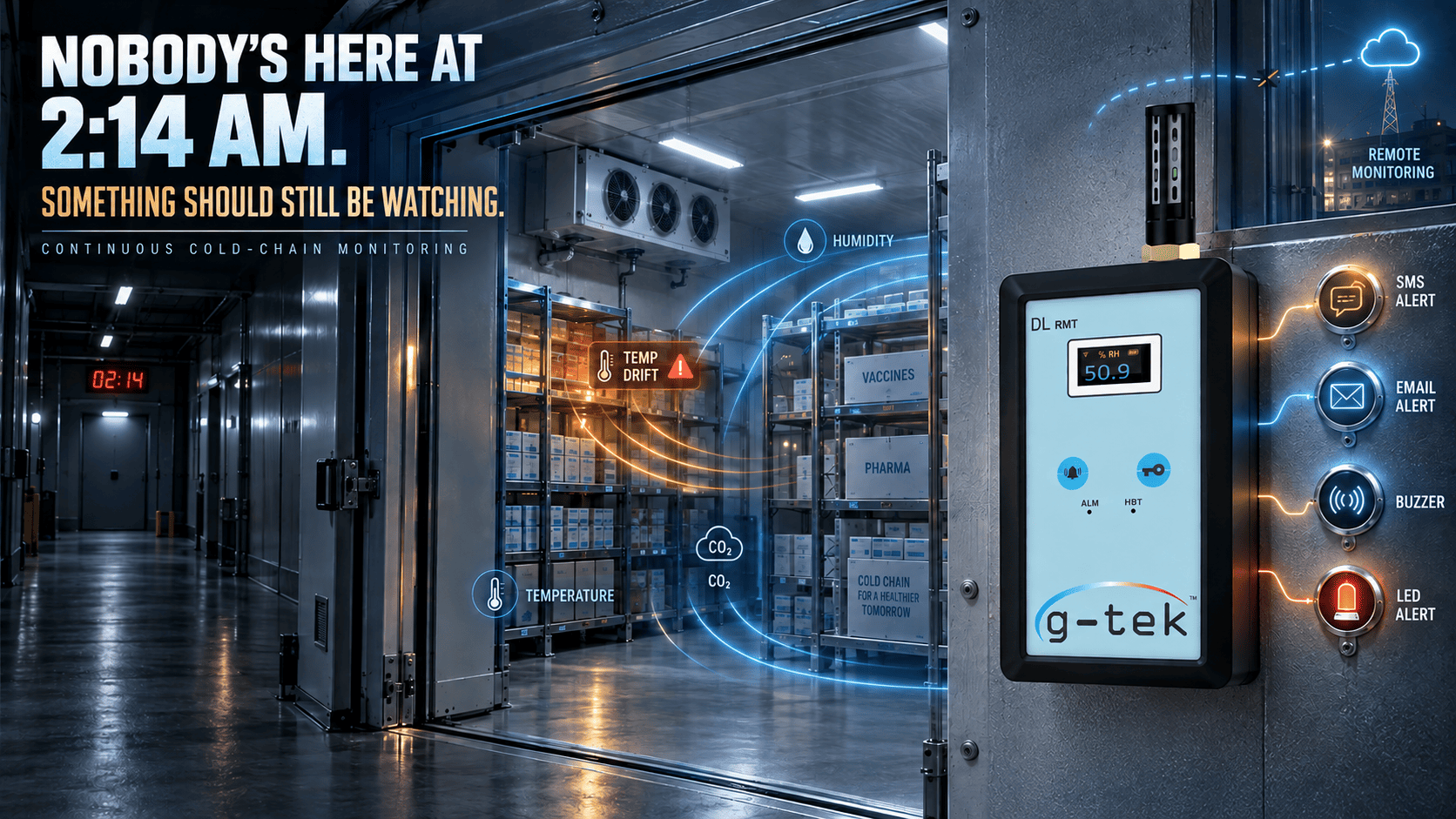
2:14 AM. The cold room is empty, the building is dark, and the temperature has just begun to climb. No one is there to see the display. No one will be, for another six hours. That’s the gap IoT monitoring exists to close.
That gap (the hours when a space runs unattended) is where cold-chain losses actually happen. Not because the equipment is bad, but because when it slips, there’s no one in the room to notice and act.
An IoT monitoring device watches an unattended cold room continuously. It sends an instant alert by SMS, email, buzzer, and on-screen the moment temperature, humidity, or CO₂ drifts. So someone knows and acts even when no one is on site.
🎯 Key Takeaways
- Cold rooms and storage often run unattended: nights, weekends, remote sites
- Most losses happen in the hours when no one is there to notice a drift
- An IoT logger monitors continuously and alerts instantly via SMS, email, buzzer, and LED
- A cloud dashboard and mobile app let anyone check any unit from anywhere
- Onboard storage keeps recording through network gaps and auto-uploads when the connection returns
The danger isn’t the drift, it’s the drift no one is there to see
An IoT data logger closes the unattended-monitoring gap by continuously recording temperature, humidity, and CO₂ and sending an instant alert the moment any reading crosses a limit. That way, a drift at night or over a weekend reaches someone immediately, not on Monday morning.
Here’s the uncomfortable truth. Equipment slips on its own schedule, not office hours. Yet a device that only records and gets read later tells you too late. By then the product may already be gone. The value isn’t the record. It’s the live alert that turns an unattended space into a watched one. This is also the thinking behind purpose-built wireless monitoring loggers designed for exactly these hours.
What happens to IoT monitoring when the network drops mid-alert?
A well-designed IoT logger keeps recording to onboard storage when the network drops, then auto-uploads when the connection returns. So no data is lost during a gap, and the record stays complete even in weak-signal locations.
That matters most where it’s hardest to monitor. Remote warehouses. Rural cold rooms. Sites where the signal comes and goes. Onboard buffering of thousands of readings plus auto-sync means a network drop never becomes a blind spot. The alert layer and the never-lose-a-reading layer work together, which is what separates a serious industrial data logger from a simple recorder. It also aligns with what WHO GDP guidance (TRS 957 Annex 5, TRS 961 Annex 9) expects. That means continuous monitoring across storage and distribution, and 21 CFR Part 11 electronic records where regulated.
G-Tek Corporation, based in Vadodara, has spent more than 30 years building monitoring and calibration instruments for pharma and food facilities across India, with an in-house NABL ISO/IEC 17025-accredited calibration laboratory behind every device.
Give every unattended space a way to call for help
Fit unattended cold rooms and storage with a monitor that alerts through multiple channels (SMS, email, buzzer, and LED). That way, a critical drift reaches someone on site and off site at once, through whichever channel gets noticed.
This is exactly the job G-Tek built the DL-RMT for. It continuously records temperature, humidity, and CO₂, and transmits to a cloud dashboard over GSM or Wi-Fi. It also fires instant alerts by SMS, email, buzzer, and LED the moment a reading crosses a threshold. Meanwhile, a 14-day battery and onboard storage of thousands of readings keep it running and recording through power or network gaps. Any unit can also be checked from a phone through its mobile app, and every device traces to G-Tek’s own NABL-accredited calibration lab.
Turn Every Unattended Space Into a Watched One With IoT Monitoring
The hours no one is on site are exactly when a cold room can slip. So an IoT monitor that alerts you instantly wherever you are is what turns that blind spot into a space that calls for help the moment it needs to.
👉 Have cold rooms running unattended? Share your sites and connectivity with the G-Tek team, and get a clear recommendation on real-time IoT monitoring with the DL-RMT.
Frequently Asked Questions
Why does an unattended cold room need IoT monitoring?
Because most losses happen when no one is present to notice a drift. An IoT logger, however, monitors continuously and alerts instantly the moment temperature, humidity, or CO₂ crosses a limit.
How does the DL-RMT alert you?
Through multiple channels (SMS, email, buzzer, and LED) the moment a reading crosses a set threshold. That way, it reaches someone both on site and off site at once.
What happens to IoT monitoring if the network goes down?
The DL-RMT keeps recording to onboard storage and auto-uploads when the connection returns, so no reading is lost even in weak-signal locations.
What does the DL-RMT monitor?
Temperature, humidity, and CO₂, transmitted to a cloud dashboard over GSM or Wi-Fi, viewable from a mobile app, with NABL-traceable calibration.
Where is G-Tek Corporation located?
In Vadodara, Gujarat, manufacturing monitoring and IoT instruments for over 30 years, with an in-house NABL ISO/IEC 17025-accredited laboratory and pan-India support.
Related Posts