By Asutosh Shah & Alpesh Shah · Founders, G-Tek Corporation 30+ years in temperature monitoring,…
What “IoT Temperature Monitoring” Actually Means Beyond the Buzzword
By Asutosh Shah & Alpesh Shah · Founders, G-Tek Corporation. 30+ years in temperature monitoring, recording, and calibration instrumentation.
Not long ago, checking a cold room meant walking to it, reading a display, and writing the number on a sheet. At best, you pulled a logger’s data with a cable once a week to see what had already happened. Monitoring was something you did after the fact. “IoT temperature monitoring” flips that. The data comes to you, live, wherever you are. That shift is what the buzzword actually describes, underneath the hype.
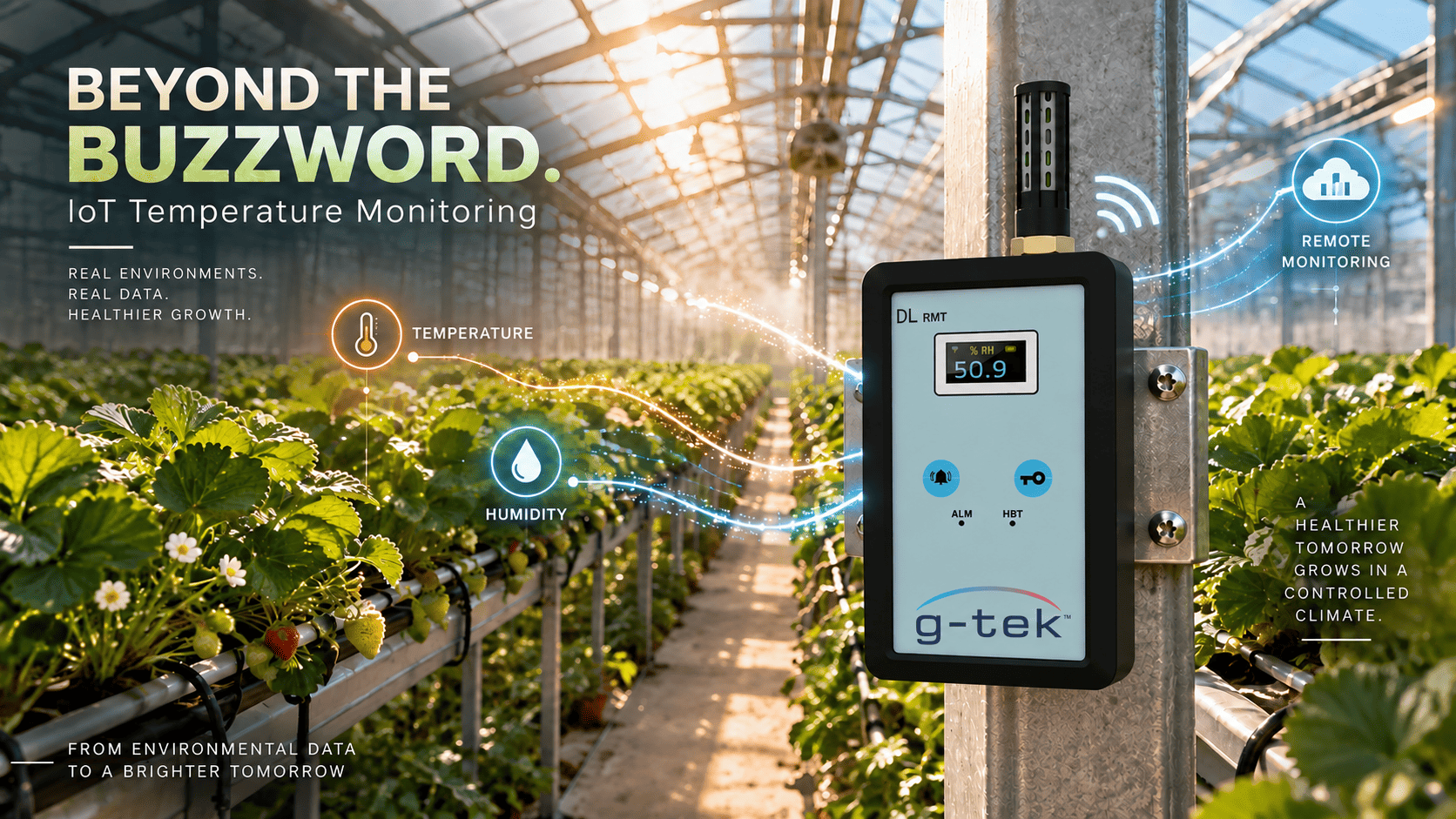
IoT temperature monitoring means a sensor-equipped device continuously sends its readings over the internet (via Wi-Fi or cellular) to a cloud dashboard you can open from anywhere. So you see conditions live and get alerted instantly, instead of downloading data later.
🎯 Key Takeaways
- IoT monitoring means a device sends readings over the internet to a cloud you can view anywhere
- It differs from a standard logger, which stores data to be downloaded and read later
- The core pieces: sensors, a connected device (Wi-Fi/cellular), a cloud dashboard, and alerts
- Its real value is live visibility and instant alerts, not just a record after the fact
- Onboard storage lets a good IoT device keep recording through network gaps
So what does “IoT temperature monitoring” actually mean?
IoT temperature monitoring means a device with sensors continuously transmits its readings over the internet (via Wi-Fi or cellular) to a cloud dashboard you can open from any phone or computer. So you see live conditions and receive instant alerts, rather than downloading data later.
Break it into pieces and the mystery disappears. A sensor measures the condition. Then a connected device transmits that reading over Wi-Fi or GSM. The internet carries it to a cloud dashboard. That dashboard lands on your phone with alerts. “Internet of Things” simply means the device is connected and talks to you. Standards like WHO Good Distribution Practice already point toward continuous monitoring of temperature-sensitive stock. This is how facilities meet that expectation in practice.
The real difference from a normal logger is when you find out
The key difference between IoT monitoring and a standard data logger is timing: a standard logger stores data you read later. An IoT device, however, tells you live and alerts you the moment something drifts. So you can act during the event, not after it.
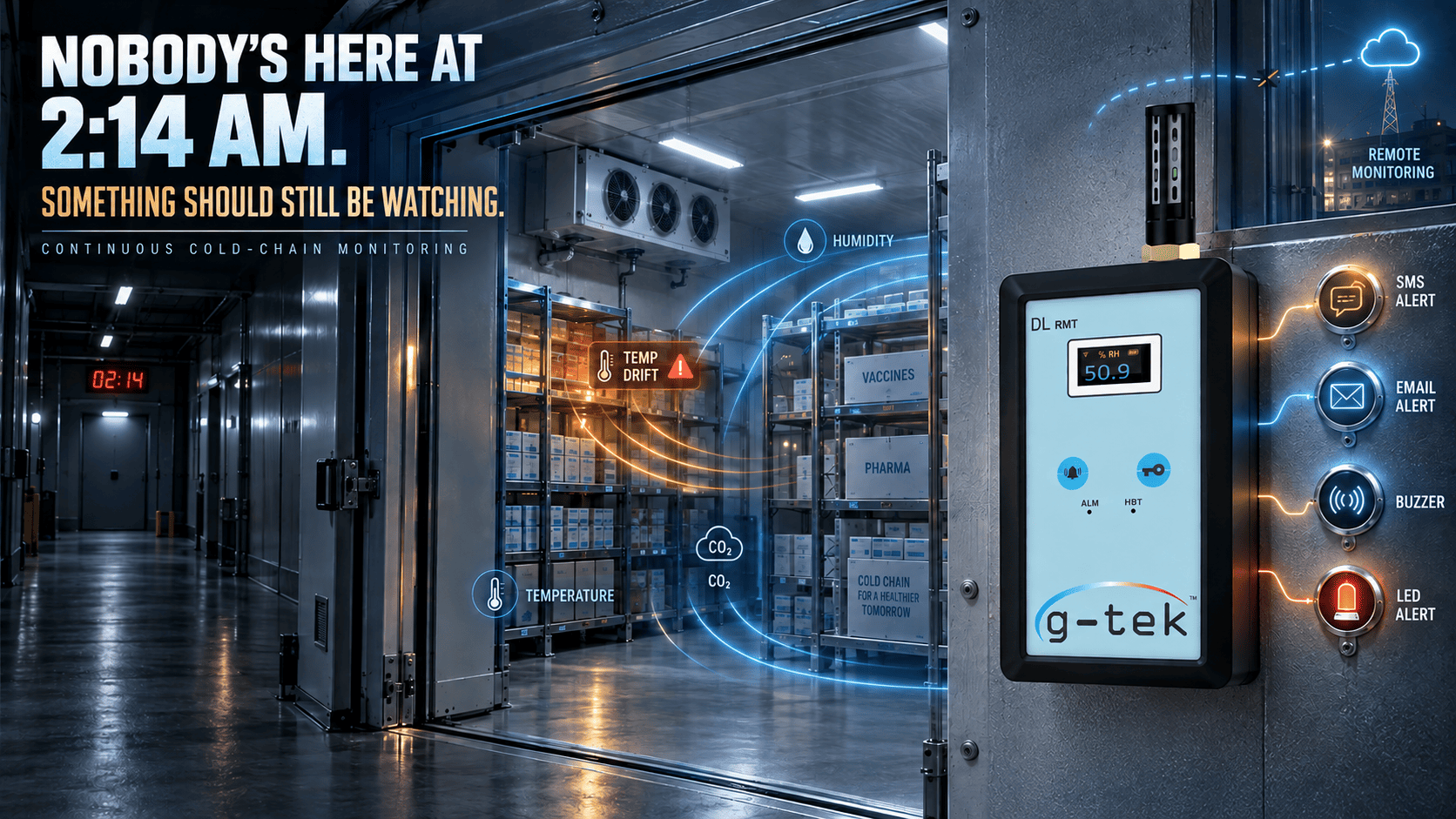
A normal logger is a record. IoT is a record plus live visibility plus alerting. Picture a freezer excursion at 2 a.m. A logger captures it faithfully, but you discover it the next morning, when the stock is already compromised. An IoT device, by contrast, wakes someone up. That gap between finding out later and finding out now is the whole point. The value was never the label. It’s the timing.
Judge IoT temperature monitoring by what it lets you do, not the label
Evaluate IoT monitoring by its practical benefits (live remote visibility, instant alerts, and a record that survives network gaps) rather than the buzzword. That way, you adopt it where those genuinely help and skip it where a simple logger is enough.
A real example makes the concept concrete. G-Tek Corporation, drawing on more than 30 years in Vadodara, built the DL-RMT as an IoT monitoring device. It continuously records temperature, humidity, and CO₂, and transmits to a cloud dashboard over Wi-Fi or cellular. It also sends instant alerts by SMS, email, buzzer, and LED. Meanwhile, onboard storage keeps recording through network gaps and uploads when the connection returns. In addition, every unit traces to G-Tek’s own NABL ISO/IEC 17025-accredited calibration laboratory. Where 21 CFR Part 11 applies, electronic records also carry the audit trail regulated facilities need. That’s IoT monitoring as a practical tool, not a buzzword.
Understand IoT Temperature Monitoring, Then Decide if It Fits
IoT monitoring earns its place where live visibility and instant alerts genuinely matter: remote sites, unattended rooms, critical stock. So understanding what it does is the first step to knowing if it’s right for you.
👉 Wondering if IoT temperature monitoring fits your facility? Share how you monitor today with the G-Tek team, and get a clear, honest view of whether an IoT device like the DL-RMT would help.
Frequently Asked Questions
What does IoT temperature monitoring mean?
A sensor-equipped device continuously sends readings over the internet to a cloud dashboard you view anywhere, giving live conditions and instant alerts instead of data downloaded later.
How is it different from a normal data logger?
A standard logger stores data you read later. An IoT device, however, transmits live and alerts you the moment a reading drifts. So you act during the event, not after.
What are the main parts of an IoT system?
Sensors that measure conditions, a connected device that transmits over Wi-Fi or cellular, a cloud dashboard, and an alert system, often with a mobile app.
What happens if the internet drops?
A well-designed device keeps recording to onboard storage during a gap and auto-uploads when the connection returns, so no readings are lost.
Where is G-Tek Corporation located?
G-Tek is based in Vadodara, Gujarat, manufacturing monitoring and IoT instruments for over 30 years, with an in-house NABL-accredited calibration laboratory and pan-India support.
Related Posts