By Asutosh Shah & Alpesh Shah · Founders, G-Tek Corporation 30+ years in temperature monitoring,…
Drawers Full of Charts, and Not One You Can Search: The Case for Going Paperless
By Asutosh Shah & Alpesh Shah · Founders, G-Tek Corporation 30+ years in temperature monitoring, recording, and calibration instrumentation.
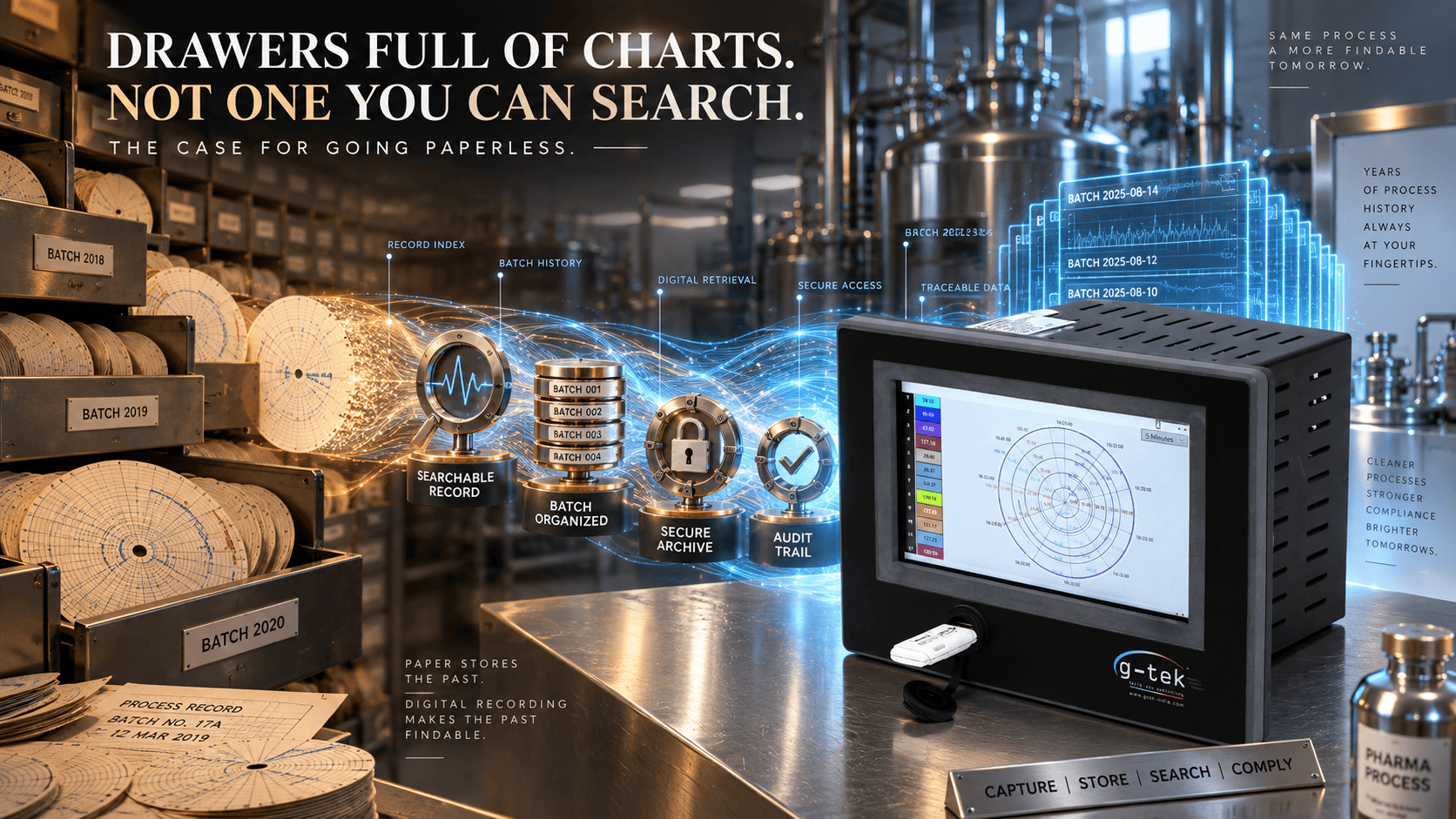
A single continuous process can generate a chart a day, every day: hundreds of paper charts a year, per instrument, stacking into drawers and cupboards that someone has to store, protect from fading, and somehow search when an auditor comes asking.
Now multiply that by every recorder in the plant. The paper isn’t just clutter. It’s a retrieval problem waiting to happen at the worst possible moment.
A paperless recorder captures process data digitally instead of on paper charts, so records are searchable, secure, batch-organized, and instantly retrievable, without the storage, fading, and filing problems of paper.
🎯 Key Takeaways
- Paper charts accumulate fast, take storage space, fade, and get misfiled
- Finding a specific past record in paper archives is slow, sometimes impossible
- A paperless recorder stores data digitally: searchable, secure, and instantly retrievable
- Digital records can be batch-organized and made tamper-evident for audits
- Going paperless removes a retrieval risk that surfaces exactly when an auditor asks
What does a paperless recorder actually change?
A paperless recorder replaces the paper chart with digital recording: the same continuous temperature and process data is stored electronically, so it can be searched, retrieved instantly, backed up, and organized by batch, instead of filed as physical discs.
The measurement job is identical. The record medium is not. A touchscreen shows live trends right at the machine, while the data is stored digitally and pushed to software. No pens to change, no paper to reorder, no discs quietly fading in a cupboard.
That single shift changes what happens eight months later, when someone needs one specific run.
The real cost of paper isn’t the paper, it’s the retrieval
The biggest hidden cost of paper charts is retrieval. When a specific batch’s record is needed for an audit or investigation, digging through physical archives is slow and error-prone, while a digital record is found in seconds.
Think about the archive itself. Storage space that keeps growing. Ink that fades. A disc filed under the wrong month. And then the audit-day scramble, hunting for the one chart that matters while the clock runs.
A digital, batch-organized, searchable archive turns that scramble into a non-issue. It also sits far better with data integrity and retention expectations. ALCOA+ asks for records that stay legible, original, and retrievable, and FDA 21 CFR Part 11 frames how electronic records and signatures should be handled. Paper struggles against both the moment it starts to fade.
For plants still scanning multiple points across a line, a Universal Scanner can bring several channels into one clear digital view.
Choose a recorder that makes records findable, not just captured
Choose a paperless recorder that organizes data by batch and integrates with software offering search, secure access, and an audit trail, so a record isn’t just captured, it’s instantly retrievable and defensible.
This is exactly what G-Tek Corporation built its Paperless Recorder to do, drawing on more than 30 years in Vadodara. It records multiple channels continuously with a clear touchscreen showing live trends at the machine, and organizes data batch-wise. It runs on GtekNet™, a 21 CFR Part 11 platform with an audit trail and secure access, so any batch’s record is retrievable in seconds. Every channel traces back to G-Tek’s own NABL ISO/IEC 17025-accredited calibration laboratory, keeping the digital record accurate as well as findable.
Before You Switch to Paperless: Verify These
- Channel count: enough inputs for all the parameters you record
- Batch organization: can it organize and retrieve records by batch or run?
- Software + compliance: 21 CFR Part 11, audit trail, secure access (via GtekNet™)
- Data security & backup: how records are protected and backed up
- Calibration: every channel NABL-traceable, so the digital record is defensible
Find Any Record in Seconds, Not Drawers
- If your paper charts are piling up, the risk isn’t storage. It’s the day you can’t find the one record that matters. Going paperless makes every batch’s record searchable, secure, and instantly there.
- 👉 Buried in paper charts? Share what you record and how you archive it with the G-Tek team, and get a clear recommendation on moving to a paperless, batch-organized system.
Frequently Asked Questions
What is a paperless recorder?
It captures continuous temperature and process data digitally instead of on paper charts, showing live trends on a touchscreen and storing records so they’re searchable and retrievable.
Are paperless records audit-ready?
Yes, when the software is compliant. G-Tek’s Paperless Recorder uses GtekNet™, a 21 CFR Part 11 platform with an audit trail, keeping records tamper-evident.
What does the G-Tek Paperless Recorder offer?
Multi-channel continuous recording, a touchscreen for live trends, batch-wise organization, GtekNet™ compliance, and NABL-traceable calibration.
Where is G-Tek Corporation located?
G-Tek is based in Vadodara, Gujarat, manufacturing recording and monitoring instruments for over 30 years, with an in-house NABL-accredited calibration laboratory.
Related Posts