By Asutosh Shah & Alpesh Shah · Founders, G-Tek Corporation · 30+ years in temperature…
“Traceable” Doesn’t Mean You Can Find the Certificate – It Means Something Much Stricter
By Asutosh Shah & Alpesh Shah · Founders, G-Tek Corporation · 30+ years in temperature monitoring, recording, and calibration instrumentation.
Most people hear traceable calibration and picture a certificate they can locate in a file. That is not it at all.
So, what is traceability in calibration?
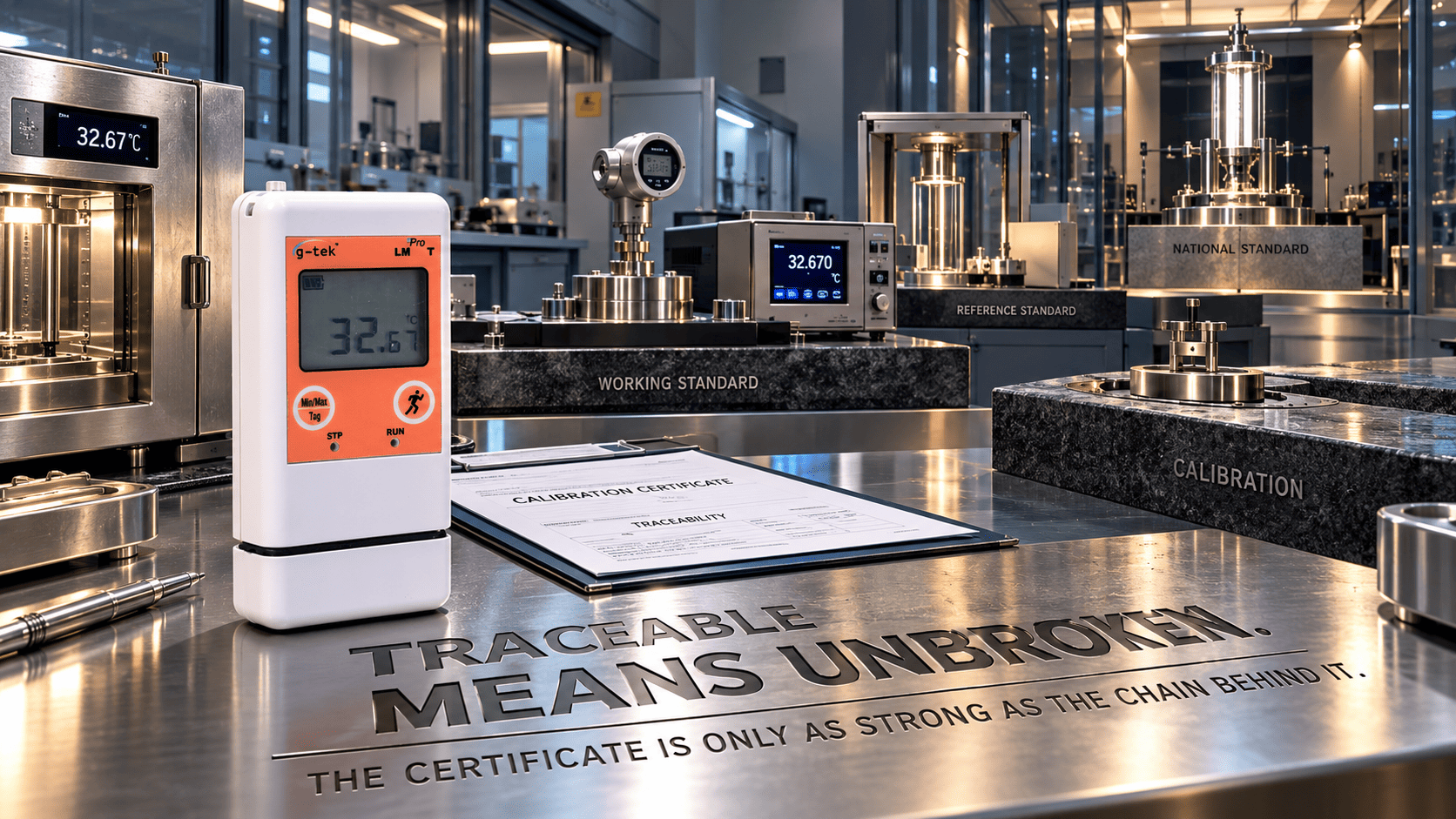
Traceability is not about finding the document. It is about an unbroken chain. Your instrument was checked against a reference, that reference against a better one, and the chain continues upward until it reaches a national standard. Each link also has its uncertainty recorded.
Break the chain anywhere, and the number at the bottom stops meaning anything.
You have probably lived this moment. The file is complete. The certificate is signed and current. Then the auditor asks where the reference standard itself was calibrated, and the room goes quiet.
Nothing was falsified. Something was simply never verified.
Key Takeaways
Traceability is an unbroken, documented chain from your instrument to a national standard.
Every link carries its own calibration and its own stated measurement uncertainty.
A certificate without traceability proves nothing against any recognised standard.
ISO/IEC 17025 accreditation, granted in India by NABL, proves a laboratory can provide that chain.
At audit, the question is not whether a certificate exists, but what it traces to.
What Is Traceability in Calibration?
Metrological traceability means a measurement result can be related to a national or international standard through an unbroken chain of documented calibrations. Each calibration also has its own stated uncertainty.
In practice, the hierarchy runs downward. The national standard sits at the top, held in India by NPL.
A higher-order reference is calibrated against it. Your laboratory’s working standard is calibrated against that reference, and your logger against the working standard.
Four links, four documents, four uncertainty figures.
Remove one, and the chain stops leading anywhere an auditor recognises.
An Unaccredited Certificate Is a Claim; an Accredited One Is Evidence
Any laboratory can issue a calibration certificate. However, only an accredited one has been independently assessed as competent to do so.
This is why an ISO/IEC 17025 certificate is treated as evidence, while an unaccredited one is treated as a claim.
Accreditation is not a logo.
In India, NABL assesses a laboratory’s methods, equipment, staff competence, and uncertainty calculations before granting accreditation.
It then defines a scope: which parameters the laboratory may calibrate and over which ranges.
A certificate issued outside that scope carries no accredited weight, even when the name on it is correct.
Check What the Certificate Is Traceable To, and Whether the Scope Covers You
Before accepting a calibration certificate, check three things:
That it states traceability to a national standard.
That it carries an accreditation with a certificate number.
That the accredited scope covers the parameter and range you measure.
These checks help establish what traceability in calibration means for your own instruments and records.
This is why G-Tek Corporation runs its own calibration laboratory instead of outsourcing it.
The laboratory is accredited by NABL to ISO/IEC 17025 under certificate number CC-4472. It is built on more than 30 years of instrument manufacturing in Vadodara.
Every data logger and circular chart recorder leaving the factory carries a certificate traceable through that chain, with the accredited scope stated.
When an auditor asks what the number traces to, the answer is documented rather than assumed.
This is the whole point of keeping calibration in-house.
Know What Your Certificate Is Standing On
A certificate is only as strong as the chain behind it.
Knowing what to check – traceability, accreditation, and scope — turns paper into evidence you can defend.
Understanding what traceability in calibration means also helps you verify whether your instruments’ certificates support the measurements being recorded.
Unsure whether your instruments’ certificates would hold up? Send the G-Tek team your equipment list and get a straight answer on traceability, scope, and what your records prove.
Frequently Asked Questions
What Does Traceable Calibration Mean?
The result connects to a national standard through an unbroken chain of documented calibrations. Each calibration also carries its own stated uncertainty.
Why Does an Auditor Ask What a Certificate Is Traceable To?
Because the certificate alone proves nothing. The auditor checks that the reference used was itself calibrated against a recognised standard.
What Is the Difference Between Accredited and Unaccredited Calibration?
An accredited laboratory has been independently assessed as competent under ISO/IEC 17025. An unaccredited certificate is a claim nobody has verified.
What Does NABL Accreditation Mean?
NABL assesses a laboratory’s methods, equipment, staff competence, and uncertainty calculations against ISO/IEC 17025.
It also defines the scope the laboratory may calibrate within.
Where Is G-Tek Corporation Located?
G-Tek Corporation is based in Vadodara, Gujarat, with an in-house NABL ISO/IEC 17025-accredited calibration laboratory and pan-India support.
Related Posts