By Asutosh Shah & Alpesh Shah · Founders, G-Tek Corporation 30+ years in temperature monitoring,…
Three Log Reductions or Nothing: Why Depyrogenation Tunnels Live and Die by Heat Penetration
By Asutosh Shah & Alpesh Shah
Founders, G-Tek Corporation Pvt. Ltd. 30+ years in temperature monitoring, recording, and calibration instrumentation.
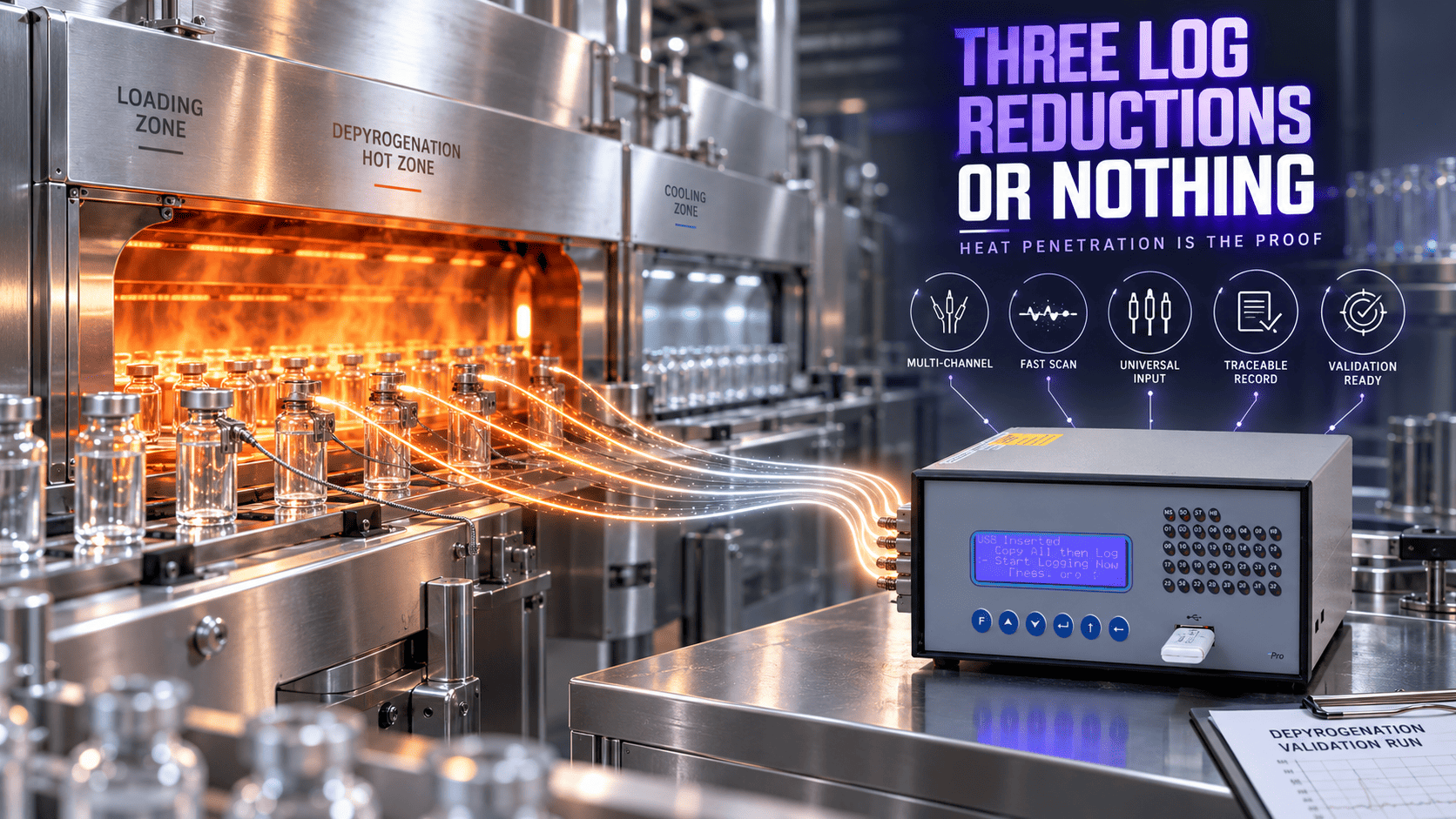
Three log reductions. A 99.9% destruction of bacterial endotoxin. That’s the number a depyrogenation tunnel exists to hit, and the whole proof of it lives in whether enough dry heat actually reached the glass.
Here’s the catch. The hot zone can sit at 300°C while a vial passing through never quite gets there. Endotoxin doesn’t care what the tunnel air read. It answers only to the heat that penetrated the container for long enough. Miss that, and a tunnel that looked flawless ships pyrogen risk downstream.
🎯 Key Takeaways
- A depyrogenation tunnel must achieve at least a 3-log (99.9%) reduction of bacterial endotoxin.
- Destruction depends on heat penetrating the vials, not just the hot-zone air.
- Dry-heat depyrogenation is driven by time and temperature at the container, measured as Fh.
- Recording temperature on the actual vials is what proves the process worked.
The hot-zone reading isn’t the process, the vial temperature is
In a depyrogenation tunnel, endotoxin destruction is driven by the heat that reaches the glass containers, not the hot-zone air, so proving the process means recording temperature on the vials as they pass through, for the time and temperature that achieve at least a 3-log endotoxin reduction.
Dry heat works on time plus temperature at the container. Hot zones typically run 250–350°C, cycles often benchmarked near 250°C, and each vial’s own exposure, expressed as Fh, inactivates endotoxin (z-value ≈ 46.4°C). A fast-moving or shadowed vial receives less than the air suggests. Under EU GMP Annex 1 and USP <1228>, dry heat is the recommended route, but the standard rests on what reached the glass, spelled out in the European Commission’s GMP guidance.
Now the part that keeps a QA head awake. The batch record shows 300°C, clean and on-target. Then the endotoxin challenge vials come back short of a full 3-log drop. Nothing in the air data explains it, because the failure never lived in the air. It lived in the vials nobody measured.
So how do you prove every vial got enough heat?
You prove it by placing temperature probes on and around representative vials in penetration and distribution positions and recording continuously, so the heat each container received is documented against the required time and temperature.
That means multiple thermocouples or RTDs on containers moving with the conveyor, captured across hot and cooling zones and read alongside endotoxin challenge vials, independent of the tunnel’s control sensor. It’s the same discipline G-Tek’s temperature data loggers apply to storage and transit, only with high-temperature probes on the glass.
This is precisely the problem G-Tek Corporation has solved for over 30 years from its base in Vadodara. The SC5x/SC9x Universal Scanner reads temperature from multiple thermocouples or RTDs on the vials as they move through the tunnel. It records continuously on GtekNet through the hot and cooling zones into a batch-traceable, 21 CFR Part 11 report. With 8, 16, 24, and up to 32 channels, it captures penetration and distribution positions in one run, every channel traceable to G-Tek’s in-house NABL ISO/IEC 17025-accredited calibration laboratory, so the record behind an endotoxin challenge holds up in qualification. See the instrument on the G-Tek Universal Scanner page.
Record the vials, not just the tunnel
Build the tunnel to record temperature on the containers themselves (multiple points, continuously, into a traceable report), so heat penetration is proven for every run, not assumed from the hot-zone reading. That one choice turns a tunnel from something a client hopes passes into something they can document.
Ship a Tunnel That Proves the Heat Reached the Glass
If your tunnels are specced by injectable manufacturers, heat-penetration proof is what protects every batch. A tunnel that documents the vials, not just the air, is one your client validates faster and orders again.
👉 Building your next depyrogenation tunnel? Walk the G-Tek team through your zones and conveyor layout, and get a clear recommendation on recording heat penetration into the vials from the start.
Frequently Asked Questions
What is a depyrogenation tunnel used for?
It uses dry heat to inactivate bacterial endotoxins on glass containers before aseptic filling, achieving at least a 3-log reduction as vials move through a high-temperature hot zone.
Why isn’t the hot-zone temperature enough?
Destruction depends on the heat reaching each vial, for enough time. The air can read on-target while a container receives less, so vial temperature must be recorded directly.
How is heat penetration validated?
By placing probes on representative vials in penetration and distribution positions, recording continuously, and running endotoxin challenge vials to confirm the required Fh at the container.
Which G-Tek product records tunnel temperatures?
The SC5x/SC9x Universal Scanner records from multiple thermocouples or RTDs on the vials via GtekNet, continuously and batch-traceable, with NABL-traceable calibration.
Where is G-Tek Corporation located?
G-Tek is in Vadodara, Gujarat, manufacturing monitoring and recording instruments for over 30 years, with an in-house NABL ISO/IEC 17025-accredited lab.
Related Posts