By Asutosh Shah & Alpesh Shah · Founders, G-Tek Corporation 30+ years in temperature monitoring,…
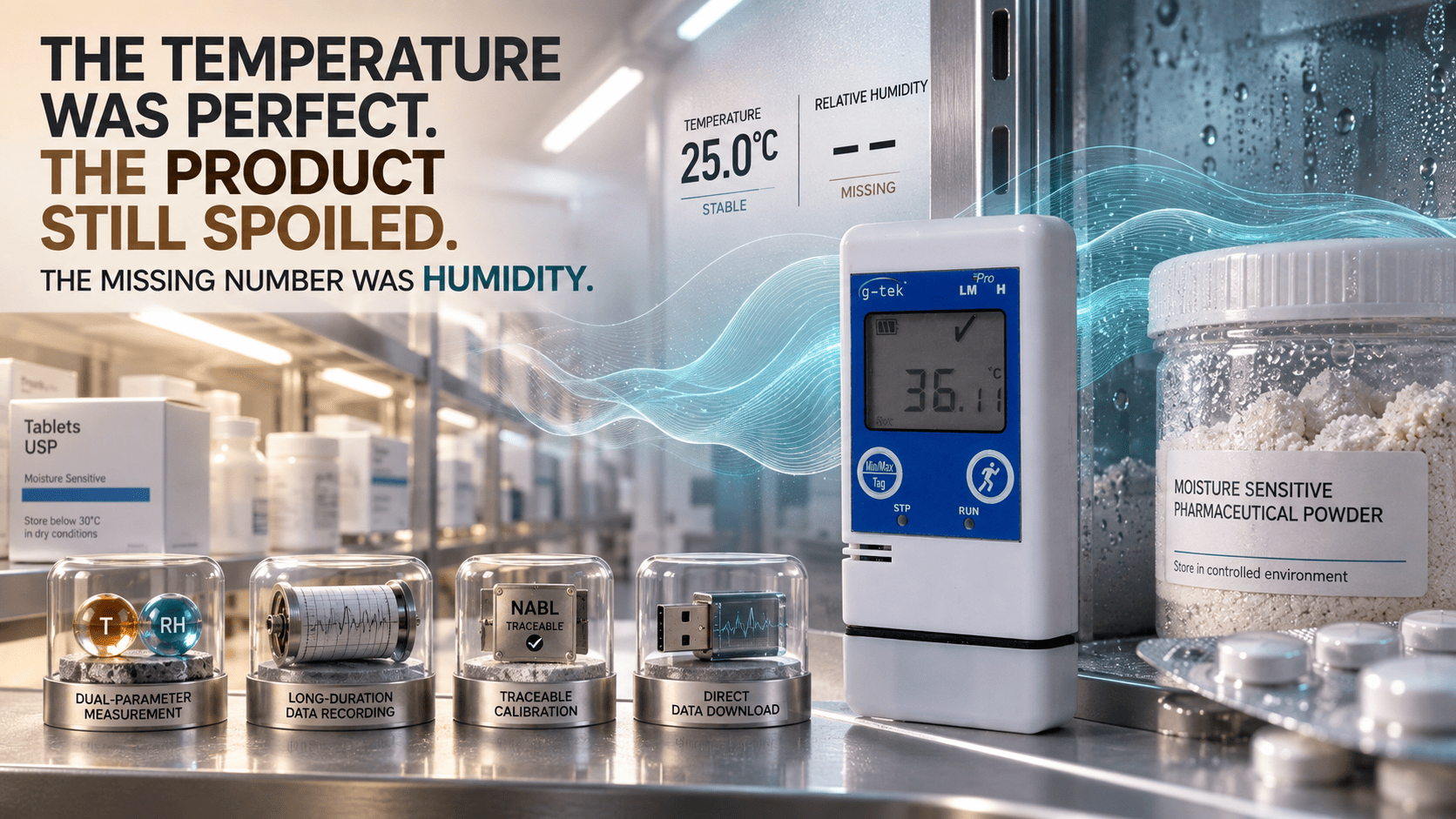
The Temperature Was Perfect. The Product Still Spoiled. The Missing Number Was Humidity
By Asutosh Shah & Alpesh Shah · Founders, G-Tek Corporation 30+ years in temperature monitoring, recording, and calibration instrumentation.
The temperature log was flawless. Every reading in range, start to finish. And the product was still ruined. It happens more often than you’d think with moisture-sensitive products.
It catches people out constantly, because temperature gets all the attention while the parameter that actually spoiled the batch goes unwatched: humidity. Tablets pull moisture from damp air and cake. Powders clump. Biologicals degrade. Labels curl and electronics corrode. None of it shows up in a temperature record because temperature was never the problem.
For moisture-sensitive products, temperature and humidity must be monitored together. A product can stay perfectly within its temperature range and still be ruined by humidity that drifted out of range unrecorded.
🎯 Key Takeaways
- Many products are damaged by humidity even when the temperature is perfectly in range
- High humidity causes caking, mold, corrosion, and degradation; low humidity causes static and cracking
- Temperature-only monitoring misses moisture problems entirely
- Recording temperature and humidity together, in one device, catches both
- A logger with an NABL-traceable certificate and a 21 CFR Part 11 version keeps the record audit-ready
If the temperature was fine, how did humidity ruin the product?
Humidity can ruin a product independently of temperature: moisture-sensitive materials absorb water from damp air and degrade, cake, or grow mold even at the correct temperature, so a temperature-only record can’t explain or prevent the loss.
Relative humidity drives moisture uptake, microbial growth, static, and stability, failure modes that sit entirely outside what a thermometer sees. This is why global storage rules pair the two: ICH and WHO stability conditions specify temperature and RH together (25°C/60% RH is a familiar one), and ICH stability guidelines treat humidity as a defined test condition, not a footnote. Many pharma, food, and electronics products carry an RH spec as strict as their temperature spec.
Two parameters, one device beats two separate instruments
Recording temperature and humidity in a single logger is simpler and more complete than running two instruments. One device captures both parameters against the same timeline, so the full environmental picture sits in one record.
One device. One calibration. One download. Both readings on the same time axis makes cause-and-effect obvious: a humidity spike at a known hour lines up against everything else that happened. Fewer instruments to manage, and nothing falls through the gap between them. Under GMP storage and USP <1079>, that single, unified record is exactly what an auditor wants to see.
Record the humidity moisture-sensitive products actually care about
Choose a logger that records humidity accurately across your product’s critical range, with a traceable calibration certificate, so the RH record is both accurate and defensible, not just an approximate reading.
This is the everyday problem G-Tek Corporation built the LM Pro H to solve, drawing on more than 30 years in Vadodara. It measures temperature from –20°C to +60°C and humidity across 0–100% RH in one portable, reusable temperature and humidity data logger, with highest accuracy between +5°C and +60°C and 20–80% RH, and a clear LCD showing current, minimum, maximum, and alarm status. Every unit ships with an individual NABL ISO/IEC 17025-traceable calibration certificate, and a 21 CFR Part 11-compliant version is available where records must survive audit. Data downloads through LmView as PDF, Excel, or CSV. For multi-point wired setups, the Universal Scanner extends the same discipline across a facility.
An approximate humidity reading isn’t a defensible record. A traceable one is.
Watch the Parameter Your Temperature Log Can’t See
If your product is moisture-sensitive, a temperature record only tells half the story. Recording humidity alongside it, accurately and traceably, is what protects the batch temperature alone can’t.
👉 Storing moisture-sensitive products? Share your temperature and humidity limits with the G-Tek team and get a clear recommendation on monitoring both together with the LM Pro H.
Frequently Asked Questions
Why monitor humidity if the temperature is controlled?
Because humidity damages many moisture-sensitive products independently of temperature, causing caking, mold, or degradation even at the correct temperature. A temperature-only record can’t detect moisture-driven spoilage.
What range does the LM Pro H cover?
Temperature –20°C to +60°C and humidity 0–100% RH, with highest accuracy between +5°C and +60°C and 20–80% RH, suited to cold storage, ambient, and controlled environments.
Is one device for both parameters better?
Yes. One logger captures temperature and humidity on the same timeline, with a single calibration and download: simpler and more complete than two separate instruments.
Is the LM Pro H suitable for regulated environments?
Yes. It ships with an individual NABL-traceable certificate, and a 21 CFR Part 11-compliant version is available, with LmView export to PDF, Excel, or CSV.
Where is G-Tek Corporation located?
G-Tek Corporation is based in Vadodara, Gujarat, manufacturing monitoring instruments for over 30 years, with an in-house NABL-accredited calibration laboratory.
Related Posts