By Asutosh Shah & Alpesh Shah · Founders, G-Tek Corporation 30+ years in temperature monitoring,…
You Can’t Open the Pipe to Check It. So How Do You Prove SIP Actually Sterilized?
By Asutosh Shah & Alpesh Shah · Founders, G-Tek Corporation 30+ years in temperature monitoring, recording, and calibration instrumentation.
With most sterilization, you can at least see the load. With Steam-in-Place (SIP) sterilization, you can’t, and that’s the entire point. SIP sterilizes a sealed system of tanks, pipes, and valves without taking it apart, so nothing is ever opened up to inspect. Which raises an uncomfortable question: if you can’t look inside, how do you actually know every surface got sterile?
The honest answer is that you don’t, unless you recorded the temperature where sterilization is hardest to achieve.
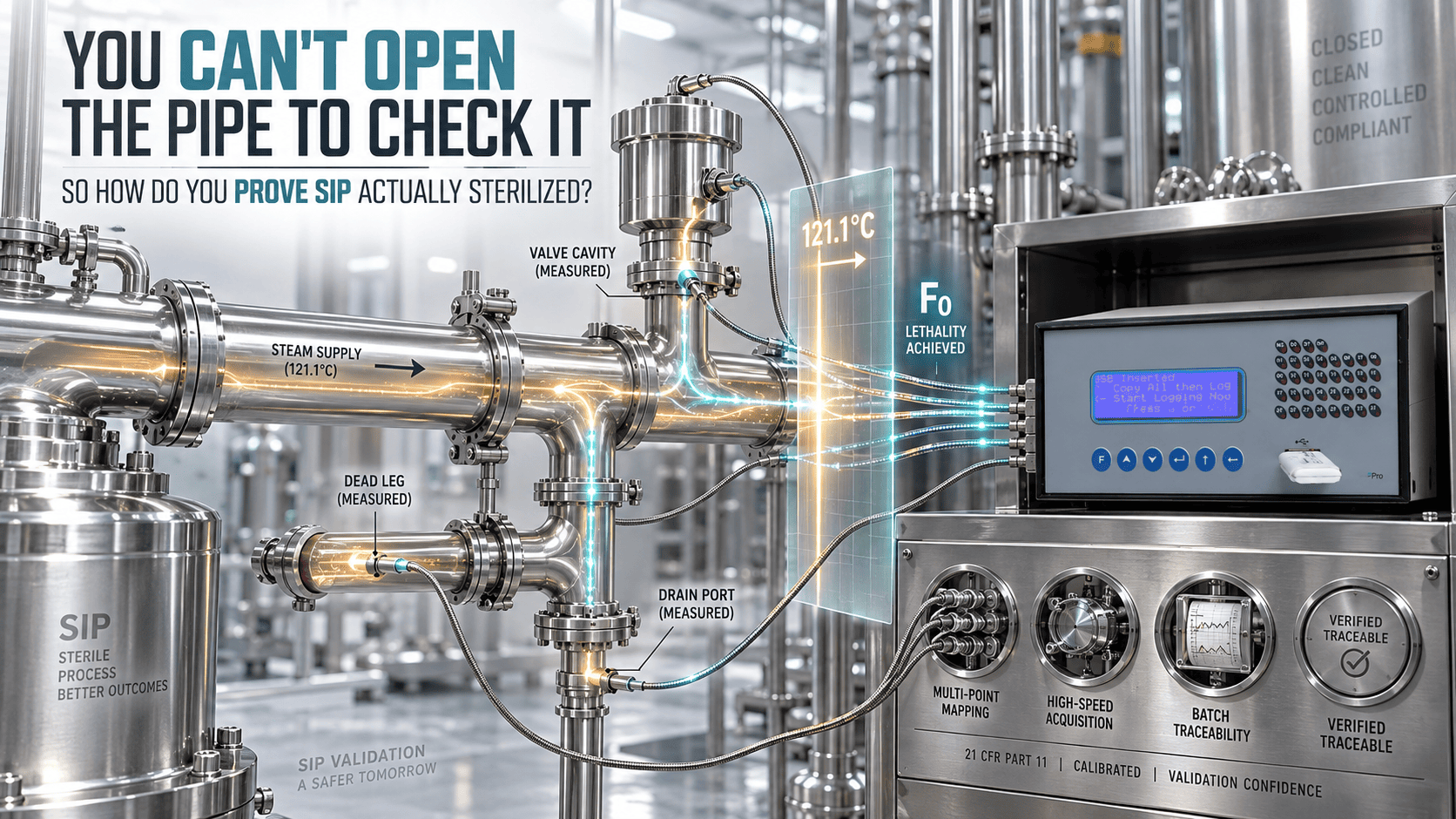
SIP is proven by recording temperature at the coldest, hardest-to-sterilize points of the closed system (dead legs, valve cavities, drain ports) and confirming each reached and held at least 121.1°C long enough to achieve the required F0 (typically ≥15 minutes).
🎯 Key Takeaways
- SIP sterilizes a sealed system in place: it’s never opened, so it can’t be visually checked
- Sterility must be proven at the hardest-to-reach cold spots: dead legs, valve cavities, drain ports
- Trapped air or condensate can leave a spot cooler than the steam header reads
- Each mapped point must reach ≥121.1°C and hold long enough for the required F0 (often ≥15 min)
- OEMs who design in thermocouple mapping ports ship SIP systems that validate faster
The steam header temperature isn’t the SIP result, the cold spot is
In an SIP sterilization cycle, sterility is decided at the coldest, hardest-to-sterilize point of the closed system, not at the steam header, because trapped air or condensate in a dead leg or valve cavity can sit cooler than the main steam, even when the header reads 121°C.
Steam displaces air axially, and it moves fast down an open run. But it reaches pipe walls, branch arms, and dead legs far slower. Residual air left behind acts as an insulator, shadowing that pocket from full steam contact. So the header reading overstates what a hidden cavity actually received. F0 has to be met there, in the worst spot, not in the pipe where steam flowed freely. Under ISO 17665 and EN 285, moist-heat sterility rests on that worst-case logic.
How do you prove a sealed system reached sterility everywhere?
You prove it by mapping temperature with thermocouples placed at the worst-case points (dead legs, valve cavities, drain ports), recording continuously and confirming each achieved the required F0 at 121.1°C, alongside biological indicators.
In practice, that means 8 to 15 thermocouples at the shadowed locations, recording without a break through equilibration, hold, and cooling. F0 is then integrated point by point, so each cavity carries its own lethality record. Biological indicators using G. stearothermophilus confirm the outcome across three consecutive runs. Crucially, this record is independent of the system’s own control sensor. It measures where the equipment can’t, satisfying EU GMP Annex 15 and cGMP under 21 CFR Part 211.
Recording temperature accurately at many points at once is exactly what G-Tek Corporation has built its instruments for across more than 30 years in Vadodara. The SC5x/SC9x Universal Scanner reads thermocouples placed at the cold spots, dead legs, and valve cavities of an SIP system. It records continuously on GtekNet™ through equilibration, hold, and cooling, into a batch-traceable, 21 CFR Part 11 report from which F0 is calculated at every mapped point. With 8 to 32 channels, one system covers the worst-case map in a single run. Every channel traces back to G-Tek’s own NABL ISO/IEC 17025-accredited calibration laboratory, so the sterility record holds up under Annex 15 and ISO 17665 scrutiny.
Design the mapping points in: don’t retrofit them later
Build validation ports and thermocouple access into the SIP system from the design stage, so temperature can be recorded at every worst-case point, because mapping designed in is far easier to validate than access forced in afterward.
An SIP skid built to ASME BPE (dead-space-free, steam-compatible, with mapping ports already placed) is one your clients can qualify quickly and repeatably. The header runs the cycle. The dead leg decides sterility. Ship the system that lets them prove it.
Frequently Asked Questions
What is Steam-in-Place (SIP) sterilization?
SIP uses saturated steam to sterilize a sealed system (tanks, pipes, valves, bioreactors) in place, without disassembly. It follows cleaning-in-place and is essential for aseptic and biologics manufacturing.
Why isn’t the steam header temperature enough to prove SIP sterilization?
Because trapped air or condensate in dead legs can stay cooler than the main steam. Sterility must be proven at these coldest points; the header can read on-target while a cavity lagged.
How is SIP sterilization validated?
By mapping temperature with thermocouples at worst-case points, recording continuously, confirming each achieved the required F0 at 121.1°C, and verifying with biological indicators over consecutive runs.
Which G-Tek product records SIP validation temperatures?
The G-Tek SC5x/SC9x Universal Scanner records thermocouples at SIP cold spots on GtekNet™, continuously and batch-traceable, calculating F0 per point with NABL-traceable calibration.
Where is G-Tek Corporation located?
G-Tek Corporation is based in Vadodara, Gujarat, manufacturing monitoring and recording instruments for over 30 years, with an in-house NABL ISO/IEC 17025-accredited calibration laboratory.
Related Posts