A tyre plant's process engineer pulls a batch flagged for inconsistent cure and walks to…
Batch-Wise Recording: Why Batch 142 Passed the Floor but Not the Audit
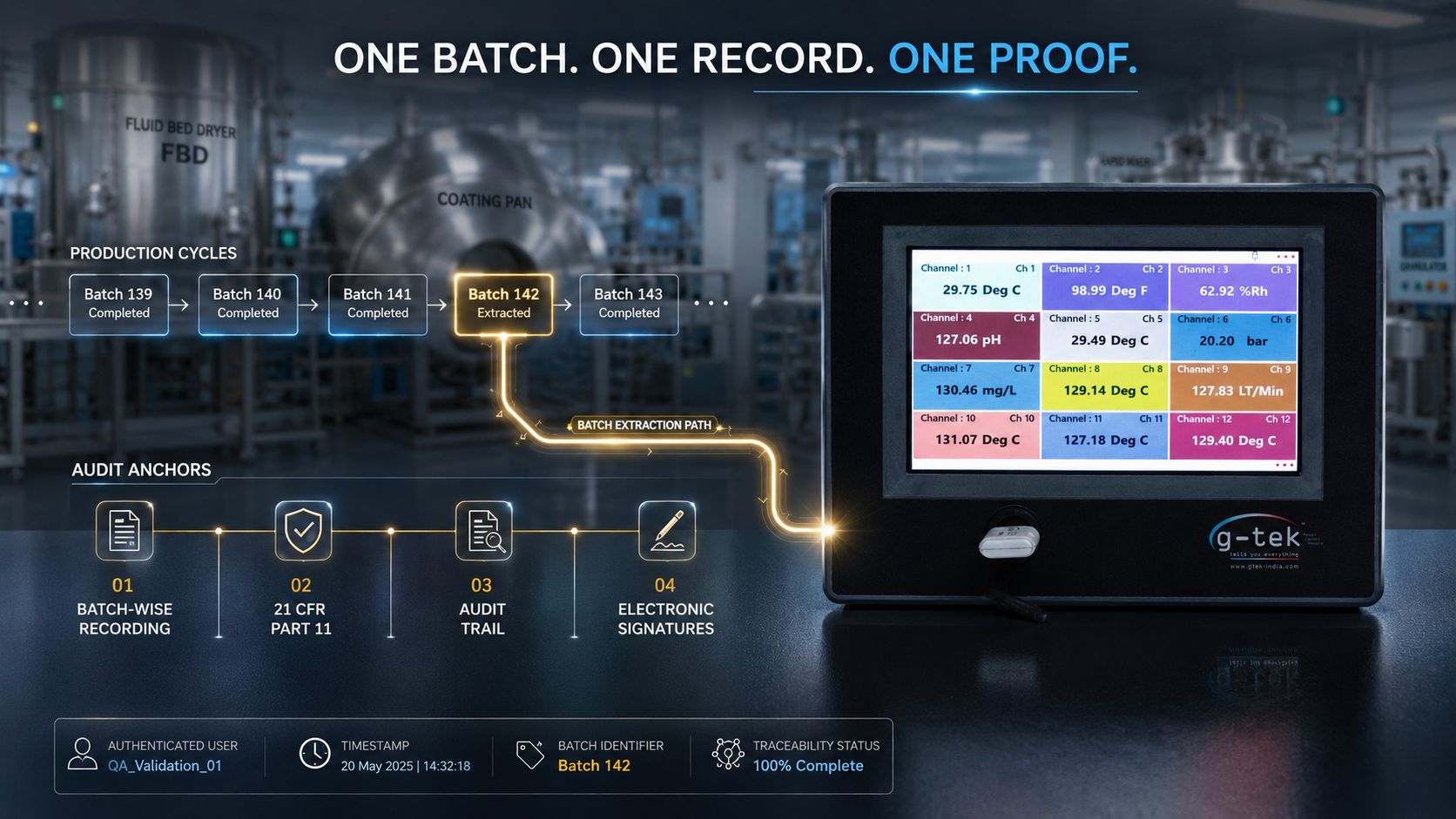
The batch ran perfectly. The operator signed off, the coating cycle hit every set point, the tablets looked exactly right. Batch 142 was a clean pass on the floor.
Weeks later, a GMP auditor asks one thing: show me batch 142’s exact drying profile.
The machine offers only one long, continuous daily log the whole shift’s controller data, with no clean way to isolate that single batch.
The batch passed in production. It fails in the audit room.
In 2026, solid-dosage equipment is judged not by whether it ran the batch, but by whether it can prove that batch on its own. GMP auditors expect each coating, drying, and granulation cycle tagged to its batch through proper batch-wise recording not a daily log someone slices apart by hand.
🎯 Key Takeaways
- Solid-dosage runs in batches, so the process record must be tagged batch-by-batch, not by the day
- Auditors expect any single batch’s trend produced on demand
- A continuous PLC log records the process but doesn’t independently tag each batch
- Batch-wise records need a tamper-evident 21 CFR Part 11 audit trail to hold up
- OEMs who build in batch-tagged recording ship machines pharma buyers qualify faster
What Makes Batch-Wise Recording Audit-Ready for Coating and Granulation?
A record is audit-ready only when each batch’s process data is tagged to that specific batch not buried inside a daily log someone slices apart to find one run.
Solid-dosage runs in discrete batches. Each carries its own Batch Manufacturing Record, and the process trend behind it temperature, time, the drying profile must attach to that batch number and stay retrievable on demand. On a fluid bed dryer, inlet and outlet air temperature drive the drying endpoint; on a coating machine, product bed and inlet air temperature shape the cycle; on a rapid mixer granulator, the process is tracked straight through granulation. If that data can’t be pulled batch-wise, the record isn’t finished. This is exactly where a dedicated paperless recorder built for process monitoring earns its place beside the machine.
Why Isn’t the Machine’s PLC Log Enough for a Solid-Dosage Audit?
A PLC log isn’t enough because it records the process continuously but doesn’t independently tag each batch with a tamper-evident audit trail exactly what an auditor checks for.
The PLC runs the machine and logs the shift. That’s its job. But it isn’t an independent, batch-tagged, ALCOA+ record. The FDA’s 21 CFR Part 11 and EU GMP Annex 11 both expect a separate record that attributes data to a specific batch and an authenticated user, with every action time-stamped. India’s revised Schedule M now carries the same data-integrity weight. The PLC ran the batch it can’t also be the unbiased, batch-tagged witness to it.
One Machine Runs the Batch. G-Tek’s Paperless Recorder Proves It.
G-Tek’s Paperless Recorder makes every batch traceable by tagging each coating, drying, and granulation cycle batch-by-batch on gtekNet™, with a full 21 CFR Part 11 audit trail.
Building recording instruments in Vadodara since 1990, G-Tek Corporation designs the Paperless Recorder to sit beside a coating pan, fluid bed dryer, or rapid mixer granulator and record its process independently then gtekNet™ tags each run to its batch, so any cycle can be pulled up on its own with the operator, the timestamps, and the audit trail intact. Every channel stays traceable to G-Tek’s own NABL ISO/IEC 17025-accredited calibration laboratory. For multi-point thermal mapping on larger machines, the same integrity carries through the G-Tek universal temperature scanner. It turns a machine that simply ran the batch into one that can prove it the traceability teams at Dr. Reddy’s, Alembic, Intas, and Biocon already expect on the equipment they buy.
Ship a Machine That Proves the Batch, Not Just Runs It
If your coating, FBD, or RMG machines are being specced by pharma plants facing GMP and USFDA audits, batch-level traceability is what decides acceptance. A machine that can produce any single batch on demand is a machine that qualifies faster.
👉 Tell the G-Tek team your equipment and the process points you record and get a clear recommendation on building batch traceability in before your next build. contact us
Frequently Asked Questions
Why do solid-dosage machines need batch-wise recording?
Because GMP requires each batch’s process trend tagged to that batch so any single batch can be produced on demand, not sliced out of a daily log.
Isn't the machine's PLC log enough for an audit?
No. It records continuously but doesn’t tag each batch with a tamper-evident audit trail, which 21 CFR Part 11 and ALCOA+ both require.
What parameters matter on FBD and coating machines?
On a fluid bed dryer, inlet and outlet air temperature; on a coating machine, product bed and inlet air temperature all tagged batch-by-batch.
Which G-Tek product gives OEMs batch traceability?
The G-Tek Paperless Recorder with gtekNet™ tags each cycle batch-by-batch, with a 21 CFR Part 11 audit trail and NABL-traceable channels.
Where is G-Tek Corporation located?
In Vadodara, Gujarat making recording instruments since 1990, with an in-house NABL ISO/IEC 17025 calibration laboratory and pan-India support.
Related Posts