She's new to the floor. Every shift, she walks past the circular chart recorder on…
Blood Bank Circular Chart Recorder: Why Paper Charts Still Matter in a Digital Age
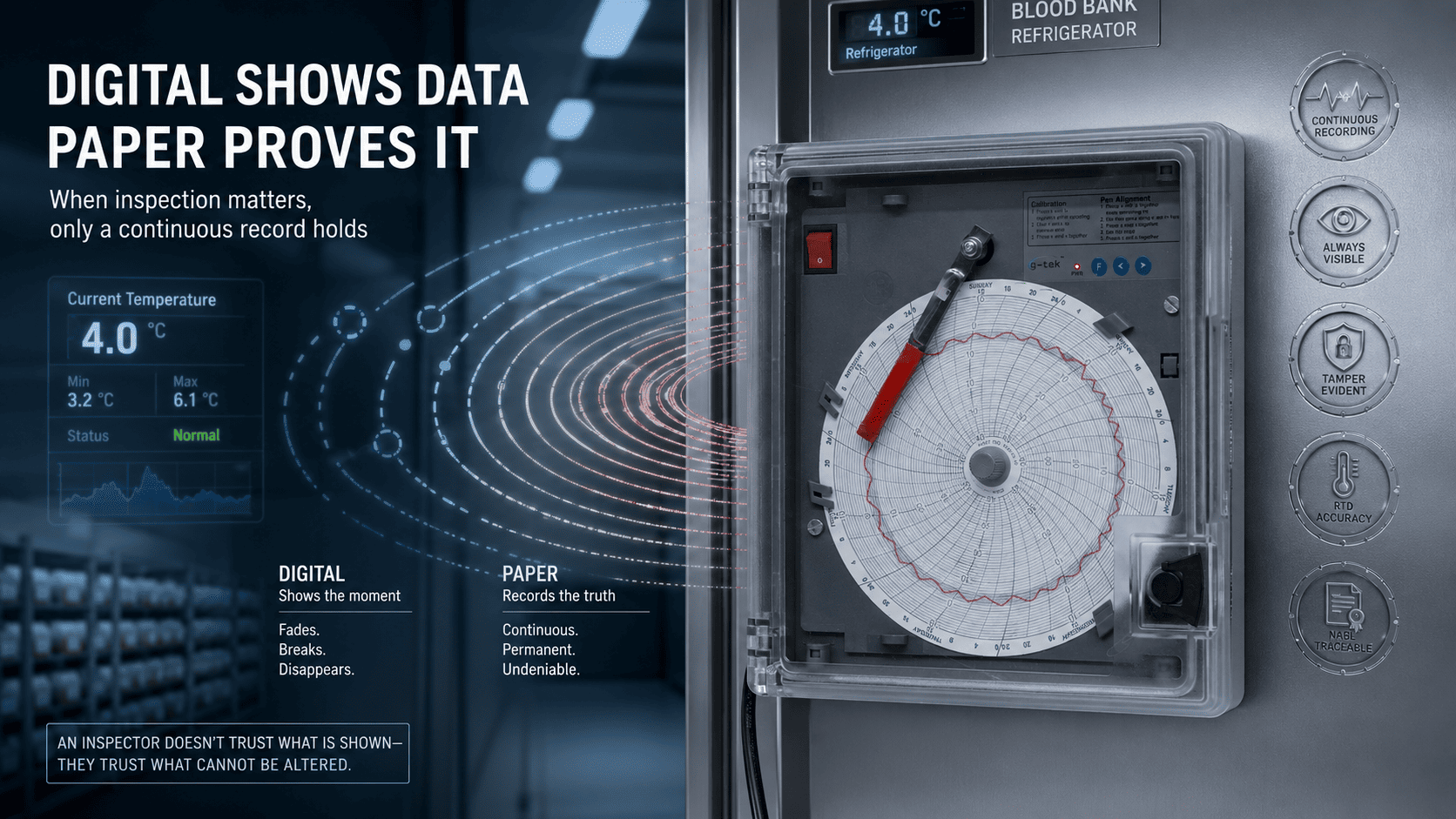
Blood banks still lean on circular chart recorders not because they’re old-fashioned, but because a physical, continuously drawn chart is tamper-evident, always visible at the unit, and needs no computer to be read or trusted.
For blood storage, that combination is exactly what an inspection wants to see. That’s why a blood bank circular chart recorder continues to play an important role even as more monitoring systems become digital.
🎯 Key Takeaways
- A circular chart recorder draws a continuous physical trace that’s hard to quietly alter.
- The chart stays visible at the refrigerator and is readable instantly, with no computer needed.
- Blood-storage inspections have long treated the physical chart as tamper-evident
- The right chart size — 4″, 5″, or 6″ — depends on the unit and available panel space.
- A physical chart and digital monitoring aren’t rivals; many blood banks use both.
Picture the scene. A blood bank in-charge proudly shows an inspector the new digital display on a refrigerator — clean, modern, exact. The inspector nods. Then asks the question that hasn’t changed in decades:
“And the chart record?”
Everything else in the facility went digital. Yet the humble circular paper chart remains an important record in blood-bank temperature monitoring. There’s a solid reason why.
You’ve felt this tension. You upgraded a unit, assumed the readout was enough, then discovered the continuous physical chart was still expected.
It’s an uncomfortable gap to find mid-audit, not because your intent was wrong, but because blood-storage norms rely on evidence that cannot be quietly edited after the fact.
Why Do Blood Banks Still Use Circular Chart Recorders?
Blood banks still use circular chart recorders because a continuously drawn paper chart is tamper-evident, always visible at the unit, and readable without a computer exactly the qualities a blood-storage inspection values.
Blood components are life-critical and heavily regulated. Inspectors need a record that’s obviously continuous and difficult to alter.
A physical chart delivers that at a glance, right on the fridge no login or file needed between the inspector and the evidence. The trace either shows an unbroken storage band, or it doesn’t.
That expectation is echoed across accreditation frameworks like NABH and WHO blood cold-chain guidance, where continuous temperature evidence sits at the centre of a compliant blood-storage setup.
What Should a Blood Bank Look for When Choosing a Chart Recorder?
A blood bank should look for the right chart size for the unit, an accurate RTD sensor, a maintenance-free pen, and NABL-traceable calibration. Together, these features make the record practical to maintain and credible during inspection.
Match the chart size — 4″, 5″, or 6″ — to the refrigerator and available panel space.
Choose a pressure or maintenance-free pen so the trace does not run dry mid-record. Insist on traceable calibration because that’s what makes the chart defensible when someone examines it.
Also confirm whether the unit needs one parameter recorded or two.
Here’s where it clicks. The gap was never in going digital. It was in dropping the tamper-evident physical record the storage norms were built around.
Many blood banks pair a blood bank circular chart recorder with a continuous digital data logger, keeping the physical trace while adding a live digital monitoring layer.
The G-Tek Chart That Answers Before the Inspector Asks
Manufacturing recording instruments in Vadodara for over 30 years, G-Tek Corporation makes a full range of circular chart recorders for blood banks.
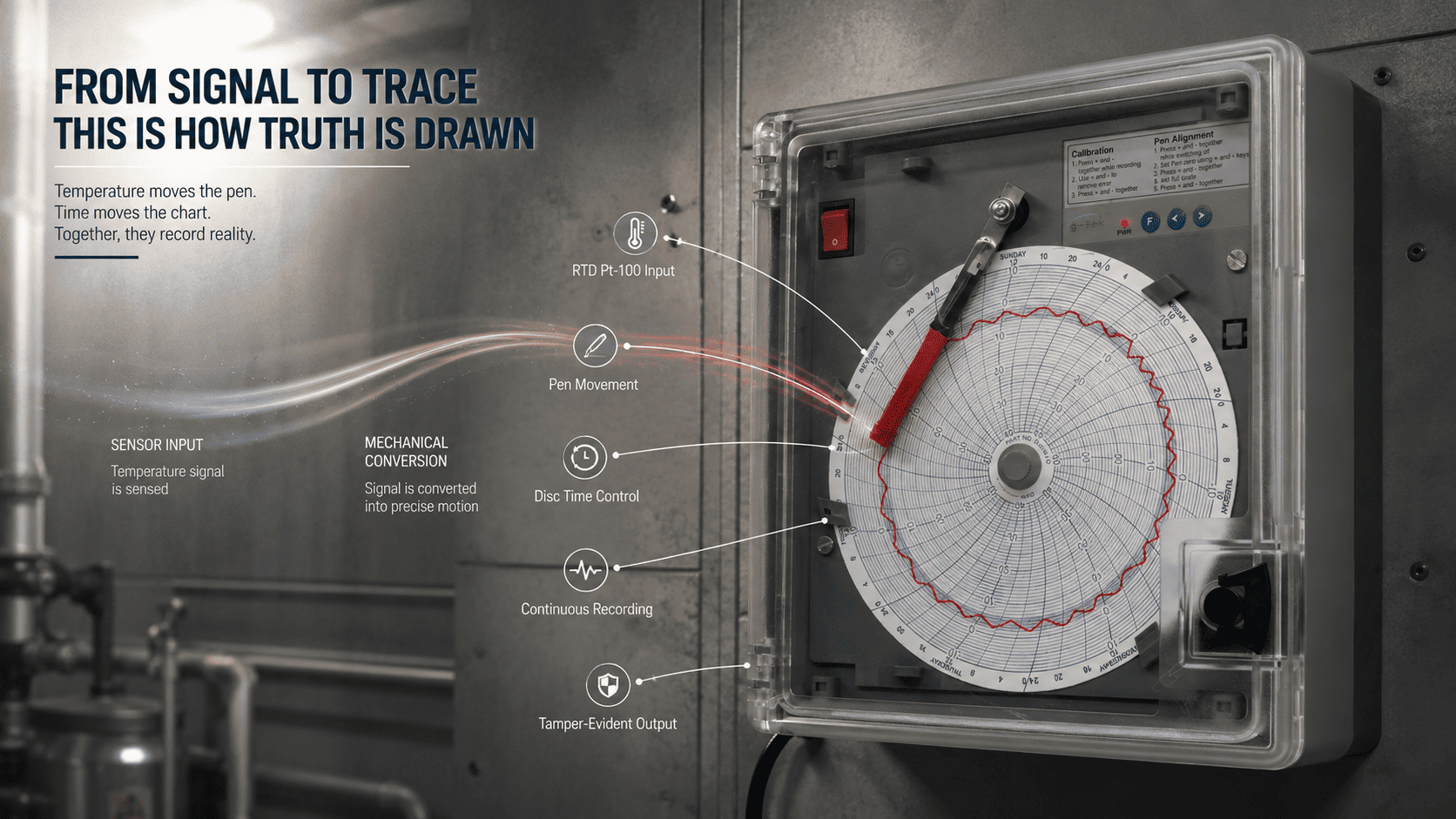
The range includes compact 4-inch and 5-inch models for smaller units and 6-inch models for larger refrigerators. Each uses an accurate RTD (Pt-100) sensor and a maintenance-free pen to support reliable, continuous recording.
Every recorder is traceable to G-Tek’s own NABL ISO/IEC 17025-accredited calibration laboratory, helping ensure the chart has the measurement traceability required when an inspector examines it.
Whether a blood bank wants the physical chart alone or alongside digital monitoring, it remains a tamper-evident record that blood-storage facilities have relied on for years.
Keep the Record Your Inspection Trusts
If your blood bank depends on its refrigerators passing inspection, the physical chart remains an important part of temperature documentation, provided it is the right size, accurately sensed, and traceably calibrated through an accredited calibration lab.
A properly selected blood bank circular chart recorder provides an immediate and continuous temperature record directly at the refrigerator.
👉 Choosing or replacing a chart recorder? Share your refrigerator type and the parameters you record with the G-Tek team and get a clear recommendation on the right recorder for your unit.
Frequently Asked Questions
Why do blood banks still use paper chart recorders?
Because a continuously drawn paper chart is tamper-evident, always visible at the refrigerator, and readable without a computer. It provides a clear physical record of temperature over time.
Is a digital display enough for a blood bank refrigerator?
A digital display shows the current temperature, but it does not always provide the same continuous physical record. Many blood banks use a chart recorder alongside digital monitoring for added assurance.
How do I choose the right chart recorder size?
Match the chart size — 4″, 5″, or 6″ — to the refrigerator and available panel space. Also confirm the sensor type, pen type, and number of parameters you need recorded.
Which G-Tek chart recorder suits a blood bank?
G-Tek offers 4″, 5″, and 6″ blood bank circular chart recorder options with RTD sensing, maintenance-free pens, and NABL-traceable calibration to suit different refrigerator sizes and monitoring needs.
Related Posts