She spread every monitoring device from her vaccine programme across one desk. Storage fridge. Shipping…
Nine Thermocouples, One Verdict – How a CQI-9 Temperature Uniformity Survey Passes or Fails in 2026
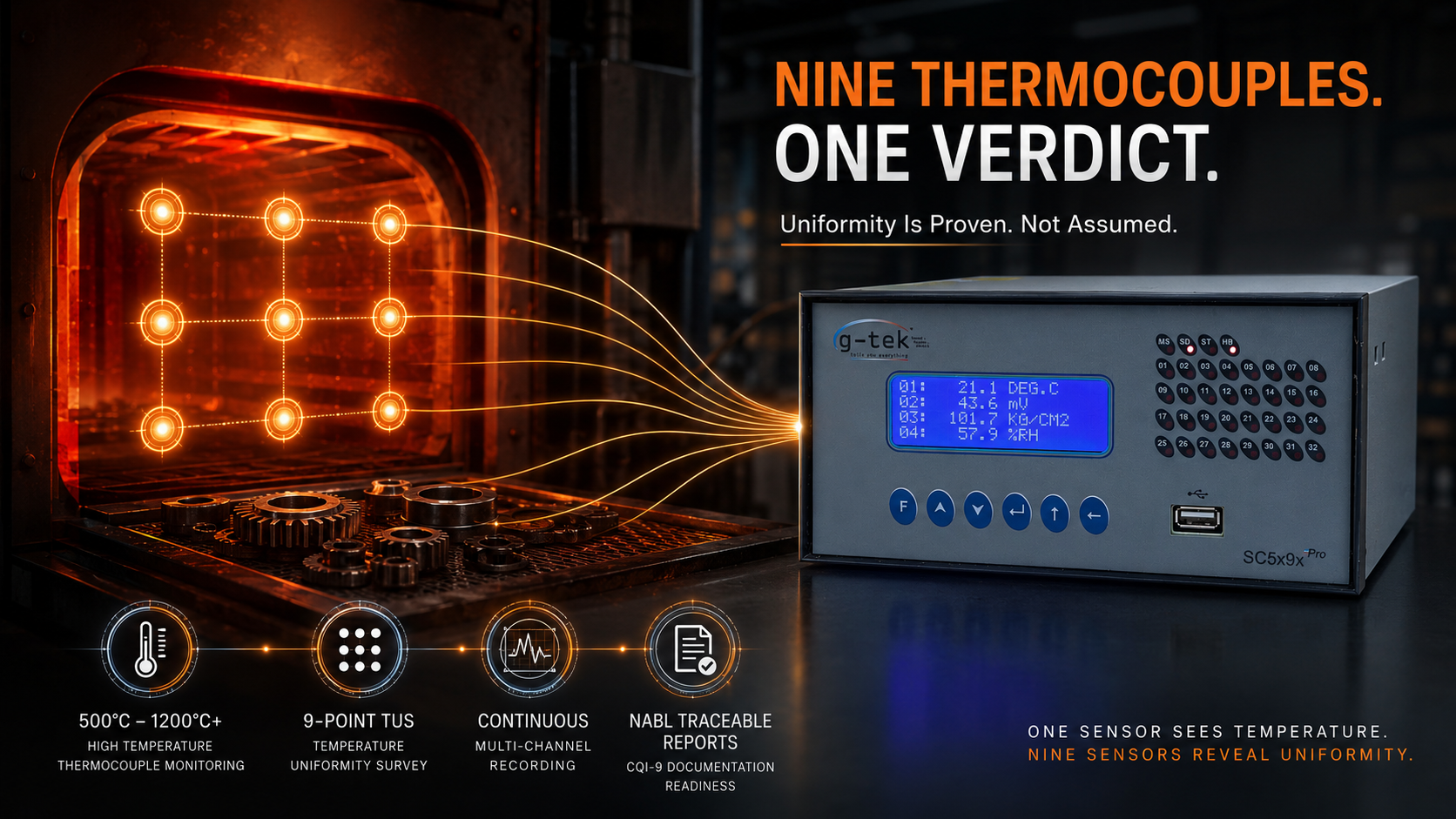
The controller shows the target temperature. The operator signs off. The parts go in. Weeks later, a CQI-9 auditor sets thermocouples through the work zone – and the back corners are drifting outside tolerance. The furnace passed on one sensor. It failed on nine.
In 2026, a heat treatment furnace is judged not by its control thermocouple, but by what nine survey thermocouples read across the work zone. CQI-9 and AMS 2750 demand proven temperature uniformity at every point through a documented temperature uniformity survey – and a furnace that records only its control sensor cannot produce that proof.
If you build furnaces, you know the sting: your machine ran clean on every gauge – then the survey failed, and the client points at you.
🎯 Key Takeaways
- CQI-9 judges a furnace on work-zone uniformity, not the control thermocouple alone.
- A Temperature Uniformity Survey (TUS) records multiple thermocouples placed through the work zone together.
- A furnace can hit set point on one sensor while corners drift out of tolerance, unseen.
- AMS 2750 defines the pyrometry and survey requirements behind CQI-9.
- OEMs who build in multi-thermocouple recording ship furnaces clients qualify on the first survey.
Why Does a Furnace Pass on Its Controller but Fail the Survey?
The control thermocouple sits at one location, driving the heating. It can read dead-on while convection, loading, and element placement leave the work-zone corners hotter or colder. Your client’s survey reads the whole zone – not that one point. The gap was never in the controller – it was in everything one sensor could not record across multiple points at once.
What Does a CQI-9 Temperature Uniformity Survey Actually Require?
A TUS places a set number of thermocouples – typically nine for a standard work zone, more for larger furnaces – at corners and centre, recorded continuously through the soak, never spot-checked. AMS 2750 sets the pyrometry rules behind it, including the SAT that separately verifies the control system’s accuracy – the checks AIAG built CQI-9 around. Heat-treat zones run from a few hundred degrees past 1200°C – thermocouple sensing, not PT-100 or humidity probes.
What G-Tek Does That a Single Sensor Never Could
Building monitoring and recording instruments in Vadodara since 1990, G-Tek Corporation makes the SC5x/SC9x Universal Scanner to read every thermocouple through the work zone at once – corners, centre, and load – and record them continuously on gtekNet, compiling each run into a downloadable, audit-ready survey report. At one Indian heat-treatment facility, that multi-point view showed the real story: the controller read on target, yet thermocouples placed across the zone revealed a genuine corner-to-corner spread a single sensor would never have shown. Because every channel is traceable to G-Tek’s own NABL ISO/IEC 17025-accredited calibration laboratory, heat-treaters can put that survey data straight into their CQI-9 documentation with the traceability assessors expect – a point clients have specifically valued. For OEMs, it turns a machine that only controlled temperature into one that proves uniformity.
👉 Bring the G-Tek team your furnace work-zone layout and see how the Scanner builds survey-ready, NABL-traceable recording into every unit you ship.
Ship a Furnace That Passes the Survey, Not Just the Set Point
If your furnaces are being specced by automotive heat-treaters facing CQI-9, the survey is where the order is won or lost. A furnace that proves work-zone uniformity is a furnace that qualifies.
Frequently Asked Questions
What is a Temperature Uniformity Survey (TUS)?
A TUS records multiple thermocouples placed across the work zone, proving the whole zone holds tolerance – not just the control point.
Why does a furnace pass on its controller but fail a CQI-9 survey?
The control thermocouple reads one spot. Convection, loading and element placement leave corners hotter or colder — a spread only a multi-point survey reveals.
How many thermocouples does a CQI-9 TUS need?
A standard work zone typically uses nine, at corners and centre, with more for larger furnaces, recorded continuously through the soak per AMS 2750.
Which G-Tek product records a furnace TUS?
The SC5x/SC9x Universal Scanner reads every survey thermocouple on gtekNet, producing a continuous, NABL-traceable report for CQI-9 documentation.
Where is G-Tek Corporation located?
G-Tek is based in Vadodara, Gujarat, building monitoring and recording instruments since 1990, with an in-house NABL ISO/IEC 17025 calibration laboratory and pan-India support.
Related Posts