A validation lead sits at her desk, quotes spread across the screen, and picks the…
Stability Chamber Monitoring: Why OEMs Are Switching to Probe-Based Multi-Channel Systems in 2026
You engineered it perfectly. Welded seams, calibrated controller, a chamber that holds 40°C and 75% RH without flinching. The pharma client loads an accelerated batch. three months in, the humidity numbers start sliding, exposing a stability chamber monitoring gap the sensor was supposed to closel. The sensor measuring it did. And the OEM gets the call.
In 2026, pharma buyers are no longer accepting stability chambers monitored by body-mounted sensors that drift under sustained high humidity. They want probe-based, independent, multi-point monitoring that holds accuracy at 90% RH and proves uniformity per ICH Q1A(R2) on every shelf.
You know the feeling. The chamber passed every internal check. Then the client’s QA team asks the one question the control sensor can’t answer alone: can you prove every shelf held condition, independently? Suddenly a finished chamber sits in acceptance limbo, and a silent sensor drift threatens an entire stability study. Months of work. One drifting sensor. The blame lands on the builder not the sensor.
🎯 Key Takeaways
- Stability chambers run sustained 75–90% RH — conditions where body-mounted humidity sensors drift or fail
- ICH Q1A(R2) demands proven uniformity across the chamber, not a single control-sensor reading
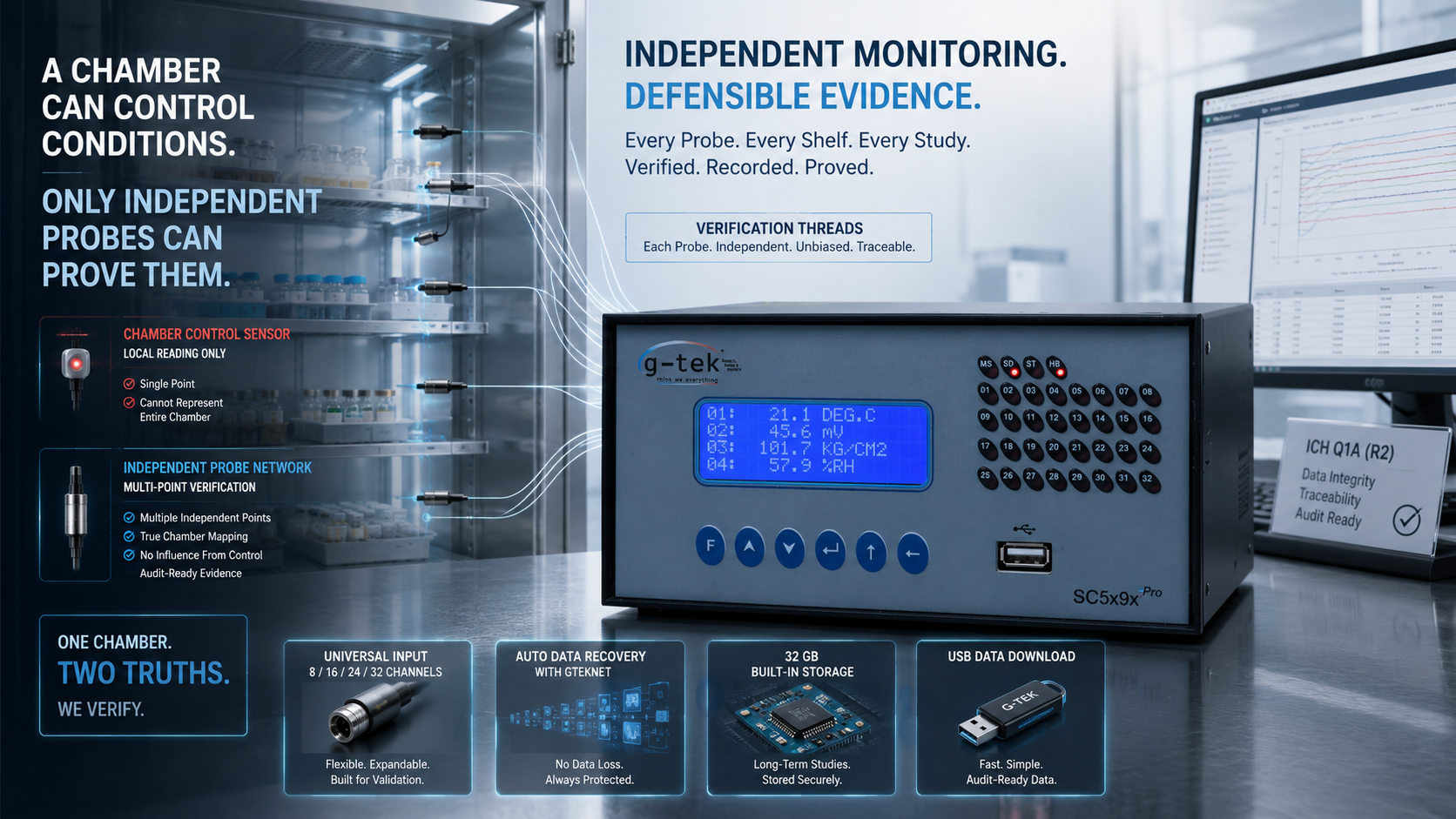
- A chamber’s own control sensor cannot be its own proof — auditors want an independent record
- Probe-based multi-channel monitoring keeps electronics protected and readings accurate for years
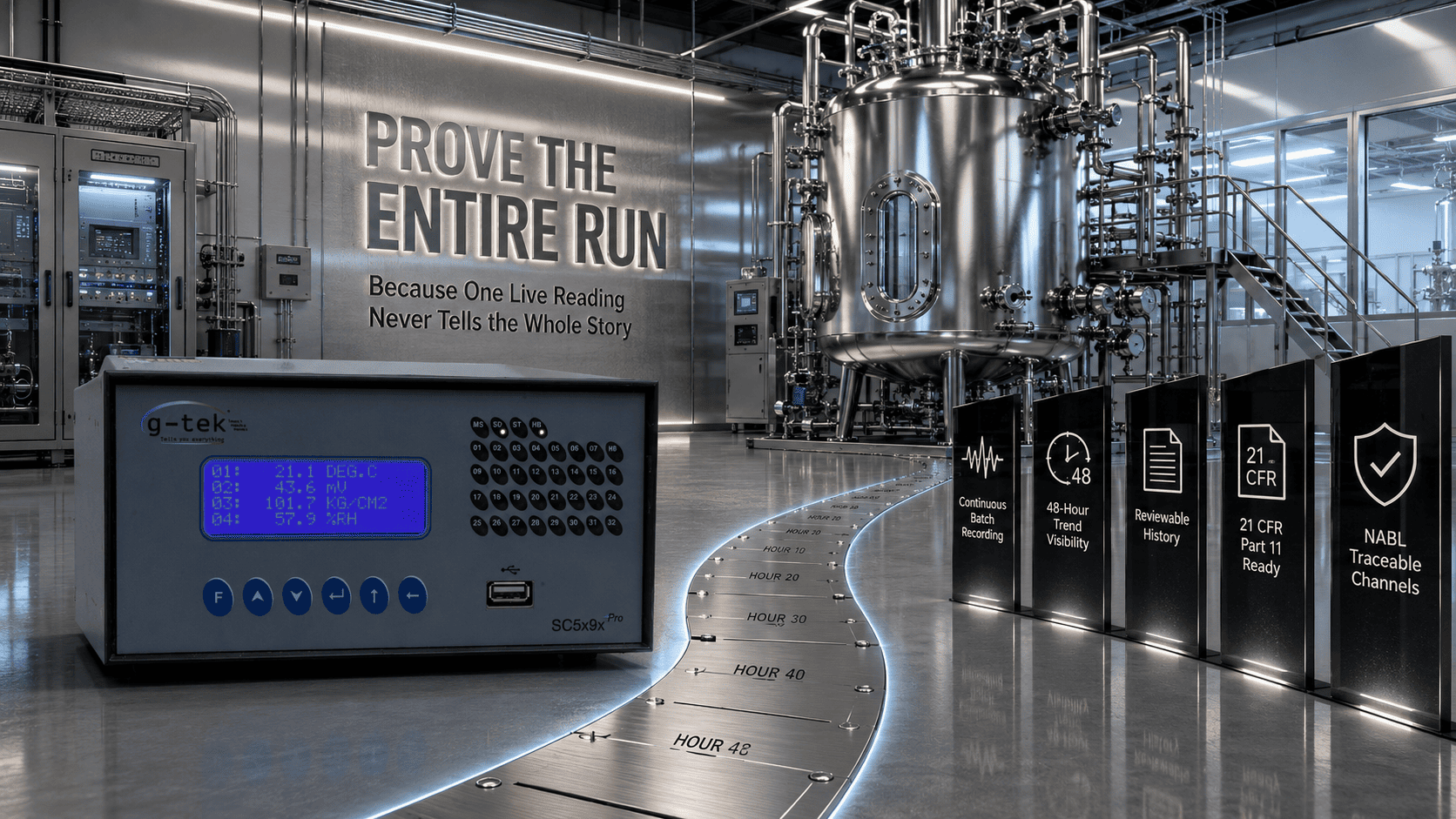
- gtekNet adds batch-wise tracking and a 21 CFR Part 11 audit trail for continuous stability studies
Why Do Body-Mounted Humidity Sensors Drift Inside Stability Chambers?
A body-mounted sensor places its electronics directly in the environment it measures. Hold that air at 75% RH for weeks — push toward 90% RH for high-humidity accelerated studies — and condensation and saturation set in. Response slows. Readings drift. The unit accurate at install is no longer telling the truth six months later. A probe-based design isolates the sensing electronics from the saturated zone, so accuracy holds across the long multi-week runs an accelerated study actually demands.
What Does ICH Q1A(R2) Actually Require for Stability Chamber Monitoring?
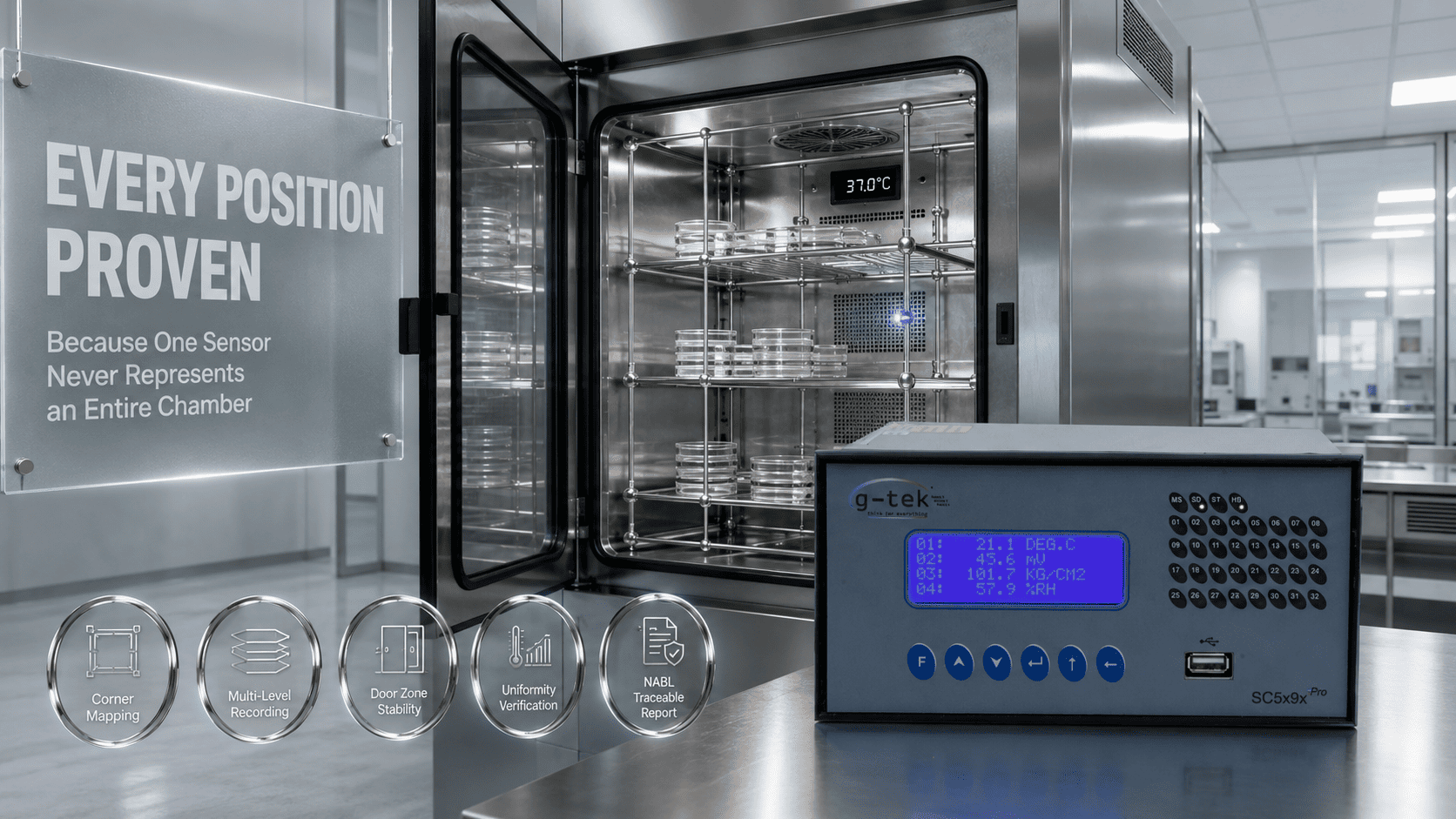
ICH Q1A(R2) expects proof of uniformity across the whole chamber — every shelf, within ± 2°C and ± 5% RH — not one number from the controller. And there is a deeper point auditors care about: the control sensor also runs the heating and humidification, so it cannot be the unbiased witness to its own work. Independent, continuous multi-point recording is what survives the inspection. WHO TRS 1010 Annex 9 reinforces the same expectation.
How G-Tek’s Scanner Solves the Stability Chamber Monitoring Gap
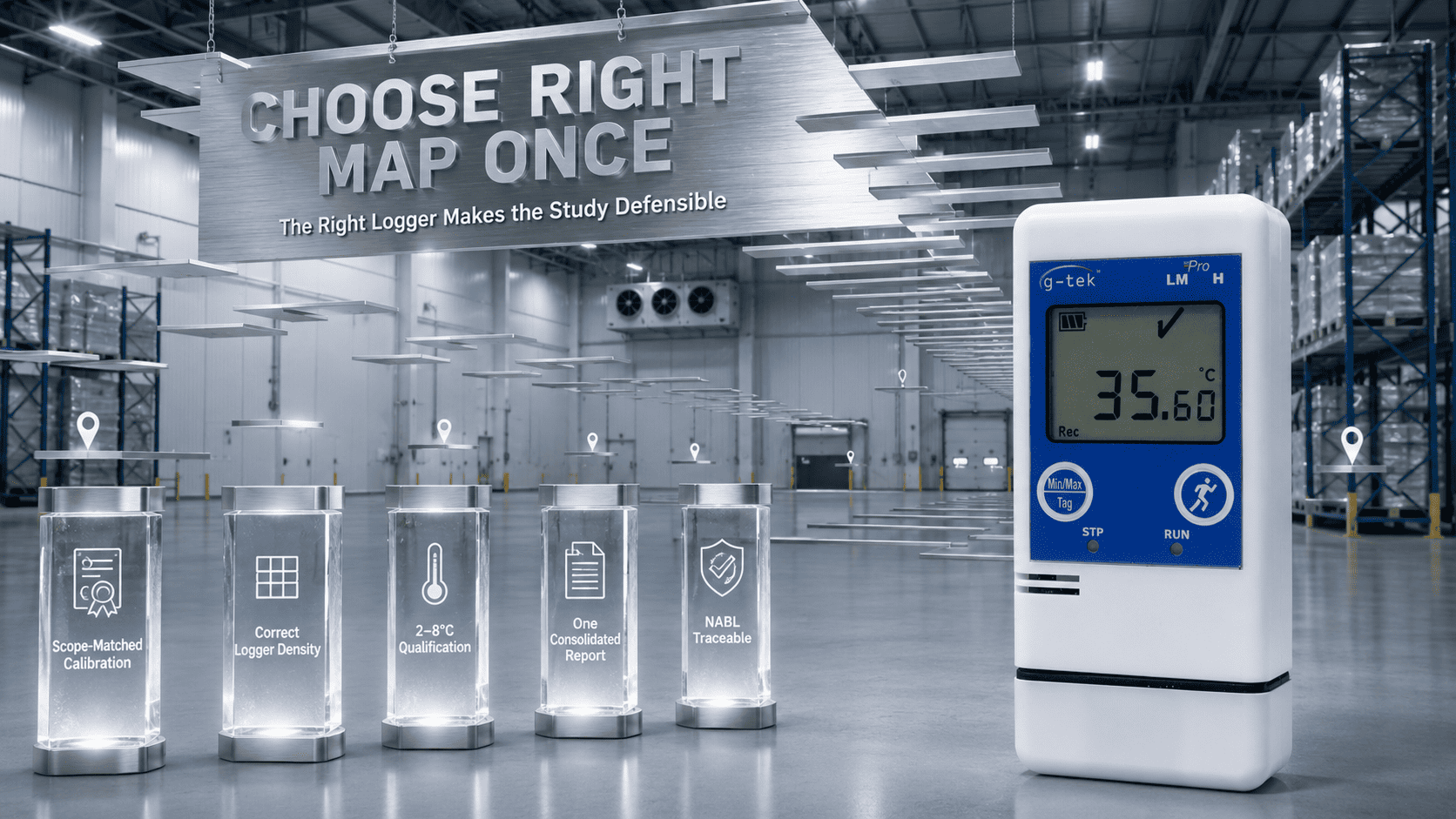
Building monitoring instruments from Vadodara since 1990, G-Tek Corporation engineers the SC5x/SC9x multi-channel Scanner around remote probes — keeping the sensing electronics out of the saturated air that makes body-mounted units drift. Every Scanner is calibrated in G-Tek’s own NABL ISO/IEC 17025-accredited laboratory and runs on gtekNet, the client-server platform bringing batch-wise tracking and a 21 CFR Part 11 audit trail to continuous stability studies. Where a chamber needs periodic mapping instead, the portable LM Pro T and LM Pro H loggers feed LmView into one consolidated uniformity report. It’s the same engineering pharma names like Dr. Reddy’s, Biocon, Cipla, and Aurobindo already trust.
Building the Chamber Pharma Auditors Trust on Day One
If your chambers are being specced by pharma QA teams preparing for ICH and USFDA audits, the monitoring layer decides acceptance. A control sensor records the chamber. An independent probe-based system proves it.
👉 Get the G-Tek team to walk your engineering team through SC5x/SC9x probe placement and gtekNet integration before your next chamber build.
Frequently Asked Questions
What temperature and humidity does a pharma stability chamber maintain?
Per ICH Q1A(R2), typically 25°C/60% RH long-term, 30°C/65% RH intermediate, and 40°C/75% RH accelerated, with some high-humidity studies reaching 90% RH.
Why do body-mounted humidity sensors fail inside stability chambers?
Sustained high-RH exposure makes them drift, respond slowly, or fail over time, because the sensing electronics sit directly in the saturated environment they are meant to measure.
Why does ICH Q1A(R2) require independent monitoring instead of the control sensor?
The control sensor also runs heating and humidification, so it cannot be an unbiased record. ICH Q1A(R2) expects independent, multi-point uniformity proof across the chamber.
Which G-Tek device is best for stability chamber monitoring?
The SC5x/SC9x multi-channel Scanner with remote probes and gtekNet provides continuous, drift-resistant, 21 CFR Part 11 monitoring across every shelf, with batch-wise study records.
Where is G-Tek Corporation located?
G-Tek Corporation is headquartered in Vadodara, Gujarat, manufacturing monitoring instruments since 1990, with an in-house NABL ISO/IEC 17025-accredited calibration laboratory and pan-India service.
Related Posts