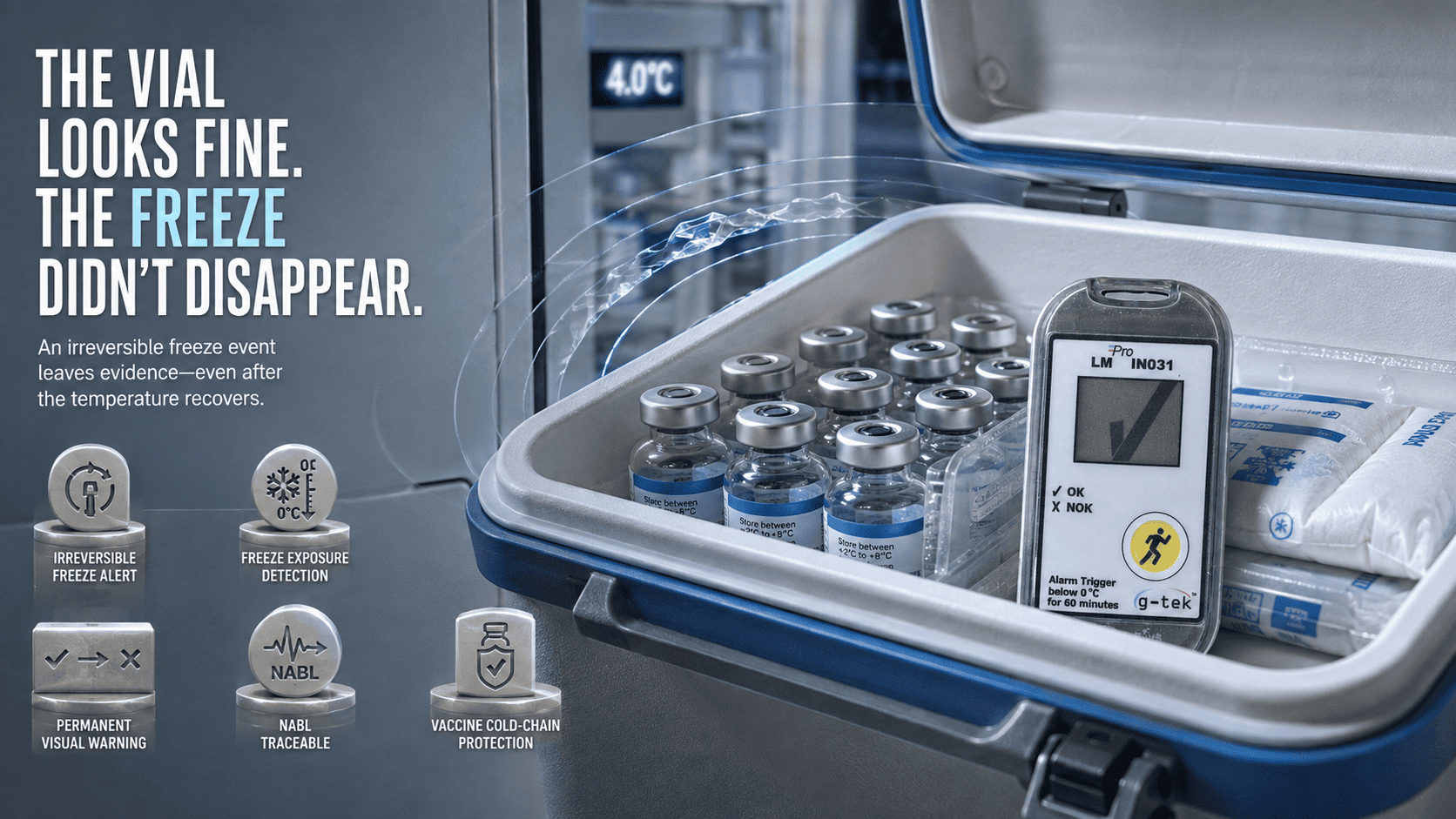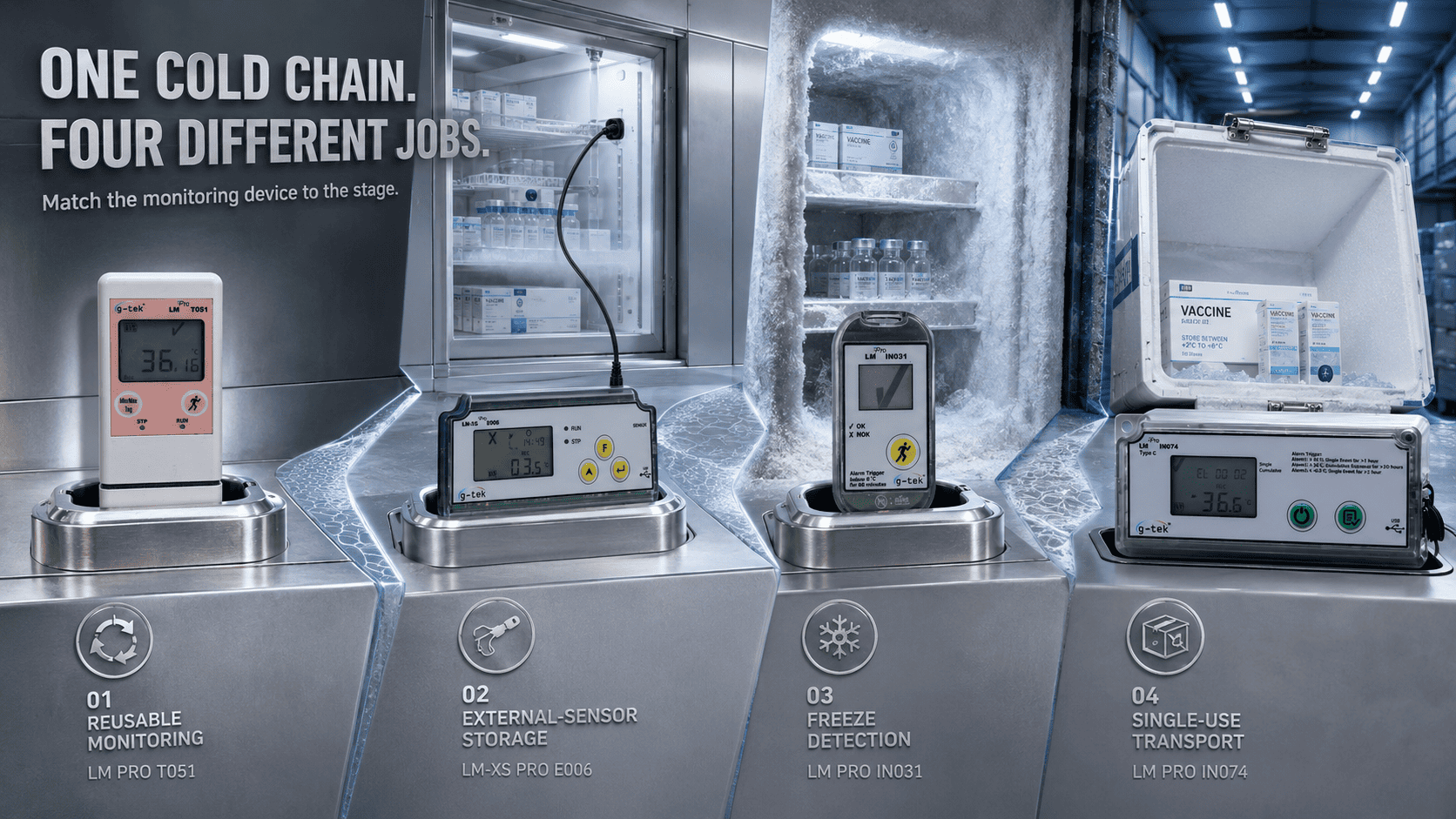
A health worker lifts a vial from the cold box. It reads 4°C. It's clear…
Your Data Logger Calibration Certificate Expired Last Month – Here’s What That Means in 2026
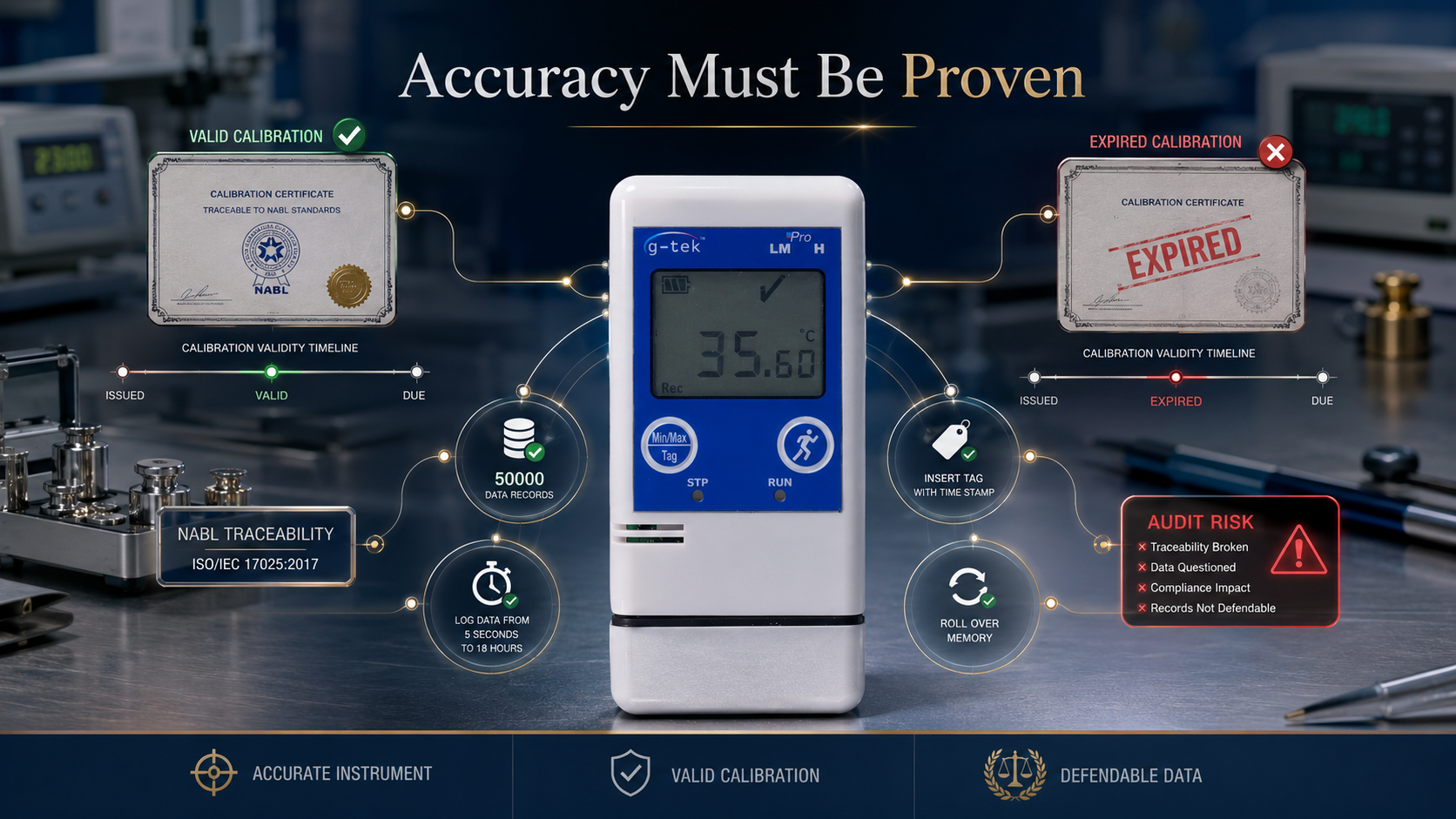
The logger on your shelf looks perfect. It powers on, reads to spec, and has logged months of clean data. Then the auditor asks one question: “Where’s its current calibration certificate?” You open the file — and the validity lapsed three months ago. In that instant, every reading since that date becomes unverifiable, no matter how accurate the device actually was.
That’s the trap of data logger calibration in 2026. Accuracy you can see is not the same as accuracy you can prove.
In 2026, calibration is not about whether a logger looks accurate — it’s about whether its accuracy is provable on the day the data was recorded. Once a calibration certificate expires, auditors treat the readings that follow as unverified.
🎯 Key Takeaways
- A logger reading correctly is not the same as one carrying valid, traceable calibration.
- Calibration certificates are commonly valid for one year — data after expiry is treated as unverified.
- Calibration must be traceable to national standards through an accredited lab.
- A general lab may calibrate to the wrong scope; manufacturer recalibration restores factory accuracy.
- Calibration proves the instrument; validation proves the process — auditors check both.
The date nobody was watching
You did everything right. The mapping was clean, the readings never wandered. Yet one expired date turns months of honest work into an audit observation. The device never failed — but the proof did. The shift, once teams see it, is simple: a calibration certificate isn’t paperwork that follows the data — it’s part of the data. Lose its validity, and you lose the reading’s standing.
What Does a Calibration Certificate Actually Prove – and Why Does Expiry Matter?
Calibration is the documented comparison of a logger’s readings against a reference traceable to national standards through an accredited lab, with a stated measurement uncertainty. It’s the evidence your numbers mean what they claim.
And that evidence has a shelf life. A certificate confirms accuracy as proven on the calibration date. Once it lapses, the logger may still read perfectly — but you can no longer demonstrate it, so the data loses its standing. Under 21 CFR Part 11 and WHO GDP (TRS 957, Annex 5), defensible records depend on instruments whose accuracy is currently provable.
Calibration vs Validation — and Why Auditors Check Both
These get blurred constantly. Calibration proves a single instrument reads accurately against a traceable reference. Validation — and instrument qualification under USP <1058> — proves a process or equipment performs as intended.
One without the other leaves a gap. Auditors expect the pair, and they check that the calibration range matches the range you actually measured. A certificate covering 0–50°C while you map a 2–8°C cold room is a finding waiting to happen.
Inside G-Tek’s In-House NABL Lab: Accuracy Restored to Factory Spec
Unusually for an instrument maker, G-Tek Corporation runs its own NABL ISO/IEC 17025-accredited calibration laboratory in Vadodara — the same house that has built monitoring instruments since 1990. When an LM Pro T or LM Pro H logger reaches the end of its calibration validity, it returns to the people who made it, where recalibration restores the original factory accuracy with certificates traceable to national references via NPL India.
A general third-party lab may not match that original measurement scope. G-Tek’s in-house NABL recalibration returns each LM Pro logger to factory accuracy with a certificate scoped to the exact range you measure — the calibration backbone QA teams at Zydus, Intas, and Emcure rely on. Backed by ISO 9001 and NABL ISO/IEC 17025 accreditation, the whole loop stays inside one accountable house.
>Check the Date Before the Auditor Does
If a logger is recording right now on an expired certificate, that data is already at risk — and an audit is the worst place to discover it. Current calibration is the simplest finding to avoid.
👉 Loop in the G-Tek team before your next audit — and let their in-house NABL lab bring every lapsed certificate back to factory-traceable validity.
Frequently Asked Questions
How long is a data logger calibration certificate valid?
A calibration certificate is commonly valid for one year. Data recorded after it expires is treated by auditors as unverified.
What is the difference between calibration and validation?
Calibration proves an instrument reads accurately against a traceable reference. Validation proves a process performs as intended. Auditors check both.
Why must calibration be traceable to national standards?
Traceability links a logger’s readings to recognised national references through an accredited lab — which makes the recorded data defensible during an audit.
Why recalibrate with the manufacturer instead of a local lab?
The manufacturer restores the logger to factory accuracy with a certificate scoped to the correct range, avoiding the mismatch a general lab may introduce.
Does G-Tek have its own calibration lab?
Yes. G-Tek runs an in-house NABL ISO/IEC 17025-accredited calibration lab in Vadodara, recalibrating its own loggers to factory accuracy.
Related Posts