A health worker lifts a vial from the cold box. It reads 4°C. It's clear…
Why Dairy Tanker & Milk Transport Vessel OEMs Are Bundling IoT Data Loggers in 2026 – The Cold Chain Proof Buyers Now Demand on Every Long-Haul Route

A tanker leaves the chilling centre at dawn, milk perfectly cold. It drives 300 km and arrives but somewhere on a remote stretch the temperature crept up, and nobody knew until the dairy rejected the load.
In 2026, organized dairies no longer accept milk tankers they cannot watch in real time. They want route-long temperature data streaming to a dashboard on their desk so a cold chain break is caught on the highway, not at the gate.
You know the line: “The milk reached the dairy warm and was rejected we had no way to know it climbed three hours in.” That stings. The vessel did its job at dispatch. The failure was invisibility exactly what an IoT data logger is built to close.
🎯 Key Takeaways
- Milk is highly perishable bacteria multiply the moment it warms past the chilled band.
- Long-haul tankers lose visibility on the road, where breaks go unnoticed until arrival.
- GSM enables live tracking while the vehicle moves Wi-Fi cannot.
- Onboard storage plus auto-upload means no reading is lost in dead zones.
- Dairies now want monitoring built into the vessel an OEM selling point.
Why Do Milk Tankers Lose the Cold Chain Without Anyone Noticing?
Milk leaves the centre cold. Then the route works against it ambient heat, insulation limits, long distances and unloading delays push the temperature upward. The dairy learns the truth only at delivery, too late. Once milk warms past the chilled band, bacterial growth accelerates sharply which is why FSSAI cold chain rules under the FSS Act 2006 treat transport temperature as non-negotiable.
Why Does a Moving Tanker Need GSM Monitoring, Not Just a Logger?
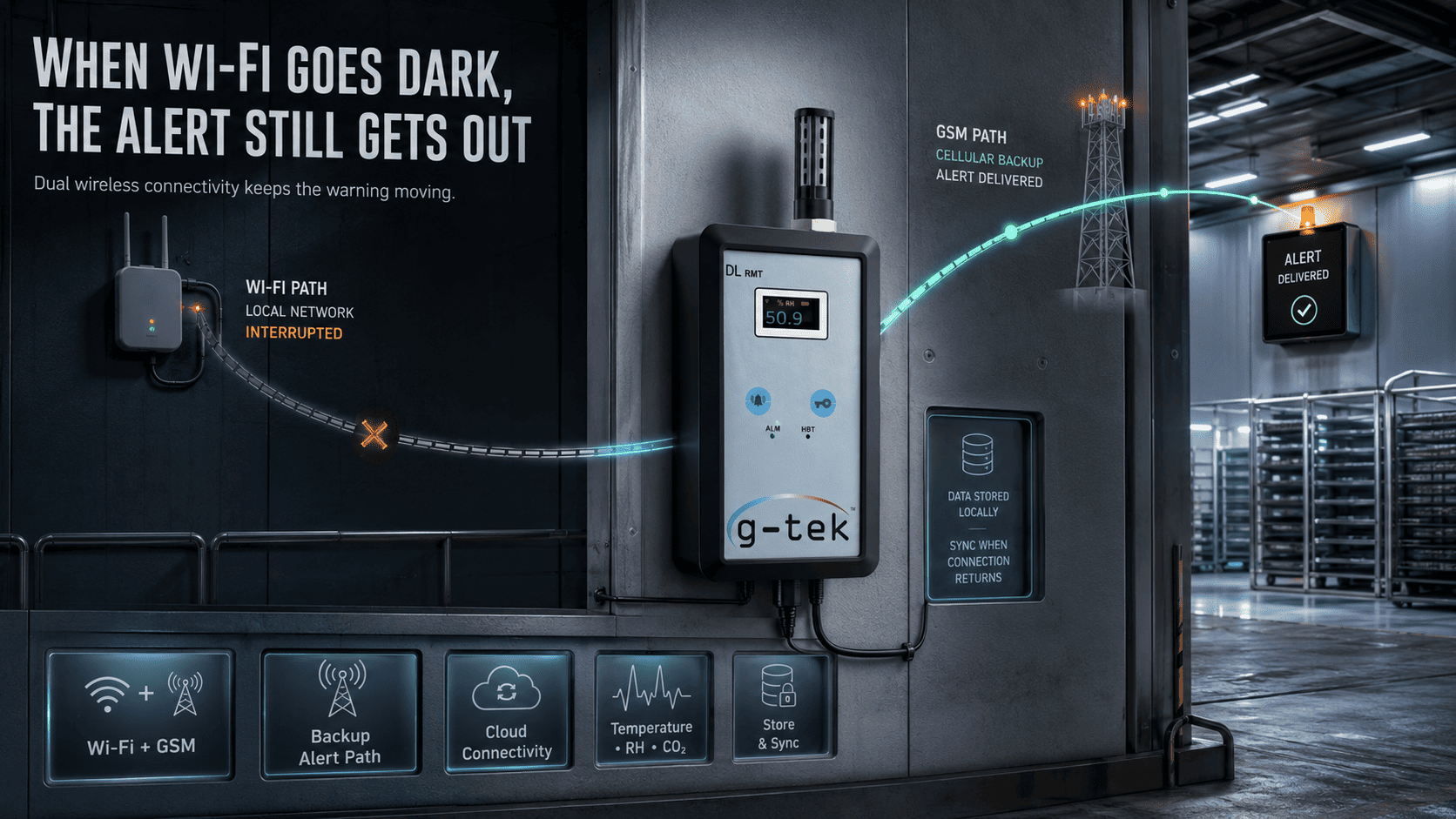
A basic logger only shows its data once downloaded at the destination, when the load is already rejected. The data must travel as fast as the truck. GSM cellular telemetry sends every reading to the cloud while the tanker moves, so the dairy sees temperature live and gets an alert the instant it climbs. The honest part: rural routes drop signal so the device holds every reading onboard and auto-uploads when coverage returns.
G-Tek’s DL-RMT: An IoT Data Logger for the Moving Cold Chain
From Vadodara since 1990, G-Tek Corporation built the DL-RMT IoT Data Logger for the moving cold chain a GSM-connected logger that streams live temperature to a cloud dashboard the dairy opens from any phone or desk. It runs on a 14-day battery, stores up to 3,500 readings onboard to survive network gaps, and fires SMS and email alerts the instant temperature drifts. Calibrated in G-Tek’s own NABL ISO/IEC 17025-accredited laboratory, it’s a monitoring layer built for the road.
Put Every Tanker on the Dairy’s Live Dashboard
If your vessels are being specced by dairies that want eyes on the milk from collection to delivery, live monitoring is what closes the order.
👉 See the DL-RMT run a live cycle on your own tanker and let the dairy watch the cold chain hold, kilometre by kilometre.
Frequently Asked Questions
What temperature should milk be kept at during transport?
Chilled milk should stay at or below 4°C throughout transport, as bacteria multiply sharply above this band making continuous monitoring essential on long-haul routes.
Why isn't a basic data logger enough for a milk tanker?
A basic logger only shows data once downloaded at the destination too late. A GSM logger streams live during transit, catching breaks on the road.
What happens to monitoring when the tanker loses mobile signal?
The G-Tek DL-RMT stores up to 3,500 readings onboard and auto-uploads them once signal returns, preserving the complete trip record through dead zones.
Which G-Tek device is best for monitoring milk during transport?
The G-Tek DL-RMT IoT data logger GSM, cloud dashboard, SMS and email alerts, 14-day battery is built for continuous milk monitoring on long-haul routes.
Where is G-Tek Corporation located?
G-Tek Corporation is headquartered in Vadodara, Gujarat, making monitoring and IoT instruments since 1990, with an in-house NABL ISO/IEC 17025-accredited calibration laboratory.
Related Posts