A plant engineer pulls open a drawer. Inside sits the history of a decade of…
Audit-Ready Temperature Monitoring System: How to Prove Every Record Is Complete, Traceable and Secure
Your temperature data is flawless. Every reading is in range, and every chamber has remained steady all quarter. So why does the auditor keep asking questions that have nothing to do with temperature?
Because that was never the only thing being tested.
The auditor wants to know who can edit the records. Whether a trail exists for every change. How the sensors were calibrated. And the moment those answers turn hesitant, the flawless data becomes harder to defend because nobody can clearly prove it wasn’t altered.
An audit rarely depends only on whether the temperature was correct. It also depends on whether the facility can prove the record is complete, unaltered, and traceable.
An audit-ready temperature monitoring system isn’t only about controlling temperature. It’s about whether your monitoring system can defend every number it produces.
🎯 Key Takeaways
- Audits question the trustworthiness of the record, not just the temperature itself.
- An audit-ready system produces traceable, tamper-evident records rather than easily editable files.
- An audit trail showing who did what and when is an important requirement under 21 CFR Part 11.
- Access control and calibration traceability help make monitoring data defensible.
- Consolidated and easily retrievable records are easier to review than data scattered across multiple files.
What Does an Audit-Ready Temperature Monitoring System Actually Mean?
Audit-ready means the monitoring system can demonstrate that its data is complete, unaltered, and traceable through tamper-evident records, an audit trail, controlled access, and calibration that a reviewer can follow.
It’s not simply about showing that temperature stayed within limits.
Here’s the split many facilities miss. Controlling temperature is the operational job. Proving it is the compliance job.
An auditor may check whether the record could have been changed, who had permission to change it, and whether every reading traces back to a calibrated sensor.
The ALCOA+ principles — attributable, legible, contemporaneous, original, and accurate, along with additional data-integrity expectations — provide an important framework for trustworthy records.
Which Features Make Temperature Data Defensible?
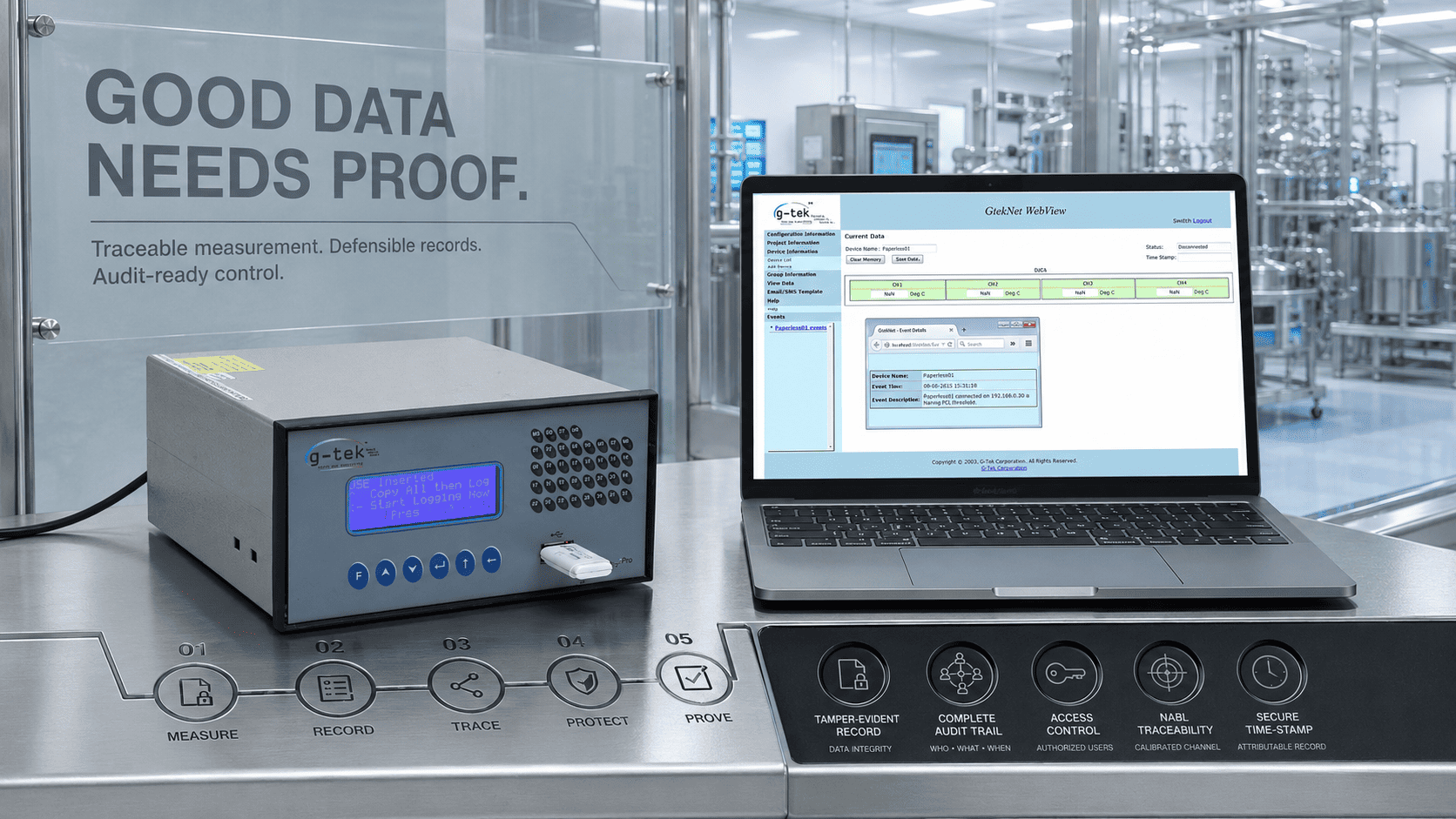
The features that make monitoring data defensible include tamper-evident electronic records, a complete audit trail, user access control, secure time-stamping, and calibration traceable to an accredited laboratory.
These are important elements when working under requirements such as 21 CFR Part 11 and EU GMP Annex 11.
Break it down.
The audit trail logs actions automatically so changes do not happen silently. Access control determines who may view, edit, or approve records. Tamper-evidence protects the integrity of the record itself.
Traceable calibration then connects each monitoring channel to an NABL ISO/IEC 17025-accredited laboratory.
The FDA explains electronic-record requirements further in its Part 11 guidance.
Before You Trust a Monitoring System at Audit — Verify These
- Audit trail — does it record important actions and changes automatically?
- Access control — who can view, edit, approve, or manage the records?
- Tamper-evidence — are records protected against unauthorized or silent changes?
- Calibration traceability — can every relevant channel be traced to accredited calibration?
- Retrievability — can you quickly retrieve one complete record when an auditor asks for it?
Where gtekNet Turns Temperature Control Into Proof
Manufacturing monitoring and recording instruments in Vadodara for over 30 years, G-Tek Corporation built gtekNet™ to support monitoring systems that need stronger electronic records and traceability.
Paired with the Universal Scanner, it records monitoring data into electronic records designed to support 21 CFR Part 11 requirements, with audit-trail and user-access-control capabilities.
Readings can be time-stamped and attributable, helping protect monitoring records from unauthorized or silent changes.
The same monitoring setup can also integrate with a Paperless Recorder for continuous on-site recording.
Each calibrated channel can be supported through G-Tek’s own NABL ISO/IEC 17025-accredited calibration laboratory, helping connect the electronic record with measurement traceability.
Rather than leaving temperature records scattered across multiple files, the system helps consolidate monitoring information into a record an auditor can follow — turning good control into provable control.
Walk Into Your Next Audit Able to Prove Every Number
If an audit is coming, controlling temperature is only part of the job. Proving how the data was generated, protected, and calibrated matters too.
An audit-ready temperature monitoring system with an audit trail, controlled access, secure records, and traceable calibration helps turn good temperature data into defensible data.
👉 Preparing for a GMP or regulatory audit? Share how you currently record and store your temperature data with the G-Tek team and get a clear path toward a more audit-ready monitoring system.
Frequently Asked Questions
What makes a temperature monitoring system audit-ready?
An audit-ready temperature monitoring system should support complete, traceable, and protected records through features such as audit trails, access control, secure records, and calibration traceability.
Why does an auditor care about the audit trail?
An audit trail shows who performed an action and when it happened. This helps demonstrate that electronic records were not changed without a trace.
Isn't controlling temperature well enough to pass an audit?
Temperature control is important, but auditors may also review how the data was created, stored, protected, accessed, and linked to calibrated instruments.
How does gtekNet support audit-readiness?
gtekNet™ supports electronic monitoring records with features such as audit trails and access control when paired with compatible G-Tek monitoring systems. Calibration traceability can also be supported through G-Tek’s NABL-accredited laboratory.
Where is G-Tek Corporation located?
G-Tek Corporation is based in Vadodara, Gujarat, and has been manufacturing monitoring and recording instruments for over 30 years, with an in-house NABL ISO/IEC 17025-accredited calibration laboratory.
Related Posts