Accurate temperature measurement is critical in furnaces for industrial processes such as heat treatment, ceramics,…
Why a Perfect Pharma Temperature Record Still Fails a Data Integrity Audit in 2026
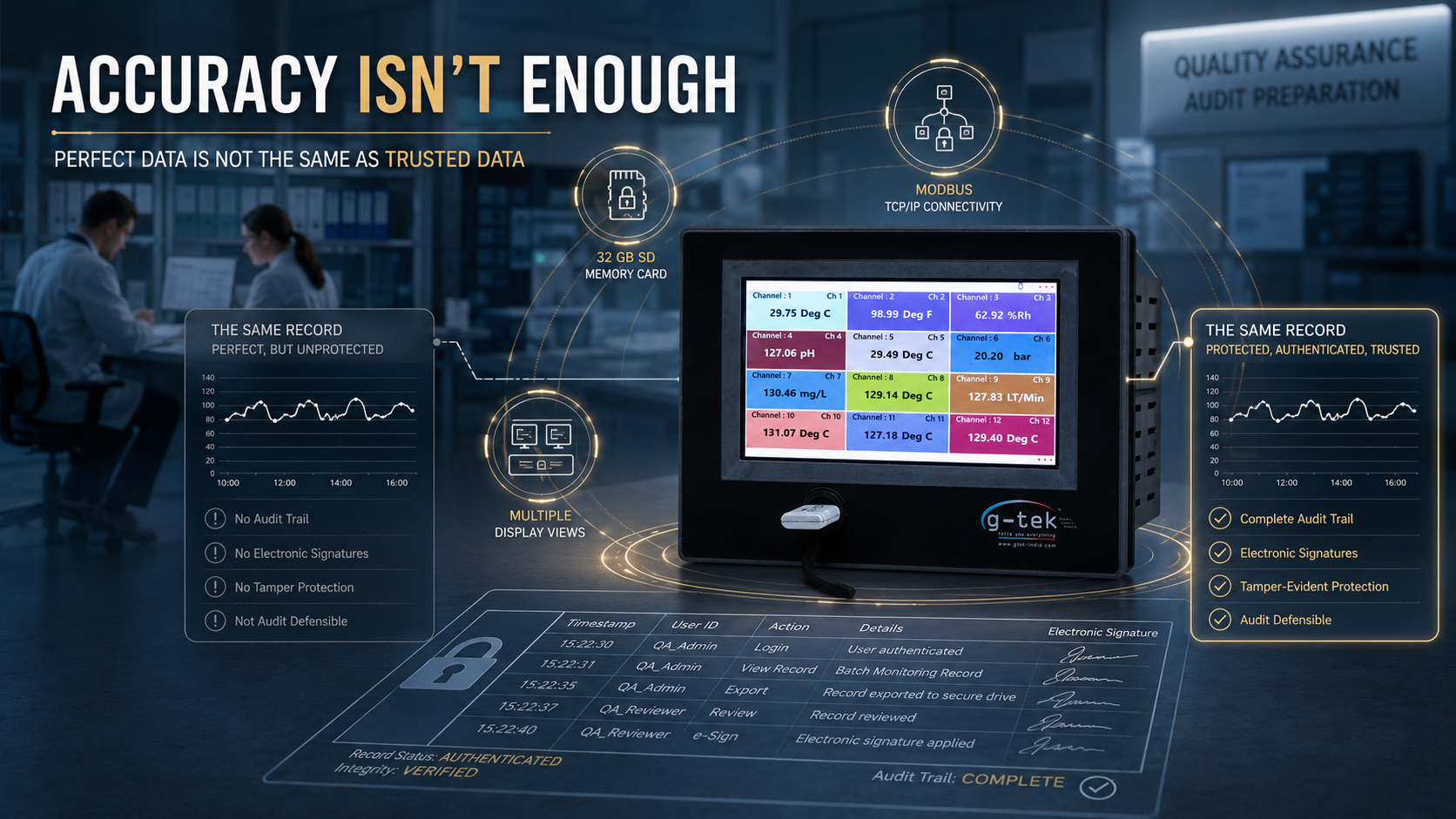
A QA head hands the inspector a flawless temperature log. Every reading in range. Nothing missing.
The inspector reads it and writes a finding anyway.
Not because a reading was wrong. Because nothing proved the record hadn’t been edited.
In 2026, accuracy is no longer enough. USFDA, MHRA, and WHO inspectors judge pharma records on data integrity whether the data is attributable, time-stamped, tamper-evident, and electronically signed. A perfect-looking record with no audit trail fails on integrity, not on accuracy.
🎯 Key Takeaways
- Accurate data and trustworthy data are not the same – audits now test for both.
- ALCOA+ is the global data integrity benchmark – accuracy is just one of its nine principles.
- A record without an audit trail, e-signatures, or tamper-evidence can fail even when every reading is right.
- Paper logs and editable spreadsheets are the most common data integrity findings.
- 21 CFR Part 11 and EU GMP Annex 11 define what an electronic record must prove.
What Is Data Integrity, and How Is It Different From Accuracy?
Accuracy asks one thing: is the reading correct? Data integrity asks a harder one: can you prove it is complete, unaltered, and trustworthy across its life?
The benchmark is ALCOA+ – Attributable, Legible, Contemporaneous, Original, Accurate, plus Complete, Consistent, Enduring, Available. A reading can be perfectly Accurate yet fail Attributable when no one can prove who recorded it which is exactly the proof that continuous electronic data loggers leave behind.
Why Do Complete, Accurate Records Still Trigger Audit Findings?
The causes are well documented. A missing audit trail. Shared logins no one can trace. Editable files anyone can change untracked.
The MHRA GxP Data Integrity Guidance and WHO TRS 1033, Annex 4 make one point: a record must prove it was never silently altered. The FDA’s 21 CFR Part 11 and EU GMP Annex 11 set that bar for electronic records.
Integrity is provability, not correctness. An editable spreadsheet is the easiest audit observation an inspector ever writes.
The Difference Between a Record and Evidence
Building monitoring instruments in Vadodara since 1990, G-Tek Corporation designs its Paperless Recorder so integrity isn’t an afterthought, it’s captured in every reading. Running on gtekNet™, each record carries a time-stamp, a verified user identity, a full audit trail, electronic signatures, and tamper-evidence that flags alteration, the exact controls 21 CFR Part 11 and EU GMP Annex 11 expect.
At one leading Indian pharmaceutical company, the electronic-signature workflow stood out ; the quality team saw how cleanly it tied every record to an authenticated user, leaving no doubt who signed what, when. Calibrated in G-Tek’s own NABL ISO/IEC 17025-accredited laboratory, it gives QA teams a record built to face an audit on integrity, not just accuracy.
The Finding You Can Remove Before It’s Written
If your records live on paper charts or editable files, the data integrity gap is open – and an inspector will find it before you do. Closing it is about how data is captured – not how accurate it is.
👉 See the G-Tek Paperless Recorder in a live cycle and watch every reading sign, stamp, and seal itself into an audit-proof record.
Frequently Asked Questions
What is data integrity in pharma records?
Data integrity is the assurance that data stays complete, accurate, unaltered, and trustworthy across its lifecycle, measured against the ALCOA+ principles regulators now expect.
How can accurate data still fail an audit?
Accurate data fails on integrity when it lacks an audit trail, electronic signatures, or tamper -evidence, because it cannot prove it was never altered.
What does ALCOA+ stand for?
ALCOA+ stands for Attributable, Legible, Contemporaneous, Original, Accurate, plus Complete, Consistent, Enduring, and Available – the benchmark for trustworthy data under 21 CFR Part 11 and EU GMP Annex 11.
Why are paper logs and spreadsheets a data integrity risk?
Paper logs and editable spreadsheets can be changed without trace, so they fail the tamper-evidence and audit-trail requirements regulators expect – a top data integrity finding.
Which G-Tek product ensures data integrity?
G-Tek’s Paperless Recorder with gtekNet™ software builds in audit trails, electronic signatures, user-access control, and tamper-evidence, meeting 21 CFR Part 11 and EU GMP Annex 11 requirements.
Related Posts