A health worker lifts a vial from the cold box. It reads 4°C. It's clear…
Elevator Control Room Monitoring: Why OEMs Are Adding Data Loggers
The 8-Month Failure No One Could Explain
A premium lift goes live. Eight months later, the VFD fails. Contactors are scorched. A control PCB has quietly overheated.
The owner raises a warranty claim. The OEM dispatches an engineer.
Then comes the question nobody can answer:
What were the temperature and humidity conditions inside that control room during the last eight months?
Nobody was monitoring them.
Without elevator control room monitoring, a site-condition failure can quickly become a warranty issue that the OEM must absorb.
The Quiet Burden Lift OEMs Are Tired of Carrying
A control room located on a terrace, in a basement, at the shaft top, or inside an MRL cabinet can gradually move outside its safe operating range.
Heat builds up. Humidity rises. Components age faster than expected.
When engineers arrive on-site, they often find damaged equipment. However, they have no environmental record showing what happened before the failure occurred.
This creates a challenge for both OEMs and building owners.
IS 14665 (Part 2) in India and EN 81-20 internationally specify that lift control environments should operate within acceptable temperature and humidity ranges, generally around 5°C to 40°C with controlled humidity.
Yet many installations still operate without continuous environmental records.
Where the Real Gap Was Hiding
The gap was never in the lift hardware itself.
Instead, the missing piece was elevator control room monitoring.
The challenge becomes even greater with modern machine-room-less (MRL) lifts. Since the controls are located within the shaft, ventilation is often limited and heat can become trapped more easily.
Without environmental records, every premature failure becomes a debate.
With documented monitoring data, the conversation changes immediately.
Service teams can review actual site conditions instead of relying on assumptions.
How LM Pro-H Quietly Protects Every Lift You Install
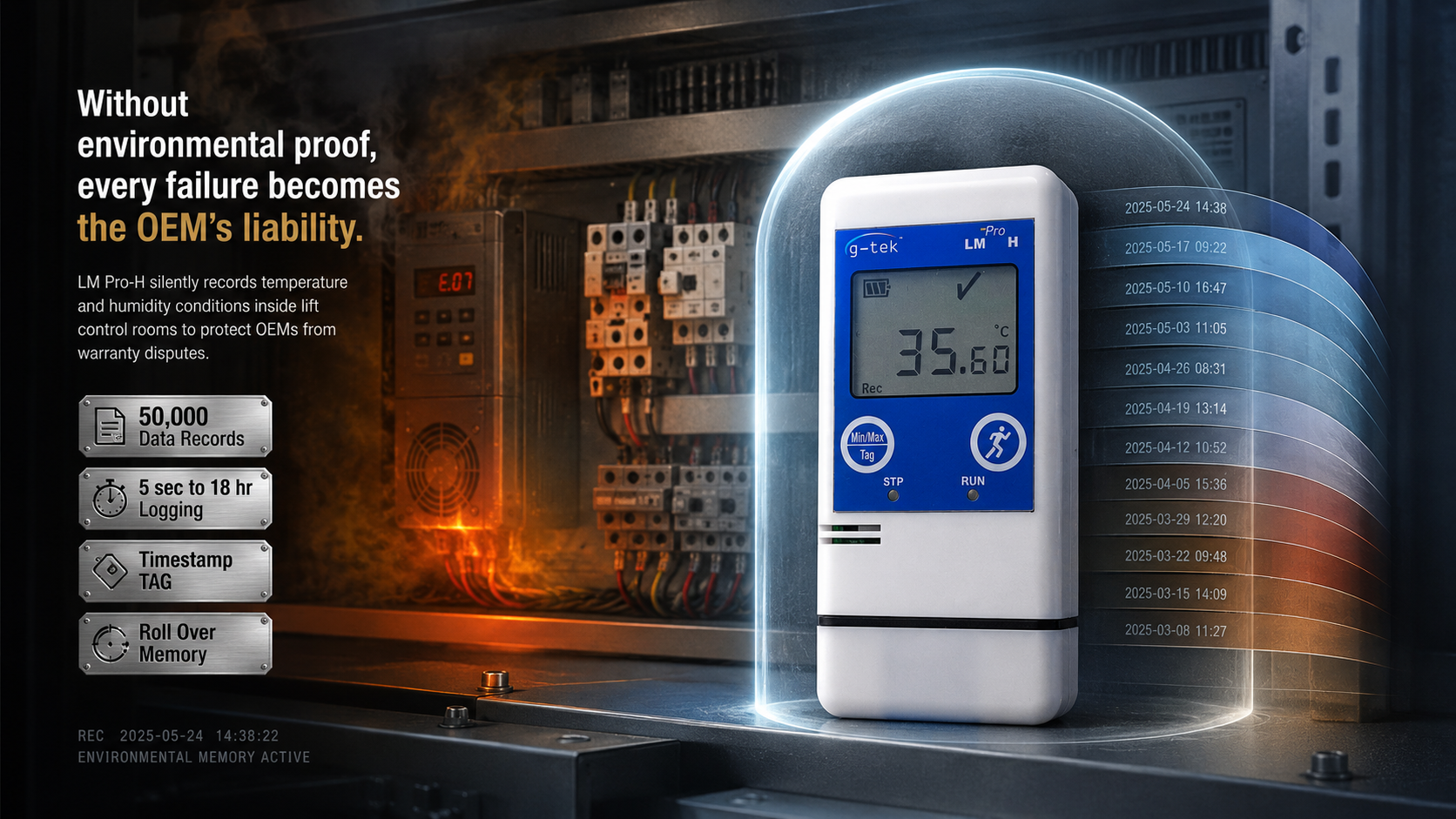
The G-Tek LM Pro-H Temperature & Humidity Data Logger is designed specifically for compact control environments.
It fits inside lift control rooms, cabinets, and shaft-mounted installations while continuously recording environmental conditions throughout the life of the lift.
Key capabilities include:
• 📡 Continuous elevator control room monitoring for temperature and humidity
• 🛡️ High and low alarm tagging with accurate timestamps
• ✅ NABL-calibrated sensors suitable for consultants, auditors, and maintenance teams
• 🧮 USB-accessible data that allows engineers to retrieve historical records in seconds
• ⚠️ Alignment with IS 14665 (Part 2) and EN 81-20 operating requirements
When a warranty claim occurs, engineers can review historical environmental data instead of relying on visual inspection alone.
This helps identify whether site conditions contributed to the failure and supports faster decision-making.
The OEM Playbook for 2026: Sell the Lift, Protect the Warranty
Forward-thinking OEMs are increasingly treating monitoring as part of the installation rather than an optional accessory.
The reason is simple.
Elevator control room monitoring creates a continuous environmental record from day one. This record can help support warranty investigations, identify site-condition issues, and improve long-term equipment reliability.
For OEMs, this means fewer unresolved warranty disputes.
For building owners, it means greater visibility into operating conditions and better protection for critical lift components.
If every lift installation included continuous elevator control room monitoring, how many warranty claims could be resolved with clear environmental evidence?
👉 Speak with the G-Tek team to learn how the LM Pro-H can support monitoring programs, protect warranties, and improve lift reliability.
Related Posts