A tyre plant's process engineer pulls a batch flagged for inconsistent cure and walks to…
Hydrostatic Test Pressure Recorder: Why the Full Pressure Hold Must Be Recorded, Not Just the Peak
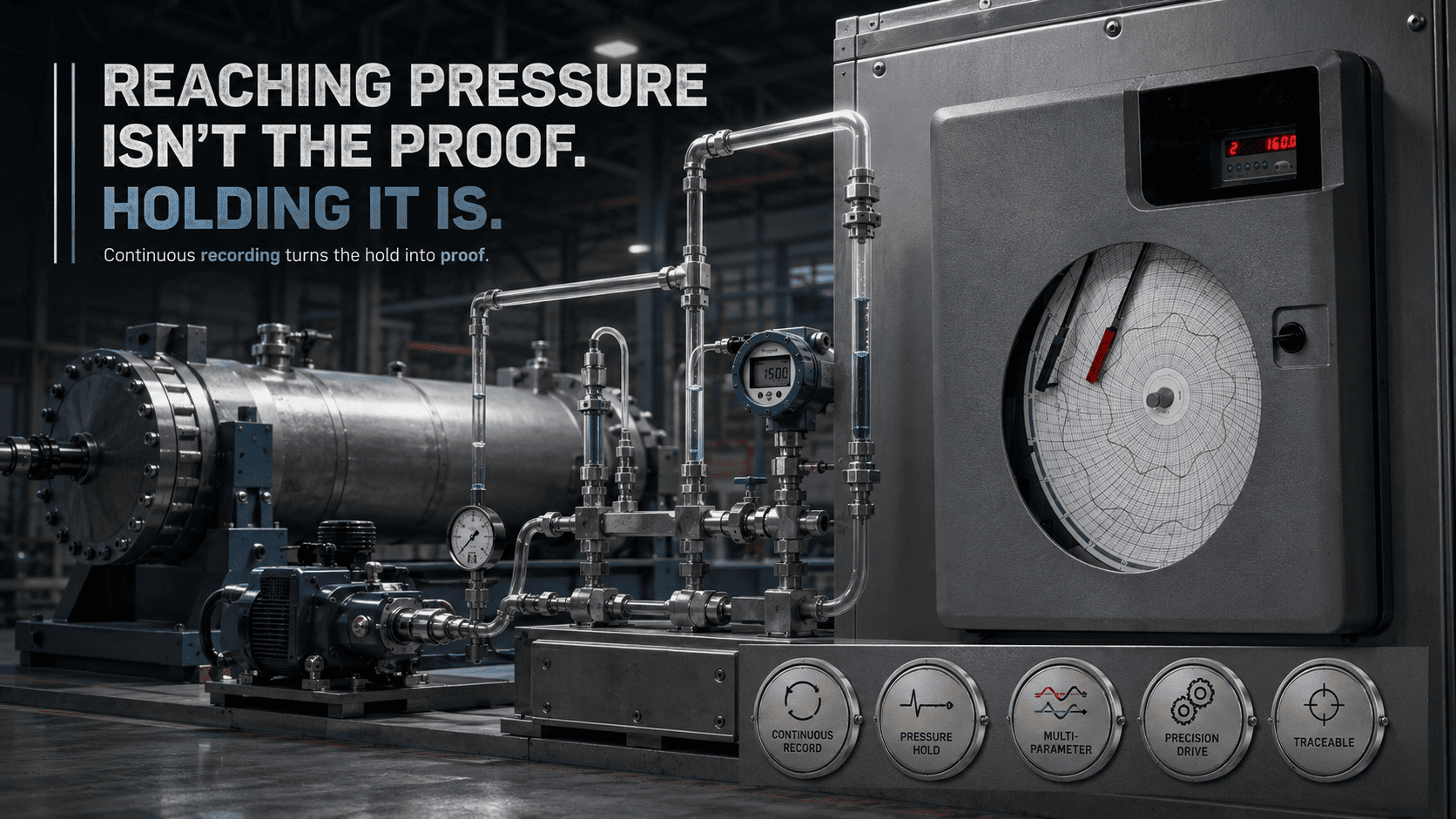
The whole test lives or dies in the hold.
Reaching the test pressure is the easy part. A pump can do that in minutes. What a hydrostatic test actually proves is that the pressure stayed there, steady, for the full required duration without a drop that could indicate a leak.
And that proof isn’t simply a final gauge reading or a photo at the end. It’s the continuous line showing every minute of the hold.
A hydrostatic test pressure recorder captures that entire pressure history, helping provide clear documentation of whether the required pressure was reached and maintained.
🎯 Key Takeaways
- A hydrostatic test proves pressure was held, not just reached.
- A final gauge reading can’t show whether pressure stayed stable throughout the full duration.
- A continuous chart captures the entire hold the actual record of the test.
- A drop anywhere in the hold may reveal a leak or pressure loss that a spot reading could miss.
- The right recorder produces a continuous, tamper-evident chart that can be reviewed by clients or inspectors.
Why Must a Hydrostatic Test Record the Whole Pressure Hold?
A hydrostatic test is demonstrated through a continuous record of the entire pressure hold, showing that the target pressure was reached and maintained for the required duration.
Pumping up to pressure is quick. The real test is the sustained hold.
Only a continuous trace across the whole period can show whether the pressure remained stable or whether a slow drop occurred during the test.
The peak pressure alone proves that the target was reached. It does not prove how long that pressure was maintained.
That is why continuous pressure records are widely used in hydrostatic testing and other documented pressure-test procedures. Established hydrostatic testing principles from organizations such as ASME also emphasize controlled and documented test conditions.
A Gauge Shows the Moment; a Chart Shows the Test
A pressure gauge shows the value at a single moment, while a hydrostatic test pressure recorder captures pressure continuously over time.
A gauge reading or end-of-test photo is only a snapshot. It does not show what happened throughout the hold period.
A continuous chart provides a much clearer record of the entire test. If a client questions the result later, the chart provides a documented pressure history that can be reviewed directly.
This is familiar ground for G-Tek Corporation, which has been manufacturing circular chart recorders in Vadodara for over 30 years.
The CR11″ 1P-2P records one or two parameters on a standard 11-inch chart. Its panel format is designed to suit common recorder installations, allowing testing setups to capture the complete pressure hold without unnecessary changes to the rig.
Every unit can also be supported through G-Tek’s own NABL ISO/IEC 17025-accredited calibration laboratory, helping provide measurement traceability when the test record is reviewed.
Replacing an Old Pressure Recorder, Will a New One Fit?
In many installations, a standard 11-inch chart recorder can be used to replace an existing panel recorder, helping make upgrades more straightforward.
The CR11″ 1P-2P can record one or two parameters pressure alone, or pressure together with another parameter such as temperature.
For an existing test panel, checking the recorder cutout, input type, and pressure range before replacement helps avoid unnecessary re-engineering.
Before You Choose a Hydrostatic Test Pressure Recorder Verify These
- Continuous recording – make sure it captures the entire hold, not just the start and end points.
- Pressure range & input – confirm the recorder matches your test pressure and transducer output.
- Chart duration – select a chart rotation period that covers the full required hold cleanly.
- Panel fit – check that the cutout matches the existing recorder or intended panel design.
- Calibration – use NABL-traceable calibration where required so the recorded pressure has documented measurement traceability.
Prove the Hold, Not Just the Peak
A pressure test that only proves the peak leaves an important part of the test undocumented.
A hydrostatic test pressure recorder captures the complete hold period, turning a single pressure reading into a continuous record that shows how the test actually performed over time.
👉 Running hydrostatic or leak tests? Share your test pressures and hold durations with the G-Tek team and get a clear recommendation on a recorder that captures the whole hold, not just the peak.
Frequently Asked Questions
Why isn't a pressure gauge enough for a hydrostatic test?
A gauge shows pressure at a particular moment. A continuous record shows whether that pressure remained stable throughout the full hold period.
What does a chart recorder show in pressure testing?
It records pressure continuously over time. Any change or drop during the hold becomes visible on the chart, providing a clearer picture of test performance.
Can a new recorder replace my existing panel recorder?
In many cases, yes. Standard 11-inch chart recorders are designed for common panel installations, but the cutout dimensions and input specifications should always be checked before replacement.
Which G-Tek recorder suits hydrostatic or pressure testing?
The CR11″ 1P-2P hydrostatic test pressure recorder records one or two parameters on an 11-inch chart, providing a continuous pressure-hold record with calibration traceability.
Where is G-Tek Corporation located?
G-Tek Corporation is based in Vadodara, Gujarat, and has been manufacturing recording instruments for over 30 years, with an in-house NABL ISO/IEC 17025-accredited calibration laboratory and pan-India support.
Related Posts