By Asutosh Shah & Alpesh Shah · Founders, G-Tek Corporation 30+ years in temperature monitoring,…
No Ink, No Thermal Fade: The Inkless Chart Recorder That Stops Losing Your Record
By Asutosh Shah & Alpesh Shah · Founders, G-Tek Corporation 30+ years in temperature monitoring, recording, and calibration instrumentation.
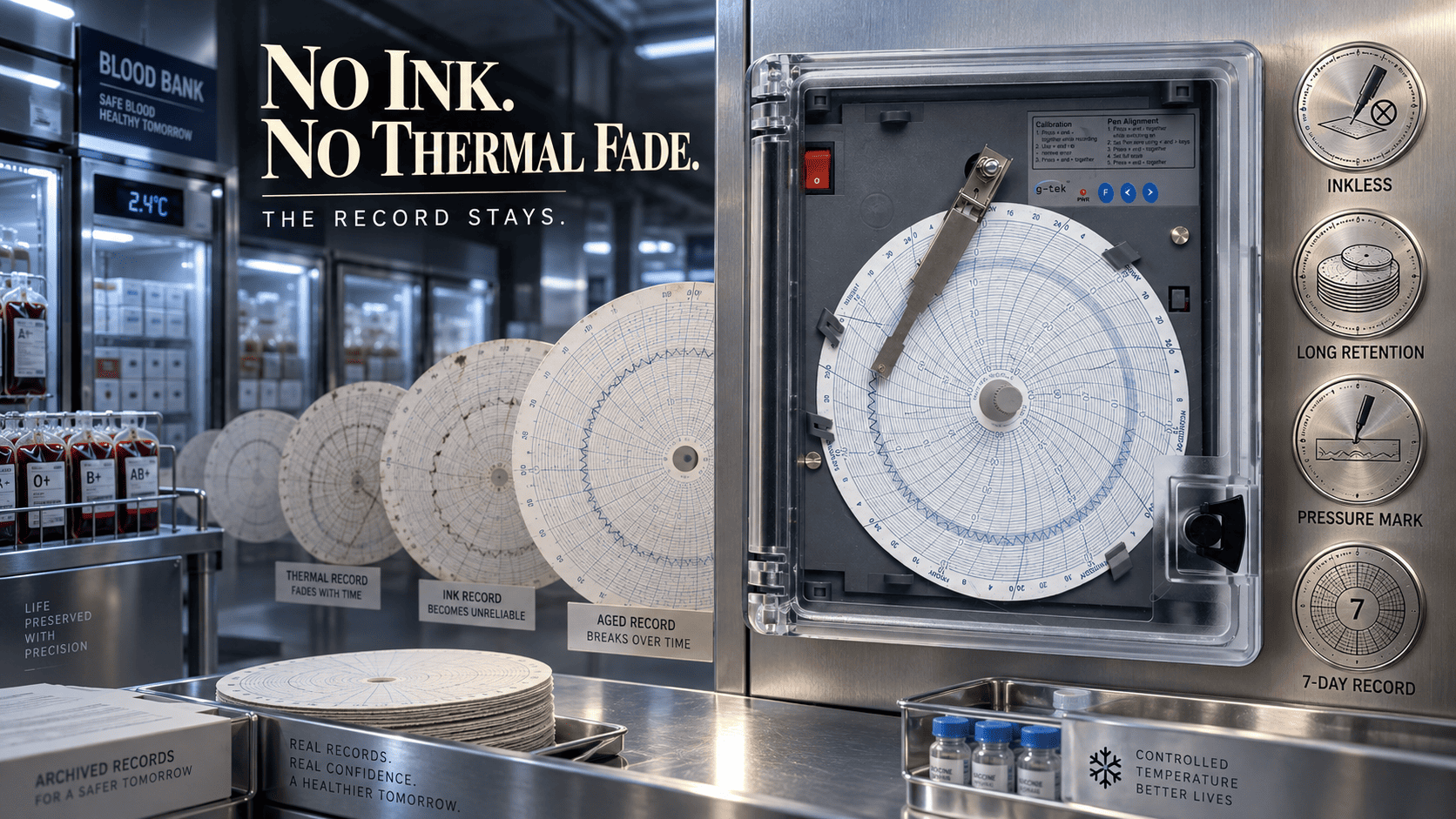
For decades, the weak link in a chart recorder was never the sensor. It was the pen. Ink dried out, clogged, or ran empty in the middle of a trace, and no one noticed until there was a gap in the record. Then came thermal paper. It fixed the ink problem and created a new one: prints that slowly fade until an old chart is barely readable. An inkless chart recorder removes both headaches at once.
An inkless recorder marks the chart with a pressurized needle on pressure-sensitive paper, so there’s no ink to run dry and no thermal print to fade, and the record stays clean and legible for the long term.
You know the feeling. You walk in for the morning check, and the trace just… stops. The pen died overnight, and those missing hours are gone. Or an auditor asks for last year’s chart, you pull it out, and the line has faded to a ghost. The monitoring was fine. The record failed you.
🎯 Key Takeaways
- Ink-pen recorders can dry out, clog, or run empty, leaving gaps in the record
- Thermal-paper prints fade over time, making old charts hard to read
- An inkless recorder marks with a pressurized needle on pressure-sensitive paper: no ink, no thermal
- The result is a clean, long-lasting, always-legible record with far less upkeep
- Available in 4″ and 6″ chart sizes for different equipment and spaces
So how does an inkless chart recorder actually make its mark?
An inkless recorder uses a pressurized needle pressing onto pressure-sensitive paper to draw the trace. The pressure itself creates the mark, so no ink is needed, and unlike thermal paper, the record doesn’t fade.
The needle applies pressure to specially coated paper, leaving a crisp, permanent line as the chart rotates. No cartridge. No drying. No coating to degrade. It’s the same familiar circular-chart format your team already reads, just without the pen problems. If you already run traditional circular chart recorders, the inkless version drops into the same workflow with one fewer thing to babysit.
The real weak point isn’t the recorder, it’s the record that fails silently
The biggest risk with a chart recorder isn’t the device. It’s a record that fails silently, through a dried pen or a faded print, exactly when you need it for an audit or investigation.
A single gap, or an unreadable old chart, can undo months of good monitoring. When an audit observation lands or an investigation opens, the first thing anyone asks for is the record, and it has to be there, and it has to be readable. Inkless removes the two most common silent-failure modes. For faster loops or remote points, many teams pair the physical chart with electronic records, the same reason data loggers often sit alongside recorders for 21 CFR Part 11 audit-trail needs.
Choose a recorder that keeps the record, not just draws it
Choose a recorder whose marking method lasts (pressure-sensitive over ink or thermal), so the chart stays legible for as long as you need to keep it, with minimal upkeep.
Match the chart size to the equipment and the input to your sensor. This is long-standing ground for G-Tek Corporation, building recording instruments in Vadodara for over 30 years. Its inkless recorders, part of the popular CR2010 series, come in 4-inch and 6-inch chart sizes and accept RTD Pt-100 and process inputs (4-20mA / 0-1V), marking every trace with a pressurized needle on pressure-sensitive paper. The RTD input follows IEC 60751, the international standard for Pt-100 sensors, and every unit is traceable to G-Tek’s own NABL ISO/IEC 17025-accredited calibration laboratory, so the record is accurate as well as durable.
Keep a Record That’s Still Readable Years From Now
A recorder is only worth having if the chart survives: no dried pen, no faded print. An inkless recorder keeps the trace clean and legible for the long term, with almost no upkeep.
👉 Tired of dried pens or faded charts? Bring the G-Tek team your recording setup and get a clear recommendation on switching to an inkless chart recorder that keeps your record intact.
Frequently Asked Questions
What is an inkless chart recorder?
It marks the chart using a pressurized needle on pressure-sensitive paper instead of ink or thermal printing, so there’s no ink to run dry and no print to fade.
How is inkless better than an ink-pen recorder?
Ink pens can dry, clog, or run empty mid-trace, leaving gaps. An inkless recorder has no ink at all and needs far less upkeep.
Does an inkless record fade like thermal paper?
No. Thermal prints fade over time, but a pressure-sensitive mark stays legible for the long term, vital when old charts must stay readable for audits.
What sizes and inputs does the G-Tek inkless recorder offer?
The CR2010 series comes in 4-inch and 6-inch chart sizes and accepts RTD Pt-100 and process inputs (4-20mA / 0-1V), with NABL-traceable calibration.
Where is G-Tek Corporation located?
G-Tek is based in Vadodara, Gujarat, building recording and monitoring instruments for over 30 years, with an in-house NABL-accredited calibration lab.
Related Posts