By Asutosh Shah & Alpesh Shah · Founders, G-Tek Corporation 30+ years in temperature monitoring,…
Your Lab Certifies Others – Why Laboratory Environmental Monitoring Matters
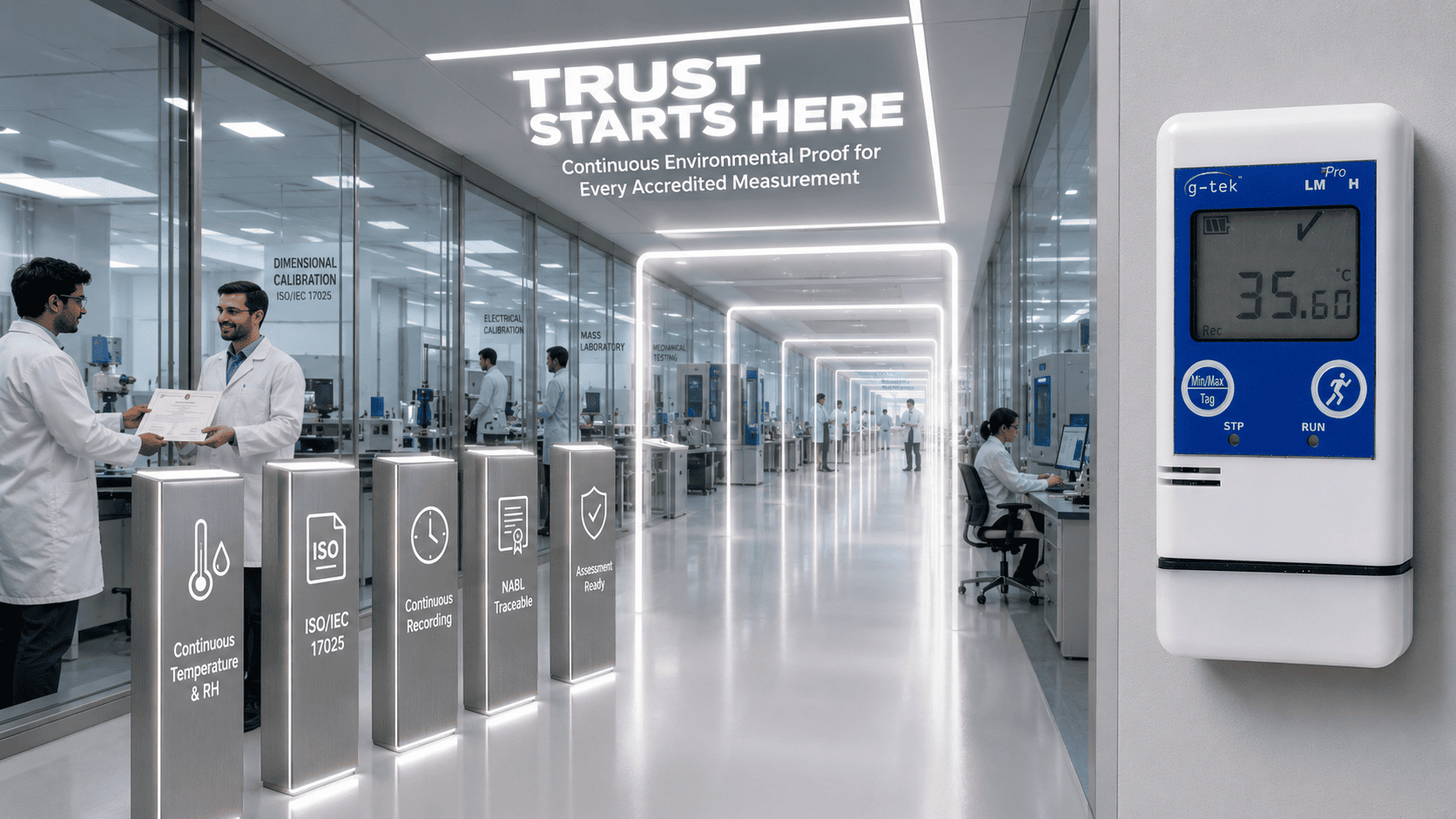
A calibration engineer spends the morning issuing certificates – precise, traceable, and signed for a client’s instruments. That afternoon, his own lab’s ISO/IEC 17025 surveillance assessment begins.
The assessor asks: “Show me your environmental monitoring for the last three months.”
The lab that documents everyone else’s accuracy has only a sparse manual logbook for its own room.
In 2026, laboratory environmental monitoring is just as important as the calibration work itself.
🎯 Key Takeaways
- ISO/IEC 17025 requires laboratories to monitor, control, and document environmental conditions that can affect results
- Temperature and humidity can influence measurement accuracy
- Manual logbook readings can leave gaps
- Laboratory environmental monitoring should provide a traceable, time-stamped record
- A laboratory that certifies other instruments also needs reliable evidence of its own operating conditions
Why Does an Accredited Lab Have to Monitor Its Own Room?
An accredited lab must monitor its own room because ISO/IEC 17025 Clause 6.3.3 requires environmental conditions that can affect results to be monitored, controlled, and recorded.
Depending on the laboratory activity and method, this can include temperature, humidity, vibration, dust, electromagnetic disturbance, and other relevant conditions.
That is why laboratory environmental monitoring forms part of the evidence that supports reliable laboratory results.
What Kind of Environmental Record Does an Assessor Actually Expect?
A continuous, time-stamped record can make monitoring much easier than relying only on occasional manual entries.
Where humidity is relevant, both temperature and RH may need to be monitored according to the applicable method or laboratory procedure.
Measurement traceability should also be considered when selecting monitoring equipment. Accreditation in India is supported through NABL India.
How Does Laboratory Environmental Monitoring Improve Audit Readiness?
Effective laboratory environmental monitoring helps quality teams demonstrate:
- When environmental conditions were recorded
- Whether conditions remained within defined limits
- Whether temperature or humidity excursions occurred
- How monitoring instruments were calibrated
- Whether the data can be reviewed and traced back to a specific period
Built by an Accredited Lab, for an Accredited Lab
G-Tek Corporation operates its own NABL ISO/IEC 17025-accredited calibration laboratory.
G-Tek offers the LM Pro-T for temperature monitoring and the LM Pro-H for temperature and humidity monitoring.
Each G-Tek data logger can be supported with calibration through G-Tek’s own accredited laboratory.
The difference is simple: a manual logbook may leave gaps. Continuous laboratory environmental monitoring gives teams a much clearer record.
Certify Your Own Conditions, the Way You Certify Everyone Else’s
👉 Preparing for a surveillance assessment? Share your lab’s disciplines and environmental conditions and get a clear recommendation on the monitoring setup.
Frequently Asked Questions
Does ISO/IEC 17025 require laboratories to monitor temperature and humidity?
ISO/IEC 17025 requires laboratories to monitor, control, and record relevant environmental conditions.
Why aren't manual logbook readings always enough?
Manual readings only show conditions at specific moments and can leave gaps.
Do I need to record humidity as well as temperature?
It depends on the laboratory method and activity.
Which G-Tek products support laboratory environmental monitoring?
The LM Pro-T records temperature, while the LM Pro-H records temperature and humidity, with traceable calibration
Where is G-Tek located?
G-Tek Corporation is based in Vadodara, Gujarat.
Related Posts