By Asutosh Shah & Alpesh Shah · Founders, G-Tek Corporation. 30+ years in temperature monitoring,…
5 Monitoring System Buying Mistakes That Stay Hidden Until the Audit
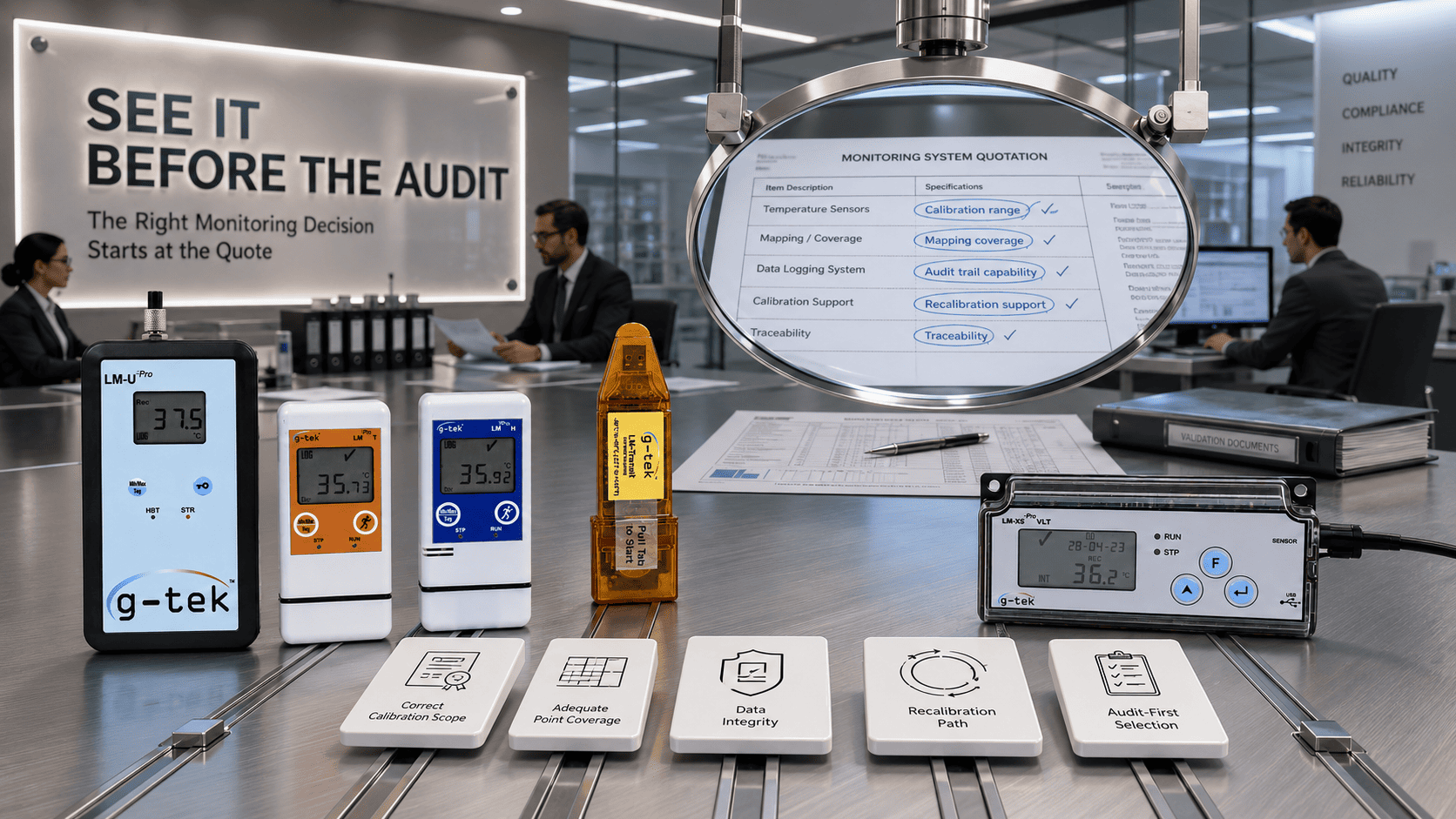
The QA manager stood beside the auditor. Eight months of green lights. Clean data. Zero alarms.
Then the auditor pointed at one detail on the calibration certificate, asked one question, and wrote a finding.
The system wasn’t broken. The decision made when it was bought was.
In 2026, the costliest monitoring system buying mistakes are often made at the purchase stage.
🎯 Key Takeaways
- The costliest monitoring system buying mistakes are often made at purchase
- Mistake 1: calibration scope doesn’t match the actual working range
- Mistake 2: too few monitoring points
- Mistake 3: missing data-integrity features
- Mistake 4: ignoring recalibration after warranty
- Mistake 5: choosing on headline pricing instead of application fit
What Monitoring System Buying Mistakes Only Show Up at the Audit?
1. Calibration Scope That Doesn’t Match Your Range
A calibration certificate is useful only when its scope supports the range you actually measure.
2. Too Few Monitoring Points
One logger may not be enough to represent a large, zoned, or temperature-sensitive space.
3. No Data-Integrity Features
Where electronic records are used, buyers may need features such as audit trails, access controls, electronic signatures, and tamper-evident records.
See G-Tek Data Loggers.
4. Ignoring Post-Warranty Recalibration
Before purchasing, buyers should ask who handles recalibration, expected turnaround time, and accreditation scope.
Ask about the process at G-Tek Calibration.
5. Buying on Headline Pricing
The lowest quotation is not always the lowest-cost system over its lifecycle.
Why Are These Monitoring System Buying Mistakes So Easy to Make?
Because at the quotation stage, most systems look acceptable on paper.
Audit-critical details include:
- Calibration scope
- Measurement uncertainty
- Coverage versus room size
- Data integrity
- Recalibration support
- Software controls
Where Audit-First Buyers Close the Gap
G-Tek Corporation provides monitoring solutions ranging from individual data loggers to multi-point scanners.
For regulated applications, G-Tek also offers systems with electronic-record and data-management capabilities through the G-Tek Paperless Recorder, gtekNet™, and LmView.
Before You Sign, Verify These
- Calibration scope covers the actual working range
- Point coverage matches the size and zoning of the space
- Required audit trail and e-signature features are available
- Recalibration process is clearly understood
- Devices and channels have suitable traceable calibration
- Electronic records are evaluated against applicable 21 CFR Part 11 requirements
Catch the Mistake at the Quote, Not the Audit
These five monitoring system buying mistakes are still avoidable before you sign.
👉 Weighing a monitoring-system quote? Send the G-Tek team the specifications you’re considering and your audit requirements.
Frequently Asked Questions
What is the most common monitoring system buying mistake?
One common mistake is choosing a system without checking whether the calibration scope matches the actual working range.
Why do monitoring system buying mistakes often appear only during an audit?
Gaps often become visible only when an auditor reviews the complete monitoring process.
How many monitoring points does a space need?
The number depends on room size, zoning, temperature distribution, risk, and validation requirements.
Why does post-warranty recalibration matter?
Knowing who performs recalibration and the turnaround time helps prevent future downtime and compliance gaps.
Where is G-Tek Corporation located?
G-Tek Corporation is based in Vadodara, Gujarat.
Related Posts