"Dry" is a feeling, not a measurement. Air that feels bone-dry can still be one…
The Oven Hit Every Set Point So Why Did the Coating Fail to Cure in 2026?
The controller displayed the exact cure temperature the entire cycle. The operator signed off. The cycle looked flawless on paper.
Then the parts came out.
The ones loaded near the door and in the far corner were under-cured, with coating peeling on the adhesion test, while the parts near the center passed clean. Same oven. Same cycle. Same signed-off record.
The controller was right about its one spot. It said nothing about the rest of the oven.
In 2026, an industrial curing oven is judged not only by what its control sensor reads, but by whether every part in the load actually reached and held cure temperature. A coating cures based on the temperature the part experiences, and a single controller reading can’t prove what the corners, door zone, and center of the load experienced.
This is where a temperature uniformity survey and continuous multi-point recording can reveal what a single control sensor cannot.
🎯 Key Takeaways
- A coating cures based on the temperature the part reaches, not only the oven’s control set point
- Ovens can have hot and cold zones; the control sensor reads only one location
- A single controller reading can’t prove the whole load reached and held the required cure temperature
- Multi-point recording across the work zone helps prove and document a uniform cure
- OEMs who build in uniformity recording can provide clearer evidence of oven performance
Why Can an Oven Hit Its Set Point and Still Under-Cure Parts?
An oven can hit its set point and still under-cure parts because the control sensor reads one location, while airflow, loading, and element placement can leave other zones of the work area cooler than the controller shows.
Cure depends on time at temperature at the part, not simply a number on a display.
A corner or door zone running a few degrees cooler through the soak may not complete the intended cure. The result can be an adhesion failure or rejected batch that the controller reading never revealed.
When the client traces the problem back, attention often returns to one place: the oven.
You can explore how continuous multi-channel logging helps close that gap through the G-Tek Universal Scanner, designed for this type of work-zone temperature recording.
What Does a Temperature Uniformity Survey Show Across the Load?
A temperature uniformity survey helps show whether temperatures remain within the required range across multiple points in the oven work zone, rather than relying on a single control sensor.
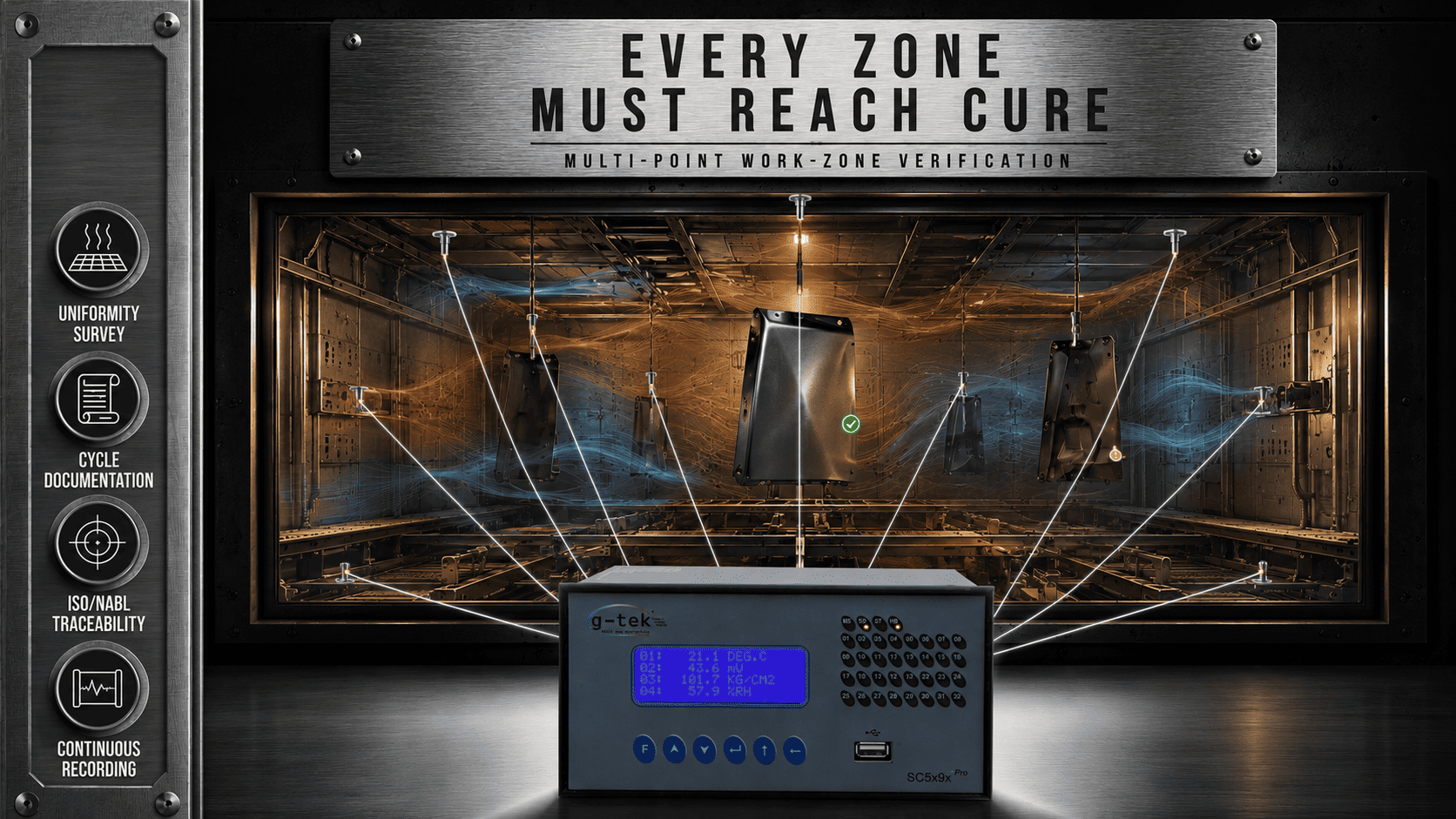
Proving a uniform cure typically requires multiple temperature sensors placed through representative areas of the work zone, such as corners, center, door zone, and different load heights.
These points are recorded continuously through the cycle so the actual temperature spread can be reviewed and documented.
The principle reflects the approach used in a temperature uniformity survey (TUS): use enough measurement points to understand the temperature distribution across the work zone, record them through the relevant cycle, and maintain evidence of what actually occurred.
Temperature uniformity principles are also important in regulated or specification-driven heat-processing environments, including those referencing standards such as AMS 2750 and CQI-9, where applicable.
Accurate and traceable sensing is an important part of this process. Proper calibration helps ensure each monitoring channel provides reliable measurement data.
Where a Set Point Ends, G-Tek’s Scanner Begins
G-Tek’s Universal Scanner supports cure-uniformity monitoring by reading multiple thermocouples placed throughout the oven work zone and recording those channels continuously through gtekNet.
Making monitoring and recording instruments in Vadodara since 1990, G-Tek Corporation builds the SC5x/SC9x Universal Scanner for multi-channel temperature monitoring across areas such as the corners, center, door zone, and different load heights.
The recorded data can then be reviewed through gtekNet to provide a documented profile of the temperature conditions across the cycle.
Every measurement channel can also be supported by calibration traceability through G-Tek’s own NABL ISO/IEC 17025-accredited calibration laboratory.
For oven OEMs, this adds another layer of evidence beyond the control set point. Instead of showing only what happened at one sensor, multi-point recording helps demonstrate what happened across the work zone.
You’ll find G-Tek’s wider sensing and recording range across its data logger solutions as well.
The uniformity approach described above follows established SAE AMS 2750 pyrometry principles where those requirements are applicable.
Ship an Oven That Proves the Cure, Not Just the Set Point
If your ovens are specced by manufacturers whose product quality depends on a uniform cure, the temperature record can provide valuable evidence of what happened throughout the load.
A curing oven that can document multiple zones gives manufacturers more confidence that the required cure conditions were achieved beyond the controller location alone.
👉 Tell the G-Tek team your oven’s work-zone size and the cure profile you run, and get a clear recommendation on building multi-point uniformity recording in before your next build.
Frequently Asked Questions
Why can a curing oven hit its set point but still under-cure parts?
The control sensor reads one location. Airflow, loading, door proximity, and heating-element placement can create temperature differences elsewhere in the work zone, so some parts may not experience the same cure conditions.
How do you prove a curing oven's temperature is uniform?
Place temperature sensors or thermocouples at representative points throughout the work zone and record them continuously through the cycle. Reviewing the temperature spread helps show whether the complete load experienced the required conditions.
What is a temperature uniformity survey for a curing oven?
A temperature uniformity survey measures and records temperature at multiple points throughout an oven’s work zone to identify hot and cold areas and evaluate whether the required temperature distribution is being maintained.
Which G-Tek product records oven cure uniformity?
The SC5x/SC9x Universal Scanner can read multiple thermocouples across the work zone and record them through gtekNet, helping create a continuous and traceable temperature record.
Where is G-Tek Corporation located?
G-Tek is based in Vadodara, Gujarat, and has been manufacturing monitoring and recording instruments since 1990. It also operates an in-house NABL ISO/IEC 17025-accredited calibration laboratory.
Related Posts