Your temperature data is flawless. Every reading is in range, and every chamber has remained…
Ultra-Low Temperature Data Logger: Why a “Freezer-Rated” Logger May Still Fail at −80°C
Ask yourself one thing before your next ultra-low purchase: is the logger you’re about to buy actually rated for −80°C, or just for “cold”?
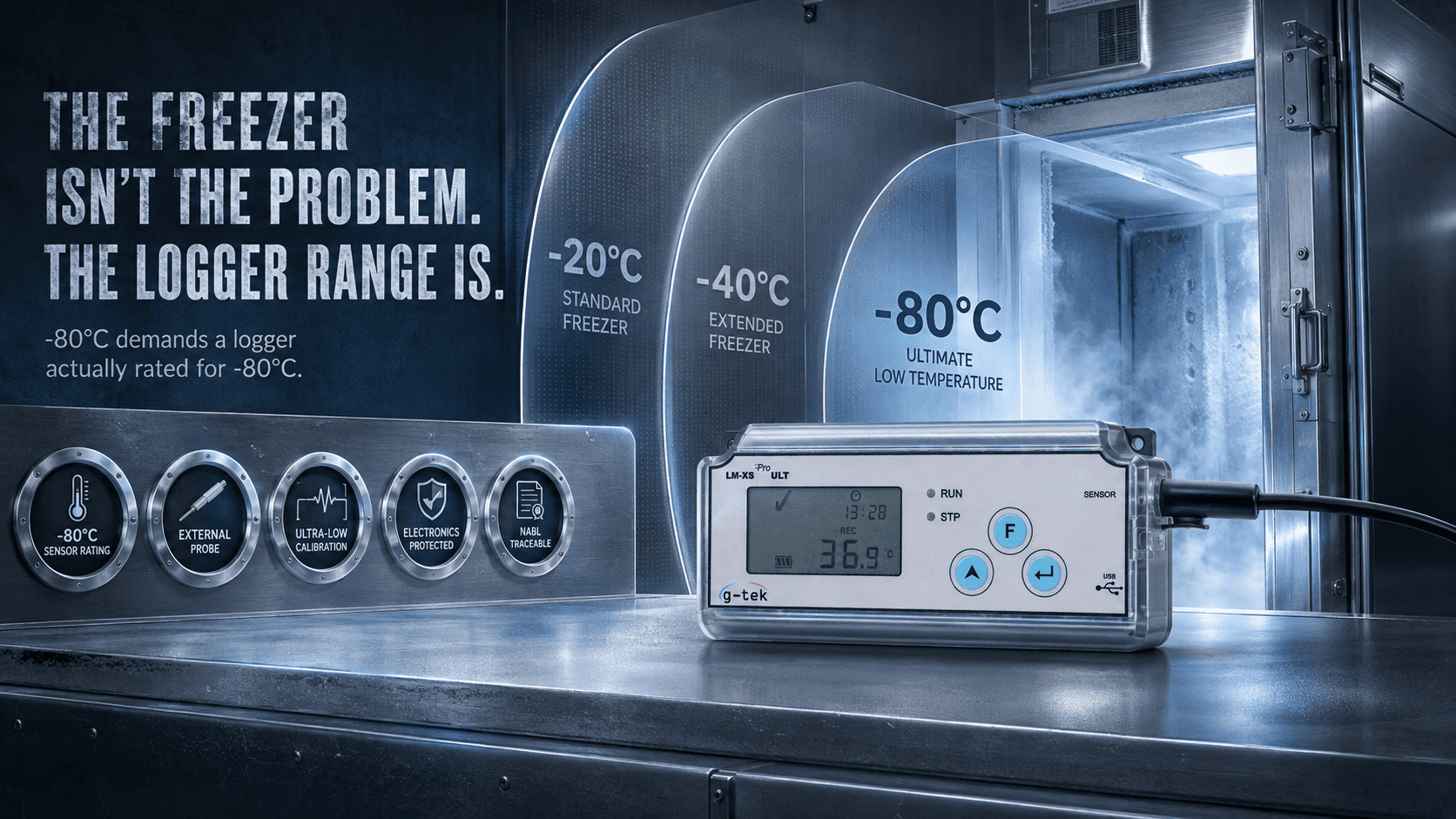
It’s a bigger gap than it sounds. Plenty of “freezer” loggers top out around −20°C or −40°C. Drop them to −80°C and accuracy can drift, batteries may weaken, and readings can scatter.
The freezer keeps performing. The logger quietly stops telling the truth and it does it right where your samples are least replaceable.
The right ultra-low temperature data logger isn’t defined by the word “freezer” on the box. It’s defined by an external sensor rated for the −80°C range and a calibration scope that actually covers it.
🎯 Key Takeaways
- “Freezer-rated” often means −20°C to −40°C, not the −80°C at which a ULT freezer may operate.
- Ambient and standard-freezer loggers can lose accuracy or fail at ultra-low temperatures.
- The right ULT logger uses an external sensor rated for the −80°C range.
- Calibration scope should cover the ultra-low band, not simply a generic wide range.
- Getting it right protects the monitoring record for your least replaceable samples.
Why “Freezer-Rated” Doesn’t Always Mean −80°C
A logger labelled “freezer-rated” may only be rated to around −20°C or −40°C. That means it cannot automatically be trusted at the −80°C range used by an ultra-low freezer.
The term “freezer” covers an enormous range.
A domestic or standard freezer may operate near −20°C, while a ULT unit may run around −80°C, with some reaching −86°C. A logger built for the former was never necessarily designed for the latter.
So the number that matters is the actual rated minimum, not the label.
This is the same discipline any buyer should apply when comparing data loggers across a product range read the specification, not just the product description.
“But It Still Shows a Number at −80°C” That’s the Trap
A logger showing a reading at −80°C isn’t the same as an ultra-low temperature data logger measuring accurately within its specified range.
An ambient or standard-freezer logger may still display numbers outside its rated limits, but readings can drift, lag, or become unreliable.
A displayed value is not automatically a validated value.
Outside its rated range, sensor accuracy and battery behaviour may change. You’re left with a record that looks fine but may not stand up to scrutiny.
Under regulated or controlled storage environments, including biobanking applications, the reliability of the monitoring record is closely tied to sample integrity. The best practices for biobanking storage also emphasize appropriate monitoring of stored biological materials.
Match the Sensor and Calibration to the Actual Temperature
Choose a logger with an external sensor rated for the −80°C range and a calibration scope that covers the temperatures you actually monitor.
This allows the probe to measure the ultra-low environment while the logger electronics remain protected outside the extreme cold. The calibration certificate then provides traceable evidence of measurement performance within the required range.
This is the problem the LM-XS Pro ULT was designed to address.
G-Tek Corporation, manufacturing monitoring instruments in Vadodara for over 30 years, designed the LM-XS Pro ULT with an external sensor for ultra-low temperature applications.
The sensor is calibrated across the required ultra-low band through G-Tek’s own NABL ISO/IEC 17025-accredited laboratory, while recording through LmView provides a traceable electronic monitoring record.
The point isn’t simply that it displays −80°C. It’s that the measurement setup is designed to prove performance at ultra-low temperature.
You can review the scope of G-Tek’s calibration accreditation when evaluating the monitoring setup.
Before You Buy an Ultra-Low Temperature Data Logger Verify These
- Actual rated minimum – confirm that the sensor covers −80°C or −86°C if required, rather than relying on the word “freezer.”
- External sensor – use a probe designed for ultra-low temperatures while keeping the logger body protected.
- Calibration scope – make sure the certificate covers your actual ultra-low range and includes stated measurement uncertainty.
- Battery behaviour – confirm the monitoring setup is suitable for the required operating duration and environment.
- Traceability – look for calibration traceable through an appropriately accredited laboratory.
Buy a Logger for the Temperature You Actually Run
An ultra-low freezer deserves an ultra-low temperature data logger built for the range you actually use not one that merely continues operating while measurement accuracy becomes uncertain.
Checking the rated range, external sensor, battery requirements, and calibration scope before you buy helps protect both the monitoring record and the samples inside.For dedicated cold-chain needs, the same logic applies right down to the vaccine and ULT series.
👉 Sourcing a logger for −80°C storage? Tell the G-Tek team your freezer’s temperature and what you’re storing and get a clear recommendation on a logger built to prove ultra-low, not just reach it.
Frequently Asked Questions
Does "freezer-rated" mean a logger works at −80°C?
Not necessarily. “Freezer-rated” may refer to ranges such as −20°C or −40°C, which are well above −80°C. Always check the actual rated minimum.
Why can't I use a standard logger in a −80°C freezer?
If a logger is used beyond its rated range, sensor accuracy and battery performance may be affected. It may continue displaying values without providing a reliable measurement record.
What should an ultra-low temperature data logger have?
It should have an external sensor rated for the required ultra-low range, protected electronics, calibration covering the actual operating range, and a suitable monitoring and power setup.
Which G-Tek logger suits −80°C storage?
The LM-XS Pro ULT uses an external sensor for ultra-low temperature applications and can be supported with calibration through G-Tek’s NABL-accredited laboratory, with data recorded through LmView.
Where is G-Tek located?
G-Tek Corporation is based in Vadodara, Gujarat, and has been manufacturing monitoring instruments for over 30 years, with an in-house NABL ISO/IEC 17025-accredited calibration laboratory and pan-India support.
Related Posts