Your temperature data is flawless. Every reading is in range, and every chamber has remained…
One Logger, Every Sensor: The Universal Input That Ends the Drawer Full of Data Loggers in 2026
A plant engineer pulls open a drawer. Inside sits the history of a decade of monitoring: one logger for an RTD on a chiller, another for a thermocouple on an oven, a third for a 4–20 mA process signal, plus two more for extreme-temperature points.
Five devices. Five chargers. Five calibration dates. All to cover measurements that one flexible universal input data logger could have handled.
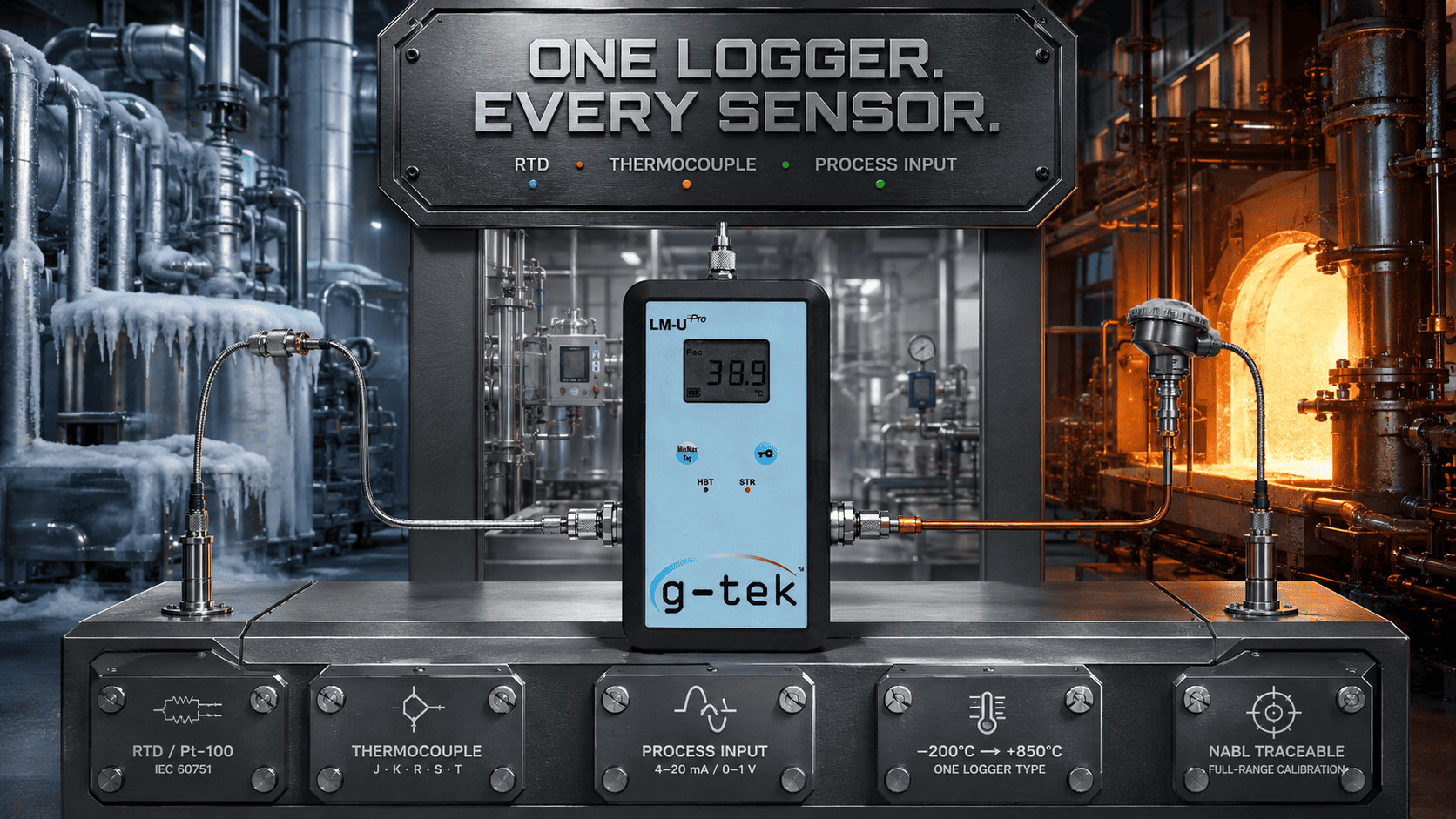
A plant doesn’t always need a different data logger for every sensor and every range. A universal-input logger reads RTDs, thermocouples, and process signals across a span from deep cryogenic to high-process temperatures. This means one device type can cover measurement points that once needed several.
🎯 Key Takeaways
- Different measurement points use different sensors – RTD, thermocouple, or process signals.
- Stocking a separate logger for each input type and range can become difficult to manage.
- A universal-input logger reads all three input families in one device.
- The LM-U Pro spans −200°C to +850°C, from cryogenic storage through high-temperature processes.
- One flexible logger type simplifies stock, spares, calibration, and training.
You know the feeling. Every time a new point comes online, someone asks, which logger fits this one? And the answer is always another purchase, another spare, and another entry on the calibration schedule.
The mess isn’t in any single device. It’s in the five different device types you’re forced to manage at once.
What Is a Universal Input Data Logger?
A universal input data logger accepts multiple sensor types RTDs, thermocouples, and process signals such as 4–20 mA in a single device. This allows it to measure points that might otherwise each require a different dedicated logger.
Most loggers are locked to one input type and a relatively narrow range.
A universal-input logger can instead be configured for whatever a given point uses: an RTD Pt-100 (IEC 60751) on the chiller, a thermocouple (IEC 60584) on the oven, or a process signal on the line.
One device family, many applications.
If you want to see how the range fits across an actual product line, G-Tek’s data logger range shows where a universal unit can be used.
Why Does One Logger Covering Multiple Sensors Matter?
It matters because standardizing on one flexible logger simplifies everything downstream fewer device types to stock, fewer spares, a more consistent calibration process, and less training while still covering different measurement points across the plant.
A drawer of mixed loggers means mixed spares, different software requirements, and separate calibration schedules.
One universal device type helps reduce that complexity.
It also future-proofs the setup: a new point with a different sensor may no longer require a completely different logger.
For facilities that also perform checks across multiple points, a universal scanner extends the same flexible-input approach to multi-channel monitoring.
The Universal Input Data Logger Built to Empty That Drawer
Manufacturing monitoring instruments in Vadodara for over 30 years, G-Tek Corporation built the LM-U Pro as a universal-input logger.
A single unit accepts RTD Pt-100, thermocouple types J, K, R, S, T, and process signals (4–20 mA, 0–1 V).
Depending on the sensor and configuration, it covers a span from −200°C at the cryogenic end to +850°C at the high-process end. This allows the same device type to be used for applications ranging from a chiller or cryogenic point to an oven or process line.
It records into LmView for a downloadable, traceable record and supports USB transfer and TAG spot-reading at the point.
Every unit is calibrated through G-Tek’s own NABL ISO/IEC 17025-accredited laboratory, supporting the kind of traceable calibration required for controlled measurement applications.
Where electronic records fall under requirements such as 21 CFR Part 11, the monitoring setup can also support appropriate electronic record management.
The sensor and process standards behind these measurement technologies are published by the IEC.
Frequently Asked Questions
What is a universal input data logger?
A universal input data logger accepts multiple sensor types, including RTDs, thermocouples, and process signals such as 4–20 mA, within one configurable device.
What sensors and range does the LM-U Pro support?
It accepts RTD Pt-100, thermocouple types J, K, R, S, T, and process signals including 4–20 mA and 0–1 V. Depending on the sensor used, its temperature range extends from −200°C to +850°C.
Why use one universal logger instead of several dedicated ones?
Standardizing on one flexible logger reduces the number of device types you need to stock and can simplify spares, calibration schedules, and operator training.
Can it handle both very low and very high temperatures?
Yes. The LM-U Pro supports applications across a wide range, from approximately −200°C to +850°C, depending on the sensor and configuration used.
Related Posts