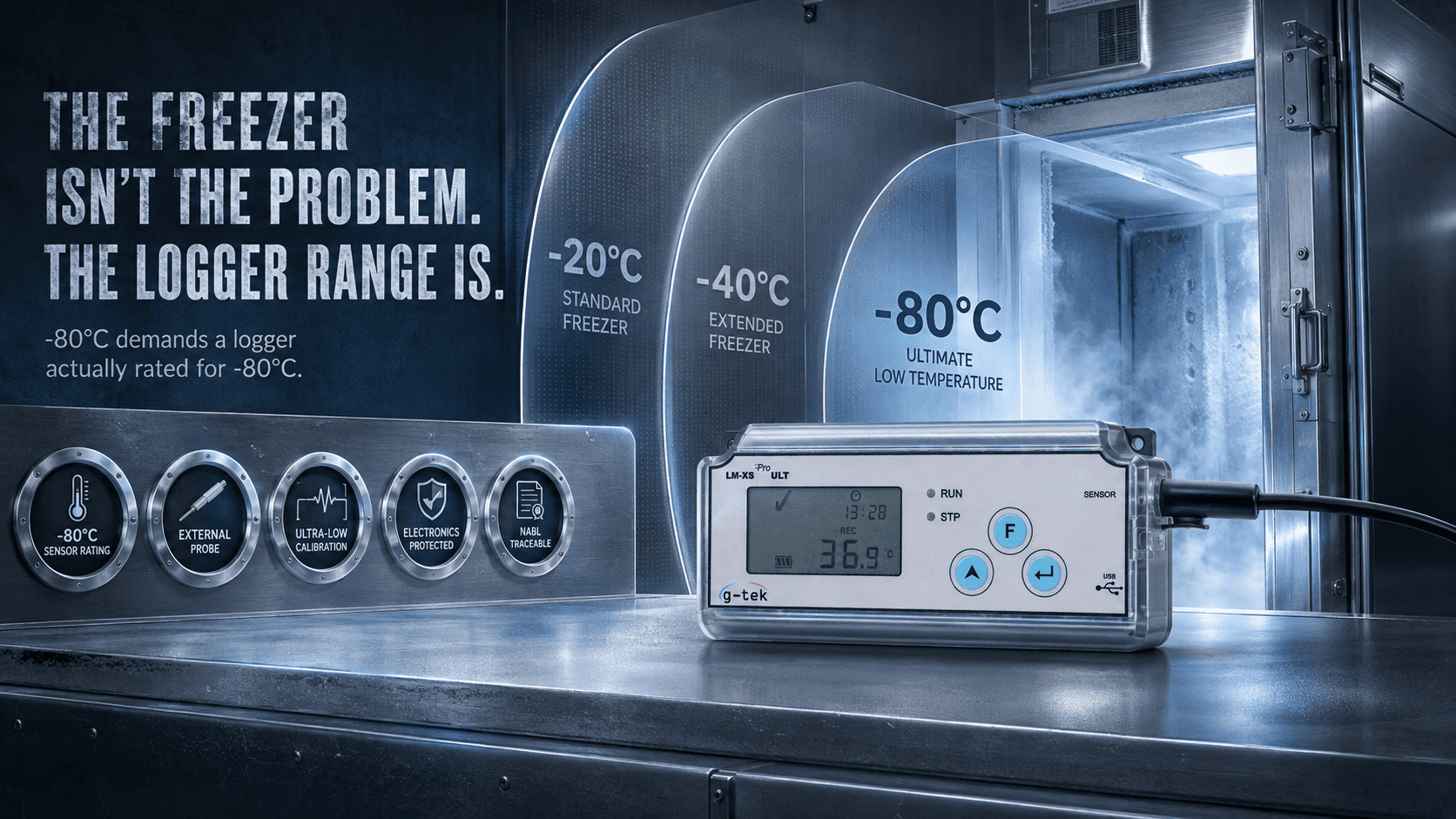
Ask yourself one thing before your next ultra-low purchase: is the logger you're about to…
Thermocouple or RTD? The Sensor Choice That Quietly Decides Your Accuracy in 2026
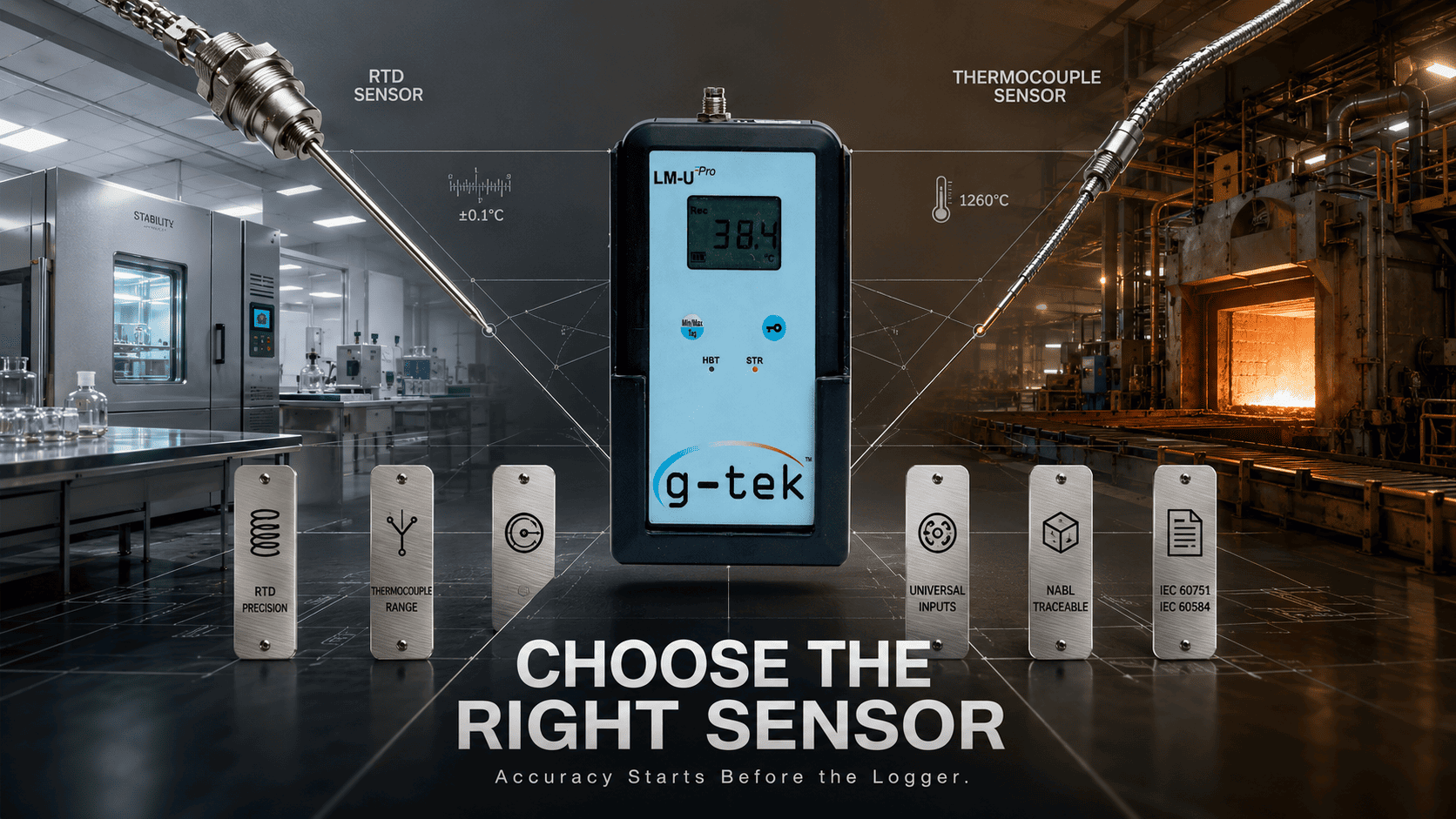
Two facilities measure what they believe is the same temperature. One uses a thermocouple. One uses an RTD. Their readings don’t match, and the gap isn’t necessarily the recorder. It’s the sensor nobody stopped to question. It was simply whatever the last device happened to use.
That quiet default sets a limit you can’t undo downstream.
In 2026, the accuracy of a temperature measurement is often decided before the logger is even chosen, by the sensor. The thermocouple vs RTD decision matters because both measure temperature differently: one offers wider range and ruggedness, while the other is preferred for precision and stability. Pick the wrong one, and you can limit measurement performance no matter how good the recorder is.
🎯 Key Takeaways
- The sensor type helps set the accuracy ceiling, because the recorder cannot improve the measurement beyond what the sensor provides
- RTD (Pt-100): known for higher accuracy and stability across moderate temperature ranges
- Thermocouple: offers a wider temperature range and ruggedness, with some types operating well beyond 1000°C
- Choose an RTD where precision and stability matter; choose a thermocouple for very high temperatures, rugged environments, or faster response
- A universal-input logger accepts both, allowing the sensor to match the application instead of forcing the application to match the device
Thermocouple vs RTD: What’s the Real Difference?
An RTD (Pt-100) generally offers higher accuracy and stability across moderate temperature ranges, while a thermocouple provides a much wider range and ruggedness, reaching far higher temperatures but usually with lower fine-measurement precision.
Here’s the plain version.
An RTD is a resistance sensor whose resistance changes predictably as temperature changes. That predictable relationship is why RTDs are widely used where precision and long-term stability matter. Standards such as IEC 60751 define characteristics and tolerance classes for industrial platinum resistance thermometers such as Pt-100 sensors.
The trade-off is that RTDs can be more delicate and, depending on their construction, may respond more slowly than thermocouples.
A thermocouple works differently. Two dissimilar metals generate a small voltage that varies with temperature. Standard thermocouple characteristics and tolerances are covered under IEC 60584.
Thermocouples are rugged, respond quickly, and can handle extreme heat. A Type K thermocouple can operate at temperatures around +1260°C depending on its construction and application, while Type R and Type S thermocouples can be used at even higher temperatures.
Thermocouples also require cold-junction compensation and generally do not provide the same fine accuracy as an RTD across moderate temperature ranges.
Same job. Two very different tools.
Which Sensor Should You Choose for Your Application?
Choose an RTD when you need high accuracy and stability at moderate temperatures, such as pharma storage, thermal mapping, and laboratory monitoring. Choose a thermocouple when you need very high-temperature capability, ruggedness, or fast response, such as furnaces, ovens, kilns, or high-heat processes.
Think in terms of the environment.
A 2–8°C cold room or stability chamber sits comfortably within the operating range where an RTD can provide the precision required for controlled monitoring.
A kiln, furnace, autoclave, or high-temperature industrial oven may be better suited to a thermocouple, where wider temperature range and durability become more important.
The thermocouple vs RTD choice should therefore be based on three main factors:
- Required temperature range
- Required measurement accuracy
- Actual process environment
The decision should come from the application, not habit.
Why a Universal-Input Logger Lets You Match the Sensor to the Job
A universal-input logger accepts both RTD and thermocouple inputs, allowing one instrument to support precise moderate-temperature monitoring as well as high-temperature process measurement.
This flexibility is why G-Tek Corporation developed the LM-U Pro as a universal-input logger.
Making monitoring instruments in Vadodara since 1990, G-Tek designed the LM-U Pro to accept Pt-100 RTDs, standard thermocouples including J, K, R, S, and T types, as well as process inputs such as 4–20 mA and 0–1 V.
You can explore the full LM-U Pro universal-input logger and see how it fits different measurement applications.
This allows the same instrument platform to support a precise cold-room measurement with an RTD and a high-temperature process with a thermocouple, depending on the selected sensor and configuration.
Every unit is supported by calibration through G-Tek’s own NABL ISO/IEC 17025-accredited laboratory, helping maintain measurement traceability regardless of the sensor selected. Recorded data can then be reviewed through LmView.
The sensor is chosen for the measurement, rather than being forced to fit the instrument.
For applications where measurement accuracy must hold up during quality reviews or audits, buyers should consider both sensor conformity with relevant IEC standards and calibration traceability.
IEC 60751 covers industrial platinum resistance thermometers, while IEC 60584 addresses thermocouples. More information on these standards is available through the International Electrotechnical Commission.
The same sensor-selection approach can be applied across the wider G-Tek data logger range.
Match the Sensor to the Measurement, Not the Other Way Around
If your readings differ at temperature extremes, or the accuracy isn’t what you expected, the sensor choice may be the quiet cause.
The thermocouple vs RTD decision determines important factors such as range, stability, response, and achievable measurement accuracy long before the logger itself becomes the limiting factor.
Choosing the right sensor for the required range and precision gives the rest of the measurement system a stronger foundation.
👉 Tell the G-Tek team your temperature range and accuracy requirements, and get a clear recommendation on whether an RTD, thermocouple, or universal-input logger fits your measurement.
Frequently Asked Questions
What's the main difference between a thermocouple and an RTD?
An RTD generally provides higher accuracy and stability across moderate temperature ranges, while a thermocouple offers wider temperature range, ruggedness, and faster response for many high-temperature applications.
In thermocouple vs RTD, which is more accurate?
An RTD is generally more accurate and stable across moderate temperature ranges, making it suitable for applications such as pharma storage, laboratories, and thermal mapping. Thermocouples trade some fine precision for wider temperature range and ruggedness.
When should I use a thermocouple instead of an RTD?
Use a thermocouple for very high temperatures, such as furnaces, ovens, kilns, and other high-heat processes, or where ruggedness and fast response are important. RTDs are generally better suited to applications where accuracy and stability matter most.
Can one data logger use both thermocouples and RTDs?
Yes. A universal-input logger such as the G-Tek LM-U Pro can accept Pt-100 RTDs, multiple thermocouple types, and process inputs, allowing one instrument to support different measurement requirements.
Where is G-Tek Corporation located?
G-Tek is based in Vadodara, Gujarat, and has been manufacturing monitoring and recording instruments since 1990. It also operates an in-house NABL ISO/IEC 17025-accredited calibration laboratory.
Related Posts