By Asutosh Shah & Alpesh Shah · Founders, G-Tek Corporation · 30+ years in temperature…
Data Logger Battery Life: Why “1 Year” Doesn’t Mean a Year for Everyone
By Asutosh Shah & Alpesh Shah · Founders, G-Tek Corporation · 30+ years in temperature monitoring, recording, and calibration instrumentation.
When a datasheet says “battery life: over 1 year,” what exactly is it promising you?
Not a year in any condition, at any setting.
Data logger battery life is measured at a specific logging interval and temperature, usually around 25°C.
Recording more frequently or operating in cold conditions can shorten real runtime. Therefore, the quoted figure is a benchmark under defined conditions, not a guarantee for every application.
Most buyers never read the small print under the headline number until a logger dies two months into a freezer study.
Key Takeaways
A stated battery life applies only at a specific logging interval and temperature.
A shorter interval means more readings, more power drawn, and less runtime.
Cold slows battery chemistry, so freezer use shortens runtime.
Wireless, display and alarm functions draw power a basic logger does not.
Compare figures at the same interval and temperature, or you are comparing nothing.
A Battery Figure Without Its Conditions Is Meaningless
Every stated battery life carries two conditions: the logging interval and the temperature at which it was measured.
Without both, the number cannot be compared between loggers or applied to your own use.
Take LM Transit. It is specified at over one year at 25°C with a 15-minute store interval.
Both halves of that sentence matter as much as the year does. Quote the year alone, and you have marketing, not specification.
That is why battery life belongs on the same checklist as accuracy, memory depth and calibration status when shortlisting a logger.
What Actually Drains Data Logger Battery Life Faster?
Drain rises with a shorter logging interval, a lower operating temperature, and any active feature.
Wireless, a display, and an alarm each draw power that a basic internal-sensor logger never uses.
Logging Interval
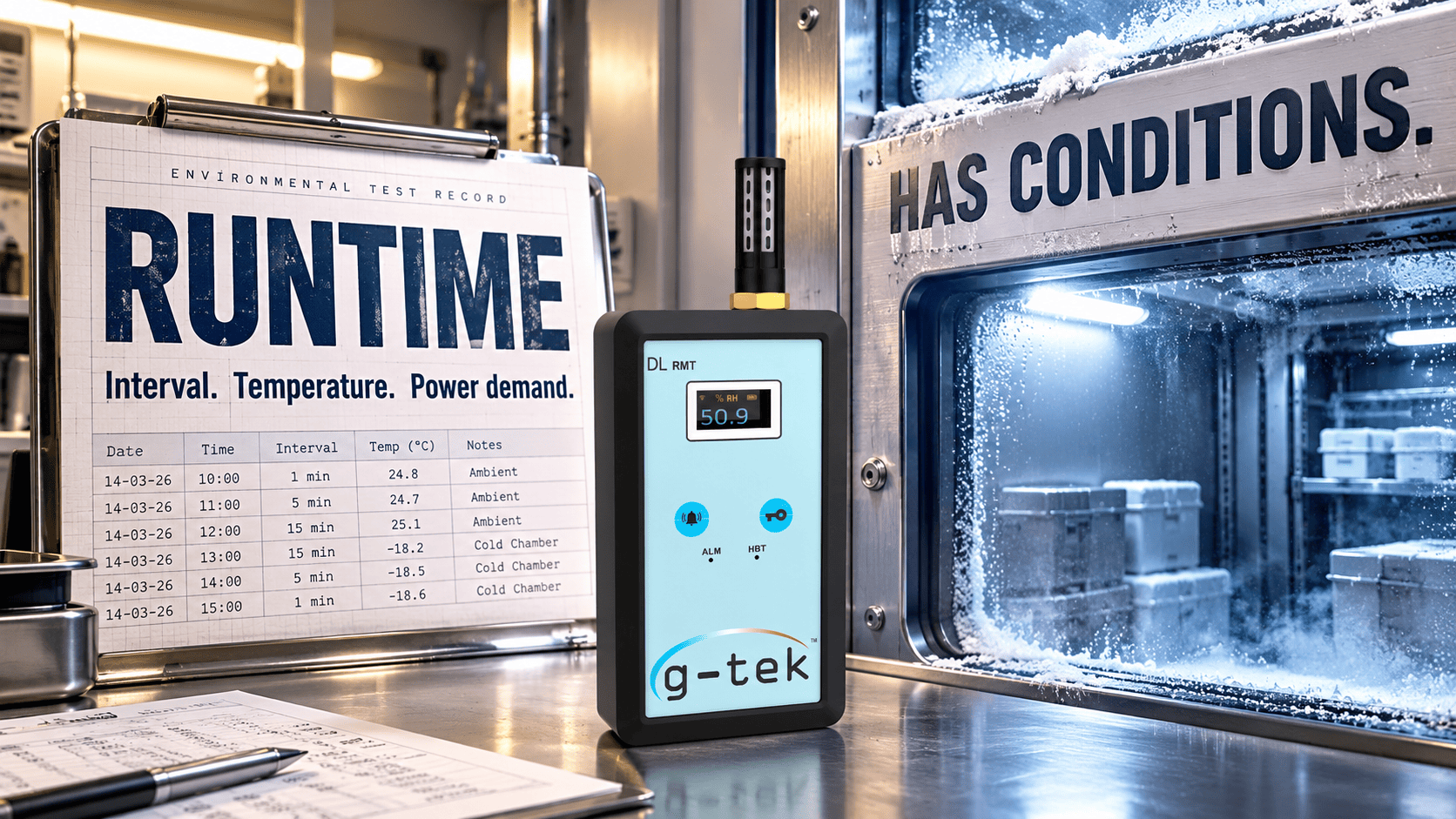
Recording every minute instead of every fifteen multiplies measurement and write cycles over the same period.
Across the G-Tek data logger range, interval moves runtime most.
Temperature
Battery chemistry slows in the cold, reducing available capacity.
A freezer or ultra-low application is harder on a cell than an ambient room. This is one of several reasons cold storage needs its own handling.
Wireless
Transmitting over Wi-Fi or cellular draws far more power than writing to local memory.
Connected loggers are designed around that trade-off, not around a weaker cell.
Display and Alarms
An illuminated screen or a buzzer consumes power every time it activates.
These features also affect data logger battery life, depending on how frequently they are used.
Specifying battery life honestly is something G-Tek Corporation has had to get right across more than 30 years in Vadodara. This is because its loggers run in very different conditions.
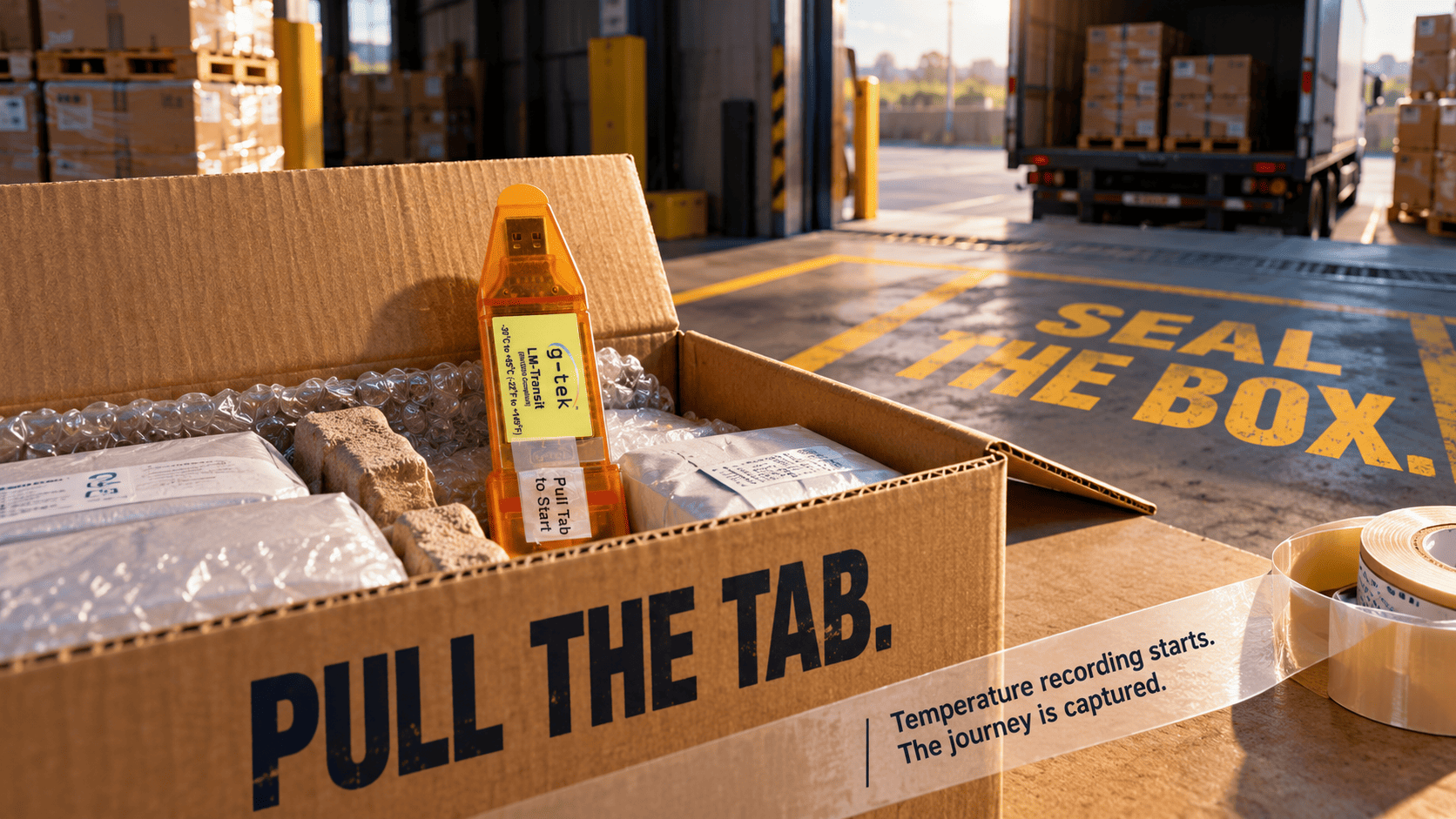
LM Transit, a single-use shipment logger, is specified at over one year at 25°C with a 15-minute store interval. These conditions are stated alongside the figure.
The DL-RMT, transmitting continuously to a cloud dashboard, carries a 14-day battery. This is because constant connectivity draws far more power than local storage.
Different jobs, different honest numbers.
Every unit is calibrated in G-Tek’s own NABL ISO/IEC 17025-accredited laboratory.
Match the Battery to Your Interval and Your Environment, Before the Study Starts
Work out your required runtime from your actual interval and environment. Then confirm the logger covers it with margin.
A battery that fails mid-study takes the end of the record with it.
Start from the study, not the datasheet.
Fix the interval first. Continuous monitoring expectations under WHO good distribution practice guidance, and transport durations under EN 12830, help decide how often you must record.
Then apply your environment: ambient room, 2–8°C chamber or deep freezer.
Read the stated figure against both, and leave margin. A qualification run that overruns by a week should not erase the tail of the data.
Interval and placement belong in the same setup step.
Plan the Runtime Before the Study, Not After
A battery that stops in week six of an eight-week study does not just stop recording. It removes the part of the record you most needed.
Understanding data logger battery life helps you plan recording intervals and operating conditions before the study begins.
Planning a long study or a long route? Give the G-Tek team your logging interval and operating temperature and get a straight answer on realistic runtime for your conditions.
Frequently Asked Questions
What Does a Data Logger’s Stated Battery Life Mean?
Runtime measured under set conditions: a stated logging interval and temperature, usually 25°C.
Change either, and the real figure changes
Does a Shorter Logging Interval Drain the Battery Faster?
Yes. Recording every minute instead of every fifteen means far more measurement and write cycles, so runtime drops considerably.
Why Do Batteries Last Less in a Freezer?
Battery chemistry slows at low temperature, reducing available capacity.
Therefore, freezer and ultra-low use runs shorter than the room-temperature specification.
Why Do Wireless Loggers Have Shorter Battery Life?
Transmitting over Wi-Fi or cellular draws far more power than local storage.
The continuously connected DL-RMT carries a 14-day battery for that reason.
Where Is G-Tek Corporation Located?
Vadodara, Gujarat — manufacturing monitoring instruments for over 30 years, with an in-house NABL ISO/IEC 17025-accredited calibration laboratory and pan-India support.
Related Posts