By Asutosh Shah & Alpesh Shah · Founders, G-Tek Corporation · 30+ years in temperature…
Photostability Chamber Temperature Monitoring: The Heat the Lamps Create
By Asutosh Shah & Alpesh Shah · Founders, G-Tek Corporation · 30+ years in temperature monitoring, recording, and calibration instrumentation.
“I don’t need a logging study. I just need the reading, now.”
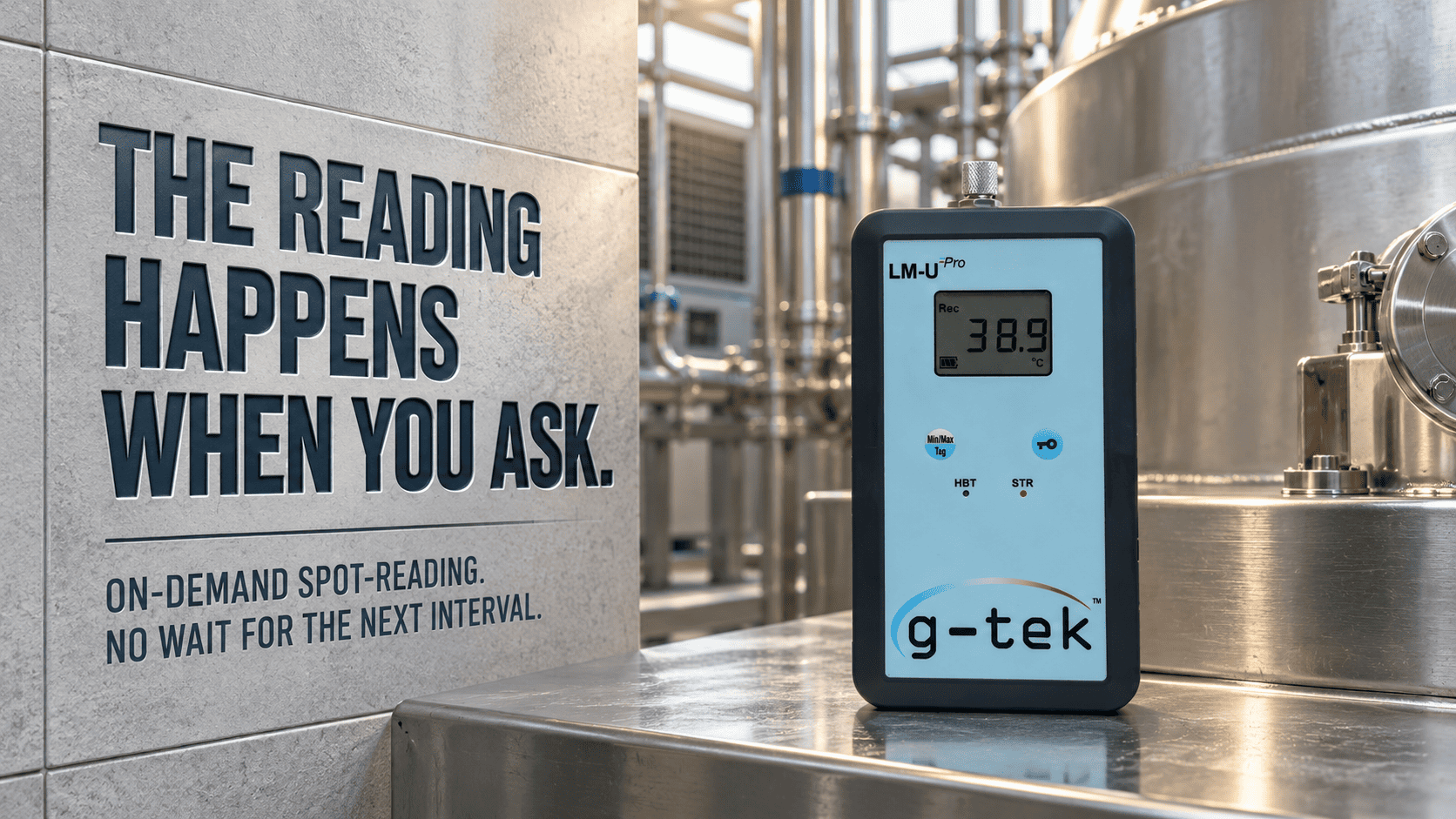
A spot-reading feature lets a handheld temperature logger capture the current measurement on demand without waiting for the next scheduled automatic recording.
As a result, a technician can take a reading at a point immediately, record it, and move on to the next.
It’s a fair objection, and most loggers handle it badly.
They’re built around a schedule: set an interval, start the run, wait, and download afterwards.
Exactly right for a mapping study. Exactly wrong for a technician walking a plant with a list of points to check.
Key Takeaways
- Most loggers record on a schedule, which suits a study but not a spot check.
- Spot-reading captures the current value on demand, with no waiting.
- A universal-input handheld accepts whatever sensor the point already uses.
- One device covers RTD, thermocouple and process-signal inputs across a wide span.
- Fewer instruments to carry means fewer reasons a check doesn’t get done.
What Does Spot-Reading Actually Do Differently?
Spot-reading captures the current condition on demand rather than on a timer.
The technician triggers the reading while standing at the point instead of waiting for the device’s next scheduled automatic recording.
The way our team explains it to customers who haven’t used it: it’s like taking a quick snapshot of the current conditions right now, without waiting for the next scheduled automatic recording.
That difference matters more than it sounds.
If the interval is fifteen minutes and you arrive at minute three, you either wait twelve minutes or you take nothing.
Across eight points, that’s the morning gone.
And the reading still counts where it matters. In fact, spot verification during field audits is frequently what supports periodic requalification under EU GMP Annex 15.
A Handheld Is Only Useful if It Accepts the Sensor Already at the Point
The practical limit on a handheld is its input.
A device that reads only RTD is dead weight at a thermocouple point. Therefore, a universal input is what lets one instrument cover a full round.
Different points use different sensors.
An oven on a thermocouple (IEC 60584), a chiller on an RTD Pt-100 (IEC 60751), and a process line on a 4-20 mA signal.
If you’re still mapping which sensor belongs where, our breakdown on thermocouple vs RTD selection covers it.
Picture a maintenance round of six points in one morning: two thermocouples on heat-treatment equipment, three RTDs on cold storage, and one 4-20 mA transmitter.
With a universal input data logger, that’s one instrument and one round.
Carry One Instrument, Not a Bag of Them
Specify a handheld by whether it covers every sensor type on your round.
This is because a check that requires fetching a second instrument is a check that often doesn’t happen.
This is the working pattern G-Tek Corporation built the LM-U Pro around, drawing on more than 30 years in Vadodara.
It accepts RTD Pt-100, thermocouple types J, K, R, S and T, and process inputs of 4-20 mA and 0-1 V, across −200°C to +850°C.
It runs on an AA battery, so it isn’t tied to a power point.
Additionally, its TAG spot-reading function returns an immediate reading instead of an interval.
Recorded data downloads over USB into LmView.
Every unit leaves our NABL ISO/IEC 17025-accredited calibration laboratory with traceable documentation alongside the wider G-Tek data logger range.
A handheld temperature logger with universal inputs therefore supports spot checks across different measurement points without requiring a separate instrument for each sensor type.
Frequently Asked Questions
What Is Spot-Reading on a Data Logger?
It captures the current measurement the moment the user triggers it, rather than waiting for the device’s next scheduled automatic recording.
How Is This Different From a Logging Run?
A logging run records on a set interval for a study and is downloaded afterwards.
Spot-reading gives the value immediately at the point.
What Sensors Does the LM-U Pro Accept?
RTD Pt-100, thermocouple types J, K, R, S and T, and process signals of 4-20 mA and 0-1 V, covering −200°C to +850°C.
Does It Need a Power Connection?
No. It runs on an AA battery, so it can be carried on a round and used at any measurement point.
Where Is G-Tek Located?
Vadodara, Gujarat — manufacturing temperature monitoring and recording instruments for over 30 years, with an in-house NABL ISO/IEC 17025-accredited calibration laboratory.
One Instrument for the Whole Round
A round that needs three instruments is a round that gets shortened.
A handheld that accepts every sensor on the list and returns the reading the moment you ask for it is a round that gets completed.
Choosing the right handheld temperature logger helps technicians complete spot checks across different sensor types without waiting for scheduled logging intervals.
Walking a round with mixed sensors? List your measurement points and sensor types for the G-Tek team and get a clear recommendation on covering them with one handheld.
Related Reading
Related Posts