By Asutosh Shah & Alpesh Shah · Founders, G-Tek Corporation 30+ years in temperature monitoring,…
Photostability Chamber Temperature Monitoring: The Heat the Lamps Create
By Asutosh Shah & Alpesh Shah · Founders, G-Tek Corporation · 30+ years in temperature monitoring, recording, and calibration instrumentation.
The lamp that tests the product also heats it.
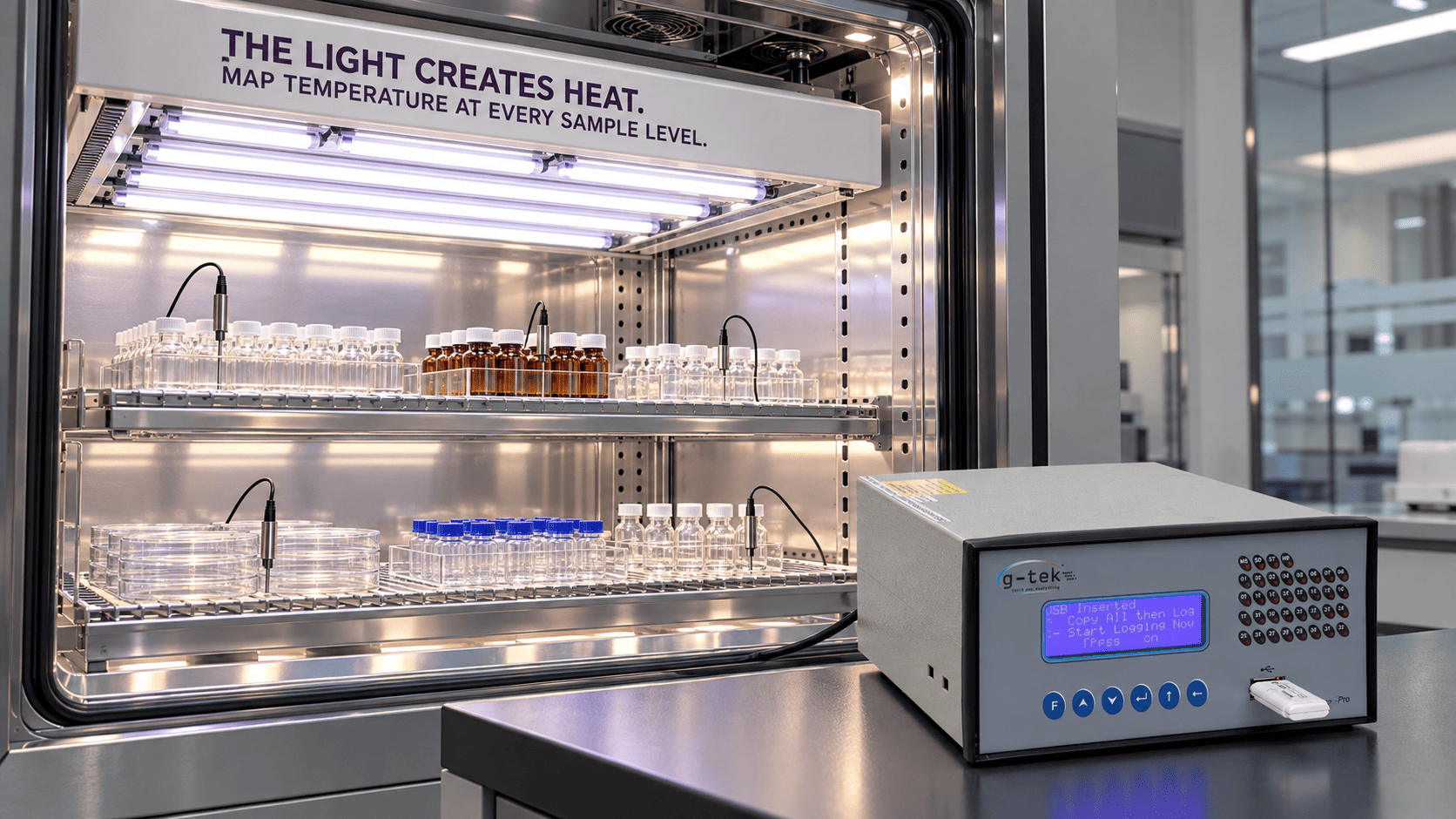
Photostability chamber temperature monitoring requires recording at multiple points across the sample area. This is because the light sources required to reach ICH Q1B dose targets also generate heat.
As a result, samples nearest the lamps can run warmer than the chamber’s control sensor indicates.
Key Takeaways
- ICH Q1B requires at least 1.2 million lux-hours visible and 200 W·h/m² near-UV exposure.
- Reaching those doses takes many hours of continuous lamp operation.
- Those lamps are also a heat source inside the chamber.
- Samples nearest the light can sit warmer than the control sensor reads.
- Multi-point temperature recording is what separates photodegradation from thermal degradation.
In a Photostability Chamber, the Light Source Is Also a Heat Source
The lamps delivering ICH Q1B’s required light dose run for many hours continuously.
This sustained illumination warms the chamber unevenly, placing the greatest thermal load on exactly the samples positioned closest to the light.
Visible and near-UV output is radiant energy. Sustained across the hours needed to reach the dose targets, that energy raises local temperature inside a closed space.
It is why photostability chambers control chamber air temperature at all.
It also explains why holding temperature uniformity across the sample area is harder here than in a probe-based stability chamber setup running without lamps.
Why Does This Matter for the Test Result Itself?
Because a photostability study is meant to isolate the effect of light.
If some samples also experienced a higher temperature, any change observed in them could be thermal rather than photochemical. Consequently, the result becomes difficult to defend.
The study design depends on light being the single variable under test.
A thermal gradient across the sample area quietly introduces a second one.
Documented uniformity across sample positions is what shows the study tested what it claims to have tested.
ICH Q1B’s provision for dark controls exists as a related safeguard.
Consider a 16-hour run to reach the visible-light target, with samples on two shelf levels.
The upper shelf sits directly beneath the lamp bank, while the lower shelf is a foot further away.
The chamber probe sits on the side wall. It reads steady throughout.
However, nothing in that record shows what the upper shelf actually experienced.
This is the same gap thermal mapping in pharma storage is designed to close.
Recording temperature accurately at many points at once is what G-Tek Corporation’s instruments are built for, drawing on more than 30 years in Vadodara.
The SC5x/SC9x Universal Scanner reads temperature from sensors placed across a chamber’s sample area, including the shelves closest to the lamps.
It logs continuously on gtekNet™ through the full illuminated run into a traceable, 21 CFR Part 11 report.
With 8 to 32 channels, the whole sample area is mapped in one run. Every channel is traceable to G-Tek’s own NABL ISO/IEC 17025-accredited calibration laboratory.
The light dose itself is measured separately with calibrated radiometers and lux meters, as ICH Q1B requires.
Build Mapping Access Into the Chamber, Not Around It
Design the chamber so temperature can be recorded at multiple sample positions during an actual illuminated run.
This includes the positions closest to the lamps, so uniformity is documented under real operating conditions, not with the lights off.
Sensor entry ports, shelf-level cable routing and channel capacity should be decided at the design stage.
These decisions save your pharma client a qualification argument later under EU GMP Annex 15.
A consolidated mapping report across multiple points is what an auditor opens first.
Therefore, photostability chamber temperature monitoring should account for the heat generated during actual lamp operation.
Document the Heat the Test Creates
A photostability study is only as defensible as its ability to show light was the variable.
Recording temperature across the sample area while the lamps run is what demonstrates that.
Effective photostability chamber temperature monitoring helps document temperature differences across sample positions during the illuminated test.
Building a photostability chamber? Walk the G-Tek team through your lamp layout and shelf positions. Get a clear recommendation on multi-point temperature recording designed in from the start.
Frequently Asked Questions
What Does ICH Q1B Require for Photostability Testing?
Minimum exposure of 1.2 million lux-hours visible and 200 watt-hours per square metre near-UV, measured at the sample position.
Why Does Temperature Matter in a Photostability Chamber?
The lamps delivering the light dose also generate heat over long runs.
Samples nearest the light can run warmer, so temperature must be documented alongside exposure.
How Can Lamp Heat Affect the Test Result?
The study isolates light.
If some samples also ran warmer, an observed change could be thermal rather than photochemical. This makes the result harder to defend in an audit.
How Is Temperature Uniformity Documented?
By recording at multiple sample positions during an actual illuminated run, including shelves closest to the lamps.
This captures the real thermal spread.
Where Is G-Tek Located?
Vadodara, Gujarat — manufacturing temperature monitoring and recording instruments for over 30 years, with an in-house NABL ISO/IEC 17025-accredited calibration laboratory.
Related Posts