By Asutosh Shah & Alpesh Shah · Founders, G-Tek Corporation 30+ years in temperature monitoring,…
Wireless Temperature Monitoring Where Wi-Fi Doesn’t Reach: Choosing GSM
By Asutosh Shah & Alpesh Shah, Founders, G-Tek Corporation · 30+ years in temperature monitoring, recording and calibration instrumentation.
Walk into a pharma plant with your phone in hand and watch the bars.
Full strength at reception. Through the airlock, into the storage area, behind two more walls, barely holding.
That last spot is usually exactly where the monitoring device has to go.
Wireless temperature monitoring should be specified by the signal available at the device’s actual installation point, not at the building.
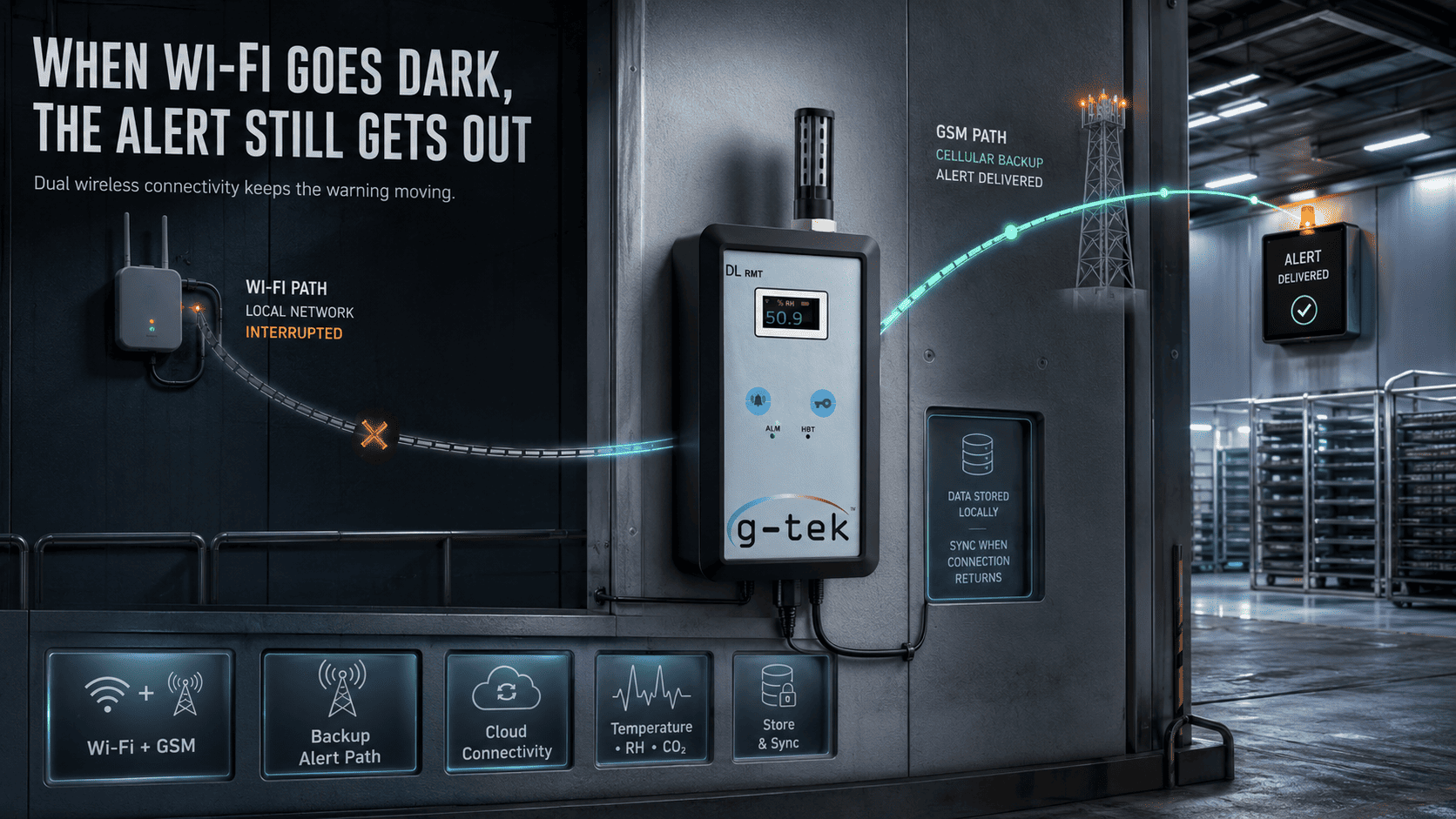
Where Wi-Fi reaches, a Wi-Fi device works. However, where walls and depth block it, a GSM device using the cellular network is the practical choice.
Key Takeaways
- Building coverage and coverage at the device differ.
- Walls, airlocks and depth weaken signal fast.
- No usable Wi-Fi there? GSM uses the cellular network.
- A dropped connection should not stop recording.
- Memory is finite; once full, oldest readings overwrite.
Why Does Wi-Fi Fail at the Exact Spot You Need It?
Wi-Fi weakens with distance and every barrier it crosses.
As a result, a plant with strong coverage at the entrance can have almost none deep inside. Walls, airlocks and insulated rooms often sit between the device and the access point.
Our team sees this constantly.
Picture a cold room two doors past an airlock, insulated panels all round, with the access point out in the corridor.
The survey says Wi-Fi is available. The device inside says otherwise.
This is the blind spot that catches cold chain monitoring projects.
The Decision Rule Is Simple: Availability at the Point of Installation
The choice comes down to one check: whether a usable Wi-Fi connection exists at the exact spot the device will sit.
If it does, Wi-Fi works. If it doesn’t, GSM over the cellular network is the alternative.
Test at that place, not the nearest corridor.
If Wi-Fi is usable there, specify the Wi-Fi version. If it is absent, specify GSM, which needs nothing from the site’s own Wi-Fi infrastructure.
This is the same rule that governs pharma multi-location monitoring.
Connectivity is fixed by order code, so it belongs in the specification.
G-Tek Corporation’s team answers this often, drawing on more than 30 years in Vadodara.
When a DL-RMT loses its connection, it keeps recording internally, storing around 3,500 readings. It then uploads the data once the link returns.
Every unit carries a certificate from G-Tek’s NABL ISO/IEC 17025-accredited laboratory.
Ask What Happens When the Connection Drops and for How Long
Check both halves of the outage question.
First, does the device keep recording when the network drops? Second, how many readings does its memory hold before the oldest are overwritten?
Most buyers ask the first half and stop. However, the second is where records are lost.
Beyond roughly 3,500 readings, the DL-RMT overwrites the earliest data. Therefore, a long outage erases the front of the trail an auditor asks for.
Keep a network backup at critical points. WHO GDP expects continuous storage monitoring, and 21 CFR Part 11 expects the record intact.
Before You Order Wireless Monitoring, Verify These
- Signal: Tested at the installation point, not the entrance.
- Connectivity: Wi-Fi or GSM, fixed by order code.
- Memory depth: Around 3,500 readings through an outage.
- Overwrite behaviour: What happens once memory fills?
- Network backup: Available at critical points.
- Calibration: A NABL-traceable calibration certificate.
The DL-RMT reads temperature, humidity and CO₂. It also offers a cloud dashboard, mobile app, SMS, email, buzzer and LED alerts, along with 14 days on battery.
Both builds sit in the wireless logger range, as does the food cold storage line.
Frequently Asked Questions
Why Does Wi-Fi Fail Inside a Plant That Has Wi-Fi?
Signal weakens with distance and every wall it crosses.
Therefore, coverage that is strong at the entrance can be absent deep inside.
When Should You Choose GSM Instead of Wi-Fi?
When no usable Wi-Fi exists at the installation spot.
GSM uses the cellular network, independent of the site’s own Wi-Fi infrastructure.
What Happens to the Data if the Network Drops?
The DL-RMT records internally, storing around 3,500 readings. It then uploads the data once the connection returns.
What if the Outage Runs Longer Than That?
Past roughly 3,500 readings, the oldest data is overwritten.
A network backup helps keep outages shorter.
Where Is G-Tek Located?
Vadodara, Gujarat manufacturing monitoring instruments for over 30 years, with an in-house NABL-accredited laboratory.
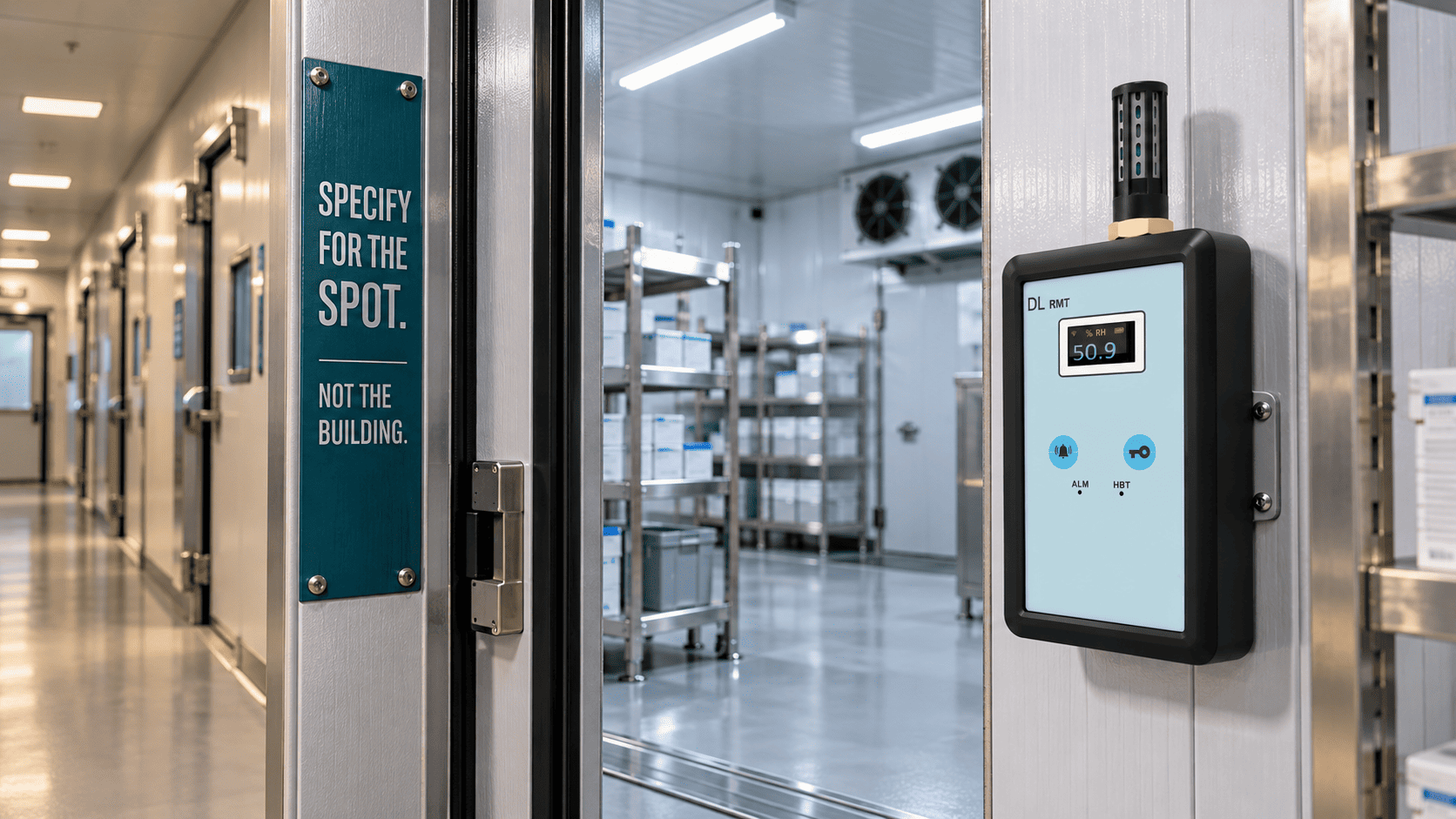
Specify for the Spot, Not the Site
A building with Wi-Fi tells you nothing about the cold room two doors past the airlock.
The signal where the device actually goes decides it.
Effective wireless temperature monitoring starts with checking connectivity at the actual installation point and planning for possible network outages.
Not sure what will connect at your installation point? Describe the location and layout to the G-Tek team and get a clear recommendation on Wi-Fi, GSM and outage cover.
Related Reading
Related Posts