A tyre plant's process engineer pulls a batch flagged for inconsistent cure and walks to…
Walk-In Cold Room Temperature Monitoring: Why One Sensor Isn’t Enough
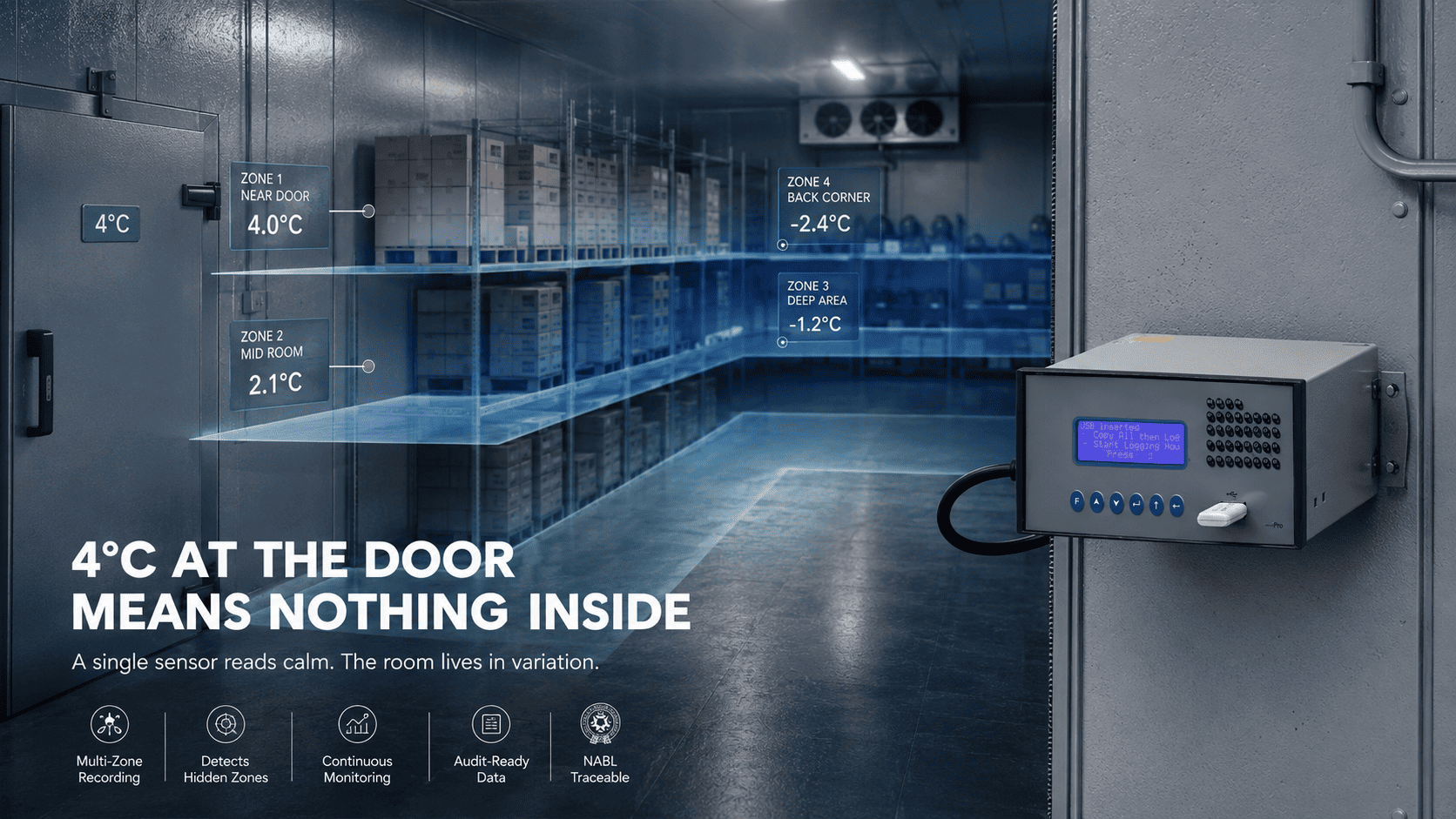
A warehouse supervisor walks into a large cold room and glances at the wall display by the door. A steady 4°C. Everything looks fine. But deep in the back corner, behind pallets stacked to the ceiling where the chilled air barely moves, the temperature has been running warmer for days.
The single sensor by the door never knew. And when a batch stored there gets questioned, that perfect 4°C is no defense at all.
Reliable walk-in cold room temperature monitoring is not judged only by the reading near the door. It is judged by whether every zone across the room’s volume held the required temperature. A large room has its own internal weather: warm spots near doors, cool spots by the evaporator, and dead air behind stacked products. One sensor cannot prove any of it.
🎯 Key Takeaways
- A large walk-in cold room has warm and cool zones near doors, corners, floor-to-ceiling, and behind products.
- A single control sensor reads one location, never the whole volume.
- Door openings and stacked products create swings a door-side sensor may never see.
- Multi-point recording across the room helps prove and document temperature uniformity.
- OEMs who build in multi-zone recording ship rooms clients can qualify more confidently.
Why Isn’t One Sensor Enough for Walk-In Cold Room Temperature Monitoring?
One sensor isn’t enough because a large volume holds distinct temperature zones warm near doors, cool near the evaporator, and still air behind stacked products. A single point cannot represent them all.
Cold air doesn’t spread evenly across a big space. Every door opening dumps in warm air, tall stacks block circulation, and the floor and ceiling rarely match. That sensor by the door reports its own micro-climate. It quietly speaks for a room it has never actually measured.
You feel this most when a client calls. The display read on-target all week, so why did the product in the back corner test out of range? The honest answer is uncomfortable: the room was monitored at one spot, and that spot was the calmest one.
What Does It Take to Prove a Cold Room Is Uniform?
Proving uniformity takes temperature recording at multiple points across the volume corners, center, near doors, and at different heights — captured continuously, not through a single control reading.
This is cold-room mapping: enough points to catch the real spread, logged over time and documented so every zone can be shown. The expectation is written into WHO TRS 961 Annex 9 and the WHO temperature mapping supplement, backed by GDP practice under TRS 957 Annex 5. You can read the full guidance on the World Health Organization’s own portal.
The record itself must satisfy 21 CFR Part 11 requirements where applicable for electronic data. Crucially, this recording sits independently of the room’s own control loop.
The search for this answer usually ends the same way: with a scanner that watches the whole room at once instead of trusting one wall sensor. That’s where G-Tek’s Universal Scanner range changed the conversation for cold room OEMs.
Giving the Back Corner a Voice of Its Own
Manufacturing monitoring and recording instruments in Vadodara for over 30 years, G-Tek Corporation builds the SC5x/SC9x Universal Scanner to record temperature at points spread across an entire walk-in cold room.
These points can include corners, the center, door zones, and different heights, capturing the zone-to-zone spread a single sensor never sees. The system logs continuously on gtekNet™ into a traceable, 21 CFR Part 11-compatible report.
Every channel traces back to G-Tek’s own NABL ISO/IEC 17025-accredited calibration laboratory, helping the uniformity record hold up in GMP or GDP audits.
It turns a room that reads 4°C at the door into one that can prove every monitored zone held the required temperature the assurance pharma, food, and vaccine buyers expect.
Where clients need portable spot verification too, G-Tek’s temperature data loggers extend the same traceable record.
Ship a Cold Room That Proves Every Zone, Not Just the Door
If your walk-in cold rooms store large volumes of temperature-sensitive products, zone-level proof is what protects the batch. Effective walk-in cold room temperature monitoring helps document every critical zone and supports qualification.
👉 Building your next walk-in cold room? Walk the G-Tek team through the room size and product stacking layout, and get a clear recommendation on multi-zone recording built in from the start.
Frequently Asked Questions
Why does a walk-in cold room need more than one sensor?
Because a large volume has distinct zones, including warm areas near doors and still air behind stacked products. One sensor reads its own spot, not the true temperature spread.
What causes temperature variation inside a cold room?
Door openings pull in warm air, the evaporator forms a cold zone, and tall stacked products block circulation. This can create warm and cool spots one sensor may not catch.
How do you prove a cold room is uniform?
Record temperature continuously at multiple points, including corners, center, doors, and different heights. Documenting the spread helps prove the whole room remained within the required range.
Which G-Tek product records cold room uniformity?
The SC5x/SC9x Universal Scanner logs points across the whole room on gtekNet™, producing a traceable, NABL-calibrated uniformity report for audits.
Related Posts