A validation lead sits at her desk, quotes spread across the screen, and picks the…
The Batch Was Perfect Until Hour 40 – Bioreactor Temperature Monitoring
It’s hour 40 of a two-day fermentation. The night shift glances at the bioreactor’s controller. The live reading sits right on setpoint, so nothing seems wrong.
What the single live value doesn’t reveal is that the temperature dipped for a stretch around hour 30, while everyone was away, then recovered.
At harvest, the yield is down, the culture is stressed, and there’s no independent trend to show what happened overnight.
In 2026, bioreactor temperature monitoring is about more than the live number on the controller.
🎯 Key Takeaways
- Fermentation runs for hours or days with a living culture
- A brief mid-run drift can affect yield
- A live controller reading shows the current moment, not the full trend
- Continuous bioreactor temperature monitoring helps document what happened throughout the run
- OEMs that build in independent batch recording can provide stronger documentation
Why Does a Brief Mid-Run Drift Compromise a Whole Fermentation?
A brief mid-run drift can affect fermentation because the culture inside the vessel is living and temperature-sensitive.
Fermentation depends on maintaining the required temperature range throughout the full run.
That is why bioreactor temperature monitoring should focus on the complete trend, not only individual readings.
Why Isn’t the Bioreactor’s Live Reading Enough to Prove the Batch?
The live reading shows what is happening at that moment.
For regulated applications, electronic records and monitoring systems should be evaluated against applicable requirements such as 21 CFR Part 11, EU GMP Annex 11, and other GMP expectations.
How Does Bioreactor Temperature Monitoring Create a Reviewable Batch Record?
Effective bioreactor temperature monitoring records temperature continuously throughout the fermentation.
This makes it easier to identify:
- When a temperature excursion started
- How long it lasted
- How far conditions moved from the required range
- Whether the temperature recovered
- Whether the event matches a later change in yield
From Live Number on Screen to a Batch Record That Holds Up
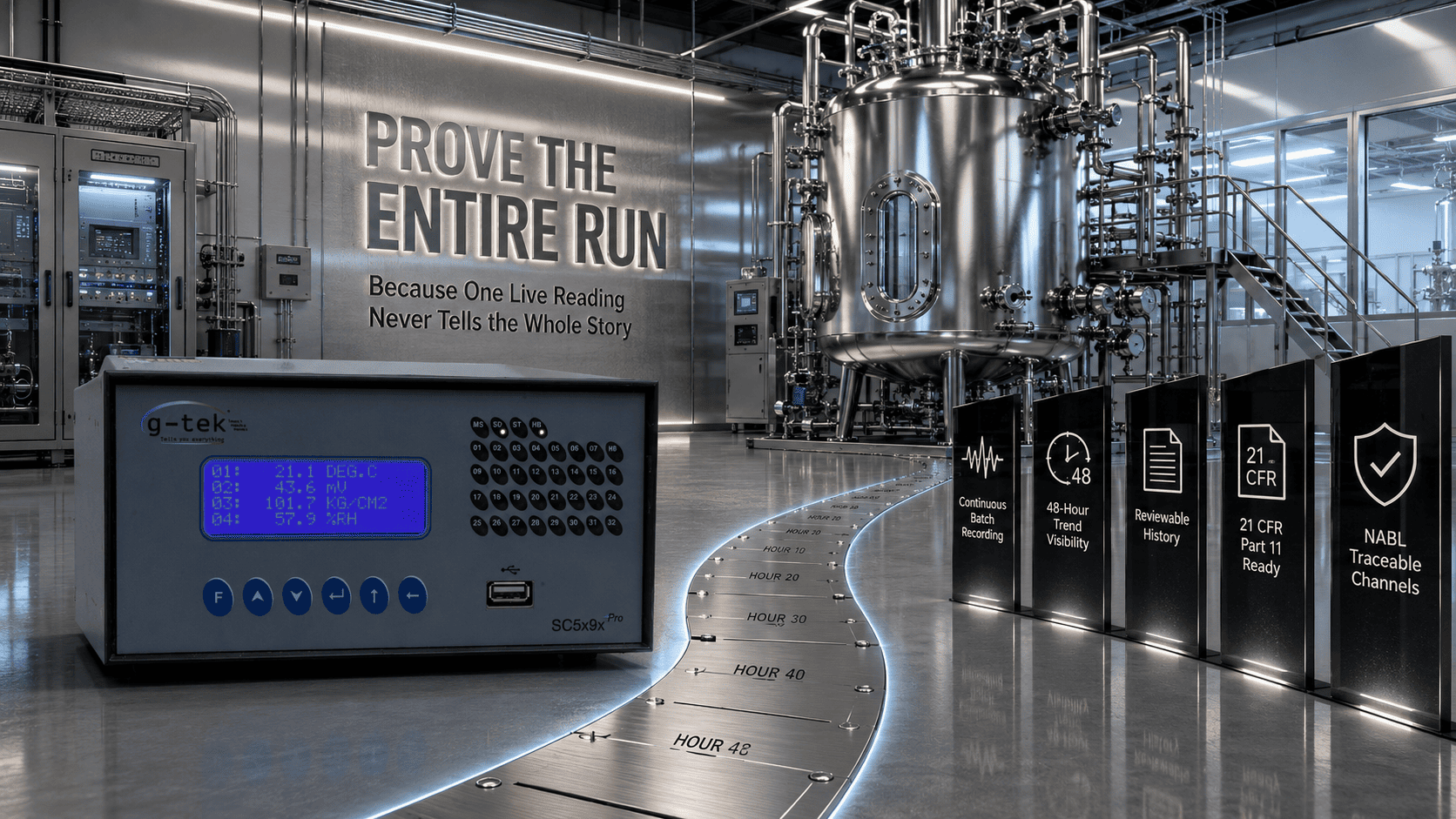
G-Tek Corporation builds the SC5x/SC9x Universal Scanner for continuous multi-point monitoring applications.
The monitored data can be logged on gtekNet™, creating a time-stamped and reviewable batch record.
Every applicable measurement channel can also be supported through G-Tek’s in-house NABL ISO/IEC 17025-accredited calibration laboratory.
Ship a Vessel That Proves the Whole Run
For fermenter and bioreactor OEMs, adding continuous bioreactor temperature monitoring helps turn a vessel that displays the live temperature into one that can also document the entire batch.
👉 Before your next vessel build, walk the G-Tek team through your process points and run duration and get a clear recommendation on building continuous batch recording in from the start.
Frequently Asked Questions
Why is continuous temperature recording important in fermentation?
Continuous recording helps identify temperature drift that may happen between routine checks.
Why isn't the bioreactor's controller reading enough?
The controller shows the live process value, but teams may also need a historical, reviewable record.
How should bioreactor temperature monitoring be done?
Bioreactor temperature monitoring should record the required process temperature continuously throughout the fermentation.
Which G-Tek product can record a fermentation run?
The G-Tek SC5x/SC9x Universal Scanner can continuously record vessel temperature and other monitored process points on gtekNet™.
Where is G-Tek Corporation located?
G-Tek Corporation is based in Vadodara, Gujarat.
Related Posts