A validation lead sits at her desk, quotes spread across the screen, and picks the…
The Incubator Held 37°C – Why Incubator Temperature Uniformity Matters
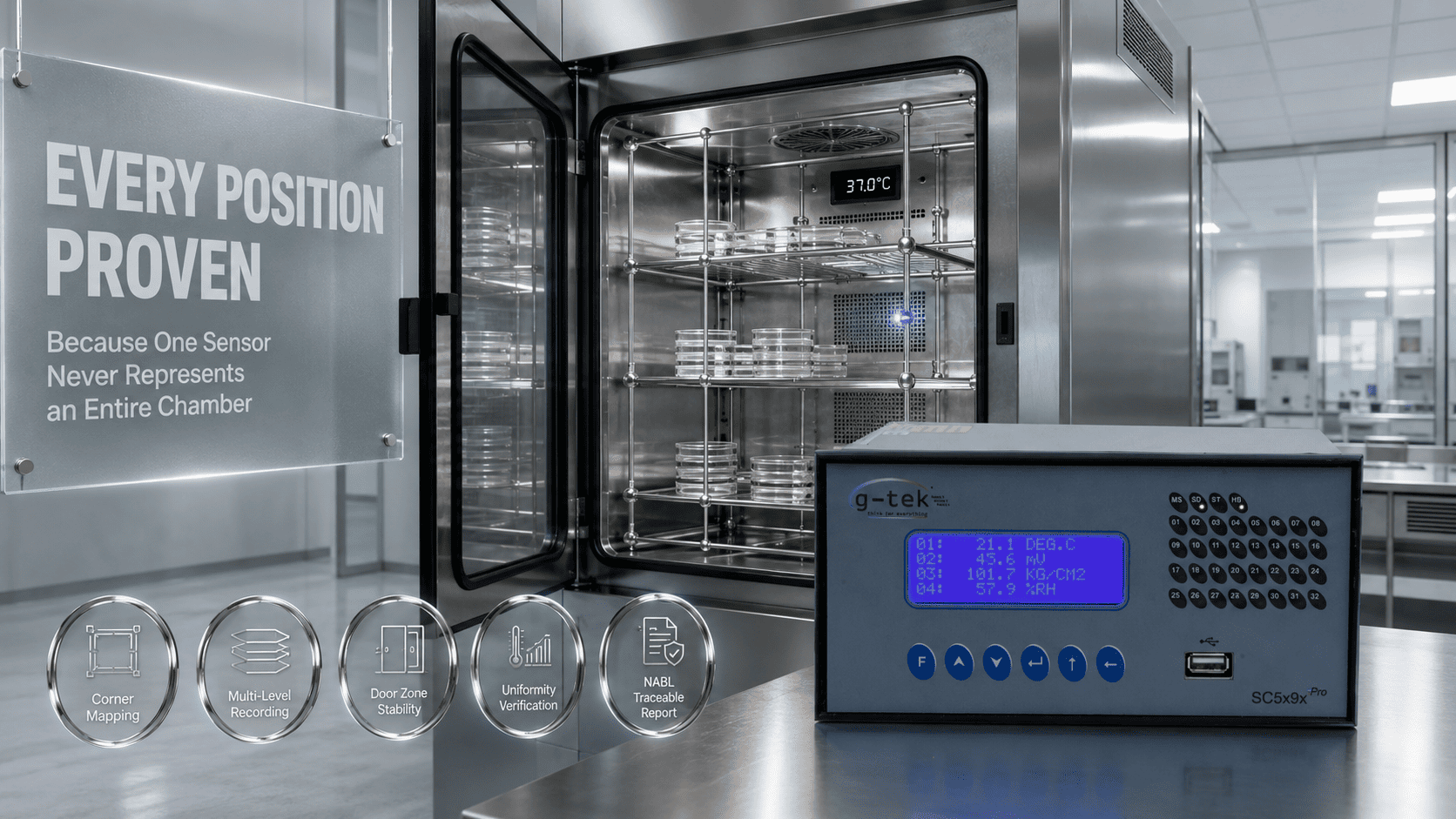
A microbiologist loads plates into the incubator, sets 37°C, and checks the display every morning.
Steady. Exactly on target.
But the plates pushed to the back behind a fully loaded shelf have been sitting a degree cooler where warm air barely circulates.
Days later, the growth is inconsistent, the run is questioned, and the display’s perfect 37°C is no help. It only ever measured one point.
In 2026, an incubator is judged not only by the number on its display, but by whether every position inside the chamber maintained the required temperature.
The control sensor reads one spot near the probe. A back corner, door zone, or packed shelf can experience a different temperature environment, and only incubator temperature uniformity testing through multi-point recording reveals the actual chamber performance.
Key Takeaways
- An incubator’s control sensor reads one location, not every position where samples are placed
- Door zones, back corners, and packed shelves can have different temperatures than the display shows
- Even small chambers can develop warm and cool zones that affect incubation results
- Incubator temperature uniformity requires multi-point recording to prove and document chamber performance
- OEMs who build in multi-point recording help laboratories qualify incubators faster
Why Can an Incubator Read 37°C and Still Be Non-Uniform Inside?
An incubator can display 37°C and still be non-uniform because the control sensor measures one location near the probe, while airflow, door openings, and loading patterns create warmer and cooler zones elsewhere.
A packed shelf can restrict airflow. A back corner can remain cooler due to limited circulation. The door area can experience temperature changes every time the chamber is opened.
The display continues showing 37°C, but the samples may experience something different.
This is why incubator temperature uniformity cannot be confirmed through a single control reading. The entire chamber needs to be evaluated through multiple measurement points.
G-Tek’s range of multi-channel monitoring instruments helps capture temperature behaviour across multiple locations instead of relying on one sensor point.
What Does It Take to Prove Incubator Temperature Uniformity?
Proving incubator temperature uniformity requires independent temperature recording at multiple points — including corners, centre, door areas, and different shelf levels — recorded continuously instead of relying only on the chamber’s internal sensor.
The principle follows chamber mapping practices: enough measurement points to identify actual temperature distribution across the complete working area.
For regulated laboratories and controlled environments, this data should create a traceable record that can support validation and assessment requirements.
Expectations around electronic records and data integrity may include requirements such as 21 CFR Part 11, EU GMP Annex 11, and ISO/IEC 17025, depending on the application.
The FDA provides guidance on electronic records and signatures through its Part 11 guidance.
How Does Multi-Point Recording Improve Incubator Validation?
A single temperature display only confirms the condition at the control sensor location.
Multi-point temperature recording provides a broader view of chamber performance by showing:
- Temperature differences between shelves
- Variations near doors and corners
- Stability throughout the incubation period
- Whether every sample location remained within the required range
This makes incubator temperature uniformity testing more reliable because laboratories can review actual chamber behaviour instead of assuming all positions performed the same.
G-Tek’s Answer to the Silent Back Corner
Making monitoring and recording instruments in Vadodara since 1990, G-Tek Corporation builds the SC5x/SC9x Universal Scanner to record temperature across multiple points inside incubators and controlled chambers.
The system can monitor locations such as corners, centre points, door zones, and shelf levels, capturing the temperature variation that a single control sensor cannot show.
The readings can be recorded continuously on gtekNet™ into a traceable report suitable for review during validation activities.
Every channel is supported through G-Tek’s own NABL ISO/IEC 17025-accredited calibration laboratory, helping ensure the uniformity record maintains measurement traceability.
For incubator OEMs, it transforms a chamber that simply displays a temperature into one that can demonstrate whether every position maintained the required conditions.
Ship an Incubator That Proves Every Position
If your incubators are being specified by pharma QC teams or microbiology laboratories, proving uniformity is what protects the result.
A chamber that documents every position provides stronger validation evidence and helps laboratories qualify equipment with confidence.
👉 Before your next incubator build, walk the G-Tek team through your chamber size and shelf layout and get a clear recommendation on building multi-point uniformity recording in from the start.
Frequently Asked Questions
Why can an incubator display the right temperature but still be non-uniform?
The control sensor measures only one location. Airflow patterns, door openings, and loading conditions can create warmer or cooler areas elsewhere inside the chamber.
Why isn't the control sensor enough to prove incubator uniformity?
The control sensor manages the setpoint but cannot show what every sample position experienced. Independent multi-point recording is needed to verify the complete chamber.
How do you perform incubator temperature uniformity testing?
Incubator temperature uniformity testing involves recording temperature at multiple chamber locations such as corners, shelves, and door zones continuously and reviewing the temperature distribution.
Which G-Tek product records incubator uniformity?
The G-Tek SC5x/SC9x Universal Scanner records multi-point temperature data on gtekNet™ and produces a traceable report supported by NABL-calibrated channels.
Where is G-Tek Corporation located?
G-Tek Corporation is based in Vadodara, Gujarat.
Related Posts